







BLOG
How to Validate Thermal Performance of Open-Frame Power Supplies in Real Enclosures
QUICK LINKS
Why Is Thermal Validation Critical for Open-Frame Power Supplies in Real Enclosures?
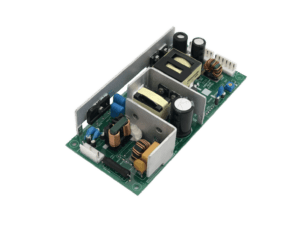
Thermal validation is critical for open-frame power supplies because their performance is inseparable from the enclosure in which they operate. Unlike enclosed PSUs, open-frame designs rely on system-level airflow, mounting orientation, and ambient conditions to dissipate heat. Bench testing or datasheet assumptions rarely reflect how heat behaves once the PSU is installed alongside other components in a real industrial enclosure.
In real products, open-frame power supplies are exposed to compounded thermal effects. Nearby heat sources such as processors, motor drives, relays, and transformers elevate local ambient temperature. Airflow may be restricted by wiring, filters, or enclosure geometry. These factors can significantly reduce available output power or accelerate component aging if not accounted for during validation.
OEMs that skip enclosure-level thermal validation often discover issues late in development or after deployment. Symptoms include unexpected derating, thermal shutdowns, reduced lifetime, or field failures that are difficult to trace back to thermal root causes. Validating thermal performance inside the final enclosure is therefore a foundational step in reliable open-frame PSU integration.
Top Benefits
• Prevents derating and overheating after enclosure integration
• Improves long-term reliability and component lifetime
• Reduces late-stage redesign and field failure risk
Best Practices
• Treat enclosure testing as mandatory, not optional
• Validate thermal behavior under worst-case operating conditions
• Evaluate sustained operation, not short bench tests
Helpful Tips
• Do not rely solely on datasheet airflow assumptions
• Account for heat from adjacent components
• Validate thermal performance before enclosure freeze
Mini Q&A
Why is bench testing not enough for open-frame PSUs?
Because bench airflow and ambient conditions differ from real enclosures.
Can enclosure integration change PSU output capability?
Yes, thermal rise directly affects derating behavior.
Is thermal validation a one-time test?
No, it should be repeated as layouts and enclosures evolve.
Understanding why enclosure-level thermal validation matters helps OEMs avoid hidden reliability risks.
(Suggested Links: Internal Power Supplies | Industrial Power Supplies)
What Thermal Conditions Must Be Tested Inside the Final Enclosure?
Thermal validation must account for the full range of conditions an open-frame power supply will experience inside the final enclosure. This includes worst-case ambient temperature, reduced airflow scenarios, and maximum sustained load. Testing only at room temperature or partial load can mask issues that appear during real operation.
OEMs should validate thermal performance with the enclosure fully populated and operating. This means all heat-generating components are active, airflow paths are realistic, and filters or vents are installed as they will be in production. Cable routing, mounting brackets, and protective covers should also be present, as they influence airflow and heat accumulation.
Environmental variation must also be considered. Industrial equipment may operate in hot facilities, poorly ventilated cabinets, or dusty environments where airflow degrades over time. Thermal validation should therefore include margin for real-world degradation rather than ideal conditions.
Top Benefits
• Captures true thermal behavior under realistic conditions
• Identifies airflow and placement issues early
• Improves confidence in long-term performance
Best Practices
• Test at maximum continuous load, not peak load
• Validate at elevated ambient temperatures
• Include worst-case airflow restriction scenarios
Helpful Tips
• Test with filters partially loaded to simulate aging
• Validate with enclosure doors closed
• Record steady-state temperatures, not transient spikes
Mini Q&A
Should validation include all system components powered on?
Yes, thermal interaction matters.
Is testing at max load sufficient?
Only if ambient and airflow conditions are also worst-case.
Do cable and wiring layouts affect thermal results?
Yes, they can significantly restrict airflow.
Testing realistic thermal conditions ensures results reflect actual deployment environments.
(Suggested Links: Internal Power Supplies | Power Supply)
How Should OEMs Measure and Interpret Thermal Data Correctly?
Measuring thermal data correctly is as important as running the test itself. OEMs should focus on component-level temperatures rather than ambient enclosure readings alone. Key measurement points include primary switching devices, magnetics, bulk capacitors, and hotspots identified by the PSU manufacturer.
Thermal sensors, thermocouples, and infrared imaging each play a role. Thermocouples provide accurate point measurements, while thermal imaging reveals airflow issues, recirculation, and unexpected hot zones. Combining both methods gives a more complete understanding of thermal behavior.
Interpreting results requires understanding component limits and margin. Operating just below maximum ratings may appear acceptable short-term but can significantly reduce lifetime. OEMs should evaluate temperature rise relative to derating curves, aging models, and expected duty cycle to determine whether sufficient margin exists.
Top Benefits
• Improves accuracy of thermal validation conclusions
• Prevents misinterpretation of acceptable temperatures
• Supports informed design decisions
Best Practices
• Measure temperatures at known component hot spots
• Use thermal imaging to identify airflow problems
• Compare results against derating and lifetime curves
Helpful Tips
• Avoid relying on enclosure air temperature alone
• Document measurement locations and methods
• Re-test after layout or airflow changes
Mini Q&A
Is thermal imaging enough by itself?
No, it should be combined with direct measurements.
Should OEMs design close to component temperature limits?
No, margin is critical for longevity.
Can thermal data change after minor layout updates?
Yes, even small changes can alter airflow.
Correct measurement and interpretation turn thermal testing into actionable design insight.
(Suggested Links: Industrial Power Supplies | Internal Power Supplies)
CLIENT'S QUOTE
Phihong's Power-Over-Ethernet solutions have transformed our network, boosting efficiency and reducing costs. Their seamless integration has simplified both installation and maintenance.
How Airflow Design and Component Placement Influence Thermal Results
Airflow design and component placement strongly influence the thermal performance of open-frame power supplies once installed in real enclosures. Even when total airflow volume appears sufficient, poor airflow paths, recirculation, or obstruction can create localized hot spots that reduce PSU margin. Open-frame PSUs are particularly sensitive because they rely on system airflow rather than an integrated housing.
Component placement around the PSU also matters. Heat-generating devices placed upstream of airflow raise inlet air temperature, while tall components, wiring bundles, or brackets can block exhaust paths. Mounting orientation affects natural convection and how forced airflow interacts with heat sinks and magnetics. These factors can cause large temperature differences between otherwise identical designs.
OEMs should validate airflow as a system behavior, not a PSU attribute. Evaluating airflow paths, inlet temperatures, and exhaust behavior early helps prevent late-stage thermal surprises and supports predictable derating performance.
Top Benefits
• Improves thermal predictability inside real enclosures
• Reduces hot spots caused by airflow obstruction
• Preserves PSU margin under sustained operation
Best Practices
• Map airflow paths from inlet to exhaust during design
• Keep PSU inlets clear of upstream heat sources
• Validate mounting orientation against airflow direction
Helpful Tips
• Use smoke or tracer methods to visualize airflow
• Avoid routing cables across PSU ventilation areas
• Re-test airflow after mechanical revisions
Mini Q&A
Can airflow volume be adequate but still cause overheating?
Yes, poor airflow paths can negate total airflow.
Does PSU orientation matter?
Yes, it affects convection and cooling efficiency.
Should airflow be validated before enclosure freeze?
Absolutely, changes later are costly.
Good airflow design is essential to reliable open-frame PSU operation.
(Suggested Links: Internal Power Supplies | Industrial Power Supplies)
How to Apply Derating Curves and Thermal Margin Correctly
Applying derating curves correctly is critical when validating open-frame power supplies in real enclosures. Derating curves show how available output power decreases as ambient temperature rises or airflow decreases. OEMs must reference these curves using the actual conditions measured inside the enclosure, not room temperature or nominal airflow assumptions.
Thermal margin should be evaluated against sustained operating conditions. A PSU operating near its derated limit may pass short tests but experience accelerated aging over time. OEMs should account for worst-case ambient temperature, component aging, airflow degradation, and load growth when determining acceptable operating points.
Using derating curves as design tools rather than documentation artifacts helps OEMs make informed decisions about power sizing, airflow requirements, and long-term reliability.
Top Benefits
• Aligns PSU ratings with real enclosure conditions
• Reduces premature aging and field failures
• Improves confidence in long-term operation
Best Practices
• Apply derating using measured enclosure temperatures
• Design for continuous operation below derated limits
• Include margin for airflow degradation and aging
Helpful Tips
• Avoid designing right at derated power limits
• Recalculate derating after layout or fan changes
• Document derating assumptions clearly
Mini Q&A
Are derating curves conservative enough by default?
Not always, enclosure conditions can exceed assumptions.
Is operating at derated maximum acceptable?
It reduces margin and lifetime.
Should derating be revisited after design changes?
Yes, even small changes matter.
Correct use of derating curves is essential for reliable PSU validation.
(Suggested Links: Internal Power Supplies | Power Supply)
Why Thermal Validation Documentation Matters for Compliance and Lifecycle
Thermal validation documentation is important not only for engineering confidence but also for compliance, manufacturing, and long-term support. Documented thermal results provide evidence that the PSU operates safely under defined conditions, which supports safety assessments and internal audits.
Over a product’s lifecycle, designs evolve. Component substitutions, airflow changes, or enclosure revisions may occur. Without baseline thermal documentation, OEMs have no reference point to assess whether changes introduce risk. This often leads to re-testing from scratch or overly conservative design decisions.
Maintaining clear thermal validation records helps OEMs respond efficiently to changes and supports consistent decision-making across teams. Documentation turns thermal testing into a reusable asset rather than a one-time exercise.
Top Benefits
• Supports compliance and internal safety reviews
• Simplifies impact assessment for design changes
• Preserves knowledge over long product lifecycles
Best Practices
• Record test conditions, measurement points, and results
• Archive thermal images and data with revision control
• Reference documentation during change reviews
Helpful Tips
• Standardize thermal test reports across projects
• Include airflow and load assumptions explicitly
• Revalidate selectively rather than repeating all tests
Mini Q&A
Is thermal documentation required for certification?
Often indirectly, as supporting evidence.
Can documentation reduce re-testing effort?
Yes, it provides a baseline for comparison.
Should documentation persist after launch?
Yes, for sustainment and updates.
Strong documentation makes thermal validation actionable across the product lifecycle.
(Suggested Links: Industrial Power Supplies | Internal Power Supplies)
How Phihong Supports Enclosure-Level Thermal Validation for Open-Frame Power Supplies
Phihong supports OEMs by treating thermal validation of open-frame power supplies as a system-level engineering task rather than a component check. Open-frame PSUs are evaluated in enclosure-representative conditions that reflect real airflow paths, component loading, and ambient environments expected in industrial deployments. This helps OEMs avoid relying on idealized bench assumptions that rarely hold in the field.
Phihong emphasizes predictable derating behavior, conservative thermal margins, and validation under sustained load. Power supplies are assessed alongside other heat-generating components to capture thermal interaction effects that influence long-term reliability. This approach enables OEMs to size power correctly, design airflow intentionally, and reduce late-stage redesign risk.
As a long-term manufacturing partner, Phihong also provides documentation continuity and lifecycle-aware support. Thermal validation results become part of the design record, allowing OEMs to assess the impact of enclosure updates, airflow changes, or component substitutions over the product’s lifetime without restarting validation from scratch.
(Suggested Links: Internal Power Supplies | Industrial Power Supplies)

FEATURED RESOURCE
Phihong's Power-Over-Ethernet solutions have transformed our network, boosting efficiency and reducing costs.
FAQ
How is thermal validation for open-frame power supplies different from bench testing?
Bench testing evaluates PSU behavior in open air or controlled conditions, which rarely represent real enclosure environments. Open-frame PSUs depend on system airflow, mounting orientation, and nearby heat sources. Enclosure-level validation captures these interactions and reveals thermal behavior that bench tests cannot predict.
Validating inside the final enclosure is essential for reliable industrial operation.
What temperature limits should OEMs focus on during validation?
OEMs should focus on component-level limits, including primary switches, magnetics, and bulk capacitors, rather than enclosure air temperature alone. Operating close to maximum ratings reduces lifetime even if immediate failure does not occur.
Thermal margin relative to derating and aging curves is more important than absolute peak temperature.
How long should thermal validation tests run?
Thermal validation should run long enough to reach steady-state conditions under sustained load. Short-duration tests may miss gradual temperature rise or thermal saturation effects.
Extended tests provide more accurate insight into long-term behavior.
Can minor enclosure changes invalidate previous thermal validation?
Yes. Changes such as cable routing, fan selection, filter addition, or mounting orientation can significantly alter airflow and temperature distribution. Previous thermal results should be reassessed when these changes occur.
Maintaining baseline documentation helps identify when revalidation is required.
Should thermal validation be repeated after product launch?
Thermal validation should be revisited when products are updated, scaled, or deployed in new environments. Lifecycle-aware validation reduces risk as conditions evolve over time.
Ongoing review helps preserve reliability throughout the product lifespan.
POE technology supports the centralization of power

AC Adapter Guide: Everything You Need to Know
Moreover, PoE technology supports the centralization of power management. By powering devices through a PoE-enabled network …
AC DC Power Chargers and How They Work: A Comprehensive Technical Breakdown
Moreover, PoE technology supports the centralization of power management. By powering devices through a PoE-enabled network …

USB-C Charger: Shaping the Future of the Tech World
Moreover, PoE technology supports the centralization of power management. By powering devices through a PoE-enabled network …

AC Adapter Guide: Everything You Need to Know
Moreover, PoE technology supports the centralization of power management. By powering devices through a PoE-enabled network …

AC DC Power Chargers and How They Work: A Comprehensive Technical Breakdown
Moreover, PoE technology supports the centralization of power management. By powering devices through a PoE-enabled network …

USB-C Charger: Shaping the Future of the Tech World
Moreover, PoE technology supports the centralization of power management. By powering devices through a PoE-enabled network …