








BLOG
What Safety Certifications Are Required for Robot Charging Stations in Public Spaces?
QUICK LINKS
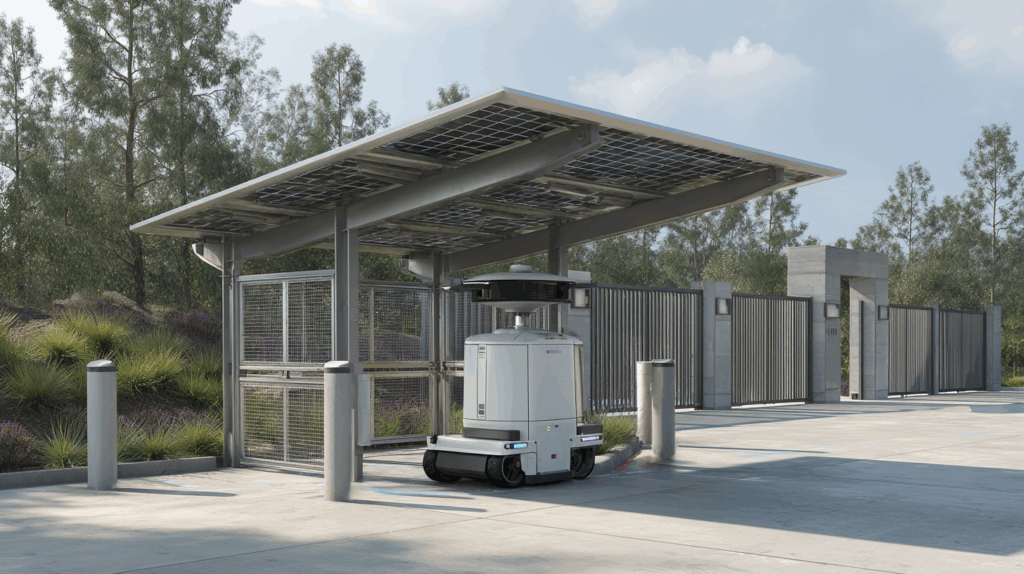
Autonomous floor-cleaning robots are quickly becoming essential tools in airports, hospitals, malls, warehouses, and public venues. As these machines grow in capability, runtime, and fleet size, their charging stations are undergoing increased regulatory scrutiny—especially in safety-critical environments like healthcare and transportation.
To keep pace, charging dock manufacturers and OEMs must now comply with stricter UL and IEC safety certification requirements, ensuring safe unattended operation, fault protection, and compliance with global standards. What was once a niche industrial appliance is now a connected, high-power system that must operate reliably around the public, near water, and often with zero supervision.
This article explores how autonomous cleaning robot deployment is accelerating UL and IEC certification demands, the key standards involved, and what charging dock designers must consider to meet compliance and deployment readiness.
Why Cleaning Robots Pose Unique Safety Challenges for Charging Systems
Unlike traditional AMRs or warehouse bots, cleaning robots often operate around water, soap, and human foot traffic. This creates a high-risk zone where electrical systems must be:
- Sealed from water and conductive liquids
- Tamper-proof in public spaces
- Safe during unsupervised charging
- Resilient to frequent thermal cycling and mechanical use
Key Charging Dock Challenges
- Exposure to liquid cleaning agents and humidity
- Risk of contact by the general public or cleaning staff
- Continuous operation near flammable flooring materials
- Demands for fast, high-current recharging between cleaning cycles
Best Practices
- Use IP67-rated connectors and housings
- Integrate ground fault, overcurrent, and thermal protection
- Include visible charge status indicators and fault alerts
- Ensure charging logic safely delays operation if faults or liquid ingress is detected
Cleaning robots don’t just need a power source—they need certified, intelligent, and robust charging systems that meet international safety codes.
The Role of UL and IEC Certifications in Dock Safety
With growing deployment across public environments, robotic charging docks must now adhere to strict global electrical safety standards, particularly UL 2593 and IEC 60335.
Key Standards Pushing Compliance
- UL 2593 – Safety of Battery Chargers for Cleaning Machines
- Covers short circuit protection, overheating, dielectric strength, and touch safety
- Required for robotic scrubbers, vacuum robots, and unattended battery charging
- Covers short circuit protection, overheating, dielectric strength, and touch safety
- UL 2231-1 & UL 2231-2 – Shock protection standards
- Governs safe contact protection for personnel
- Includes connector design, grounding, and auto-disconnect functionality
- Governs safe contact protection for personnel
- IEC 60335-2-72 / 60335-2-29 – International standards for floor-cleaning and battery-charging appliances
- Governs thermal hazards, insulation requirements, and auto-start safety
- Required in EU, APAC, and global markets for wide deployment
- Governs thermal hazards, insulation requirements, and auto-start safety
Top Benefits of Certification
- Enables sales into hospitals, airports, and schools with strict procurement requirements
- Ensures safety in high-traffic, high-moisture environments
- Reduces liability exposure for integrators and OEMs
- Simplifies insurance, municipal approval, and site audits
Best Practices
- Work with accredited labs early during dock development
- Use UL- and IEC-rated components (relays, transformers, cables)
- Validate water resistance and fault protection through third-party testing
- Include clear product labeling and safety warnings per standard
Compliance isn’t a checkbox—it’s a gateway to real-world deployment.
Key Electrical Safety Features for Floor-Cleaning Robot Charging Stations
To pass UL and IEC standards, charging docks must be engineered with layered safety protections at the hardware and firmware levels.
Required Safety Features
- Ground fault detection (GFCI) and automatic shutdown
- Overcurrent protection with fuse or smart relay intervention
- Thermal cutoffs and self-resetting breakers
- Touch-proof connector design with recessed or magnetic contacts
- Dielectric isolation between high-voltage and user-accessible surfaces
Design Elements That Support Compliance
- Conformal coating on PCBs to protect against cleaning agent exposure
- Potting or encapsulation of high-voltage components
- Wide temperature-rated components (-20 °C to +60 °C)
- Safety interlocks that prevent charging if alignment is incorrect
Best Practices
- Include firmware checks for real-time fault detection
- Design for both indoor and semi-outdoor operation, especially in public buildings
- Use UL 94 V-0 flame-retardant materials for enclosures
- Document every failure mode and mitigation strategy for certification review
UL and IEC testing is rigorous—and every design decision must support pass/fail criteria.
CLIENT'S QUOTE
"Phihong’s PoE solutions have made a huge difference for us! Our network runs more efficiently, and we’ve seen real cost savings. We couldn’t be happier!"
Global Expansion Requires IEC-Compliant Charging Systems
For OEMs shipping floor-cleaning robots into global markets, IEC certification is a must. It ensures product acceptance in Europe, APAC, the Middle East, and more.
IEC Compliance Demands
- International test procedures for safety, insulation, moisture, and overload
- Requirements for double-insulation or reinforced insulation
- Certification for use in wet rooms, commercial spaces, and healthcare
- CE marking compliance based on IEC test reports and documentation
Best Practices for IEC-Ready Docks
- Use globally approved components with pre-existing CB certificates
- Design docking logic to handle interrupted charge cycles safely
- Validate electromagnetic compatibility (EMC) in high-interference areas
- Work with certification labs familiar with IEC 60335-2-72 and 60335-1
Phihong helps clients align charging dock design with global safety and export compliance—early and efficiently.
How Phihong USA Supports UL and IEC-Certified Docking Systems
Phihong USA is a trusted provider of smart, sealed, and safety-certified charging infrastructure for floor-cleaning and commercial robotic applications. Our engineering team supports:
- UL 2593 and IEC 60335 compliance engineering for power and dock systems
- IP67/IP68-rated enclosures for wet floor environments
- Smart AC-DC and DC-DC modules with thermal, overvoltage, and fault protection
- Touch-safe connectors and communication logic for BMS handshakes
- Custom solutions that meet North American, European, and global safety regulations
Whether your cleaning robot operates in a hospital, airport, or shopping center, Phihong delivers certifiable, deployable, and field-proven power systems for next-gen robotic cleaning fleets.

Contact Our Team Today!
Our dedicated sales team and international partners are prepared to support you with your latest projects and initiatives globally.
Explore More with Phihong USA
As we conclude our exploration of PoE technology, it’s evident how these innovations are streamlining power and data integration across various industries. Phihong USA stands at the forefront of this technological advancement, offering a diverse range of power solutions designed to meet the evolving needs of modern industries.
Phihong USA’s extensive product lineup includes:
- Power over Ethernet (PoE) Solutions: Delivering reliable power and data transmission over a single cable, ideal for simplifying network installations and reducing costs.
- AC/DC Adapters and Power Supplies: From compact adapters to industrial-grade power supplies, Phihong provides solutions that ensure efficiency and reliability in various applications.
- Battery Chargers: Customizable chargers for lithium-ion and lead-acid batteries, supporting a wide range of power requirements for mobility and industrial applications.
- Medical Power Supplies: Specialized power solutions designed to meet the stringent requirements of the healthcare industry, ensuring safety and reliability.
Phihong USA is committed to innovation and excellence, continually developing products that meet the highest standards of performance and reliability. Their global reach and dedication to customer support make them a trusted partner in powering the future.
Here are some useful links to explore Phihong USA’s offerings further and bring in new potential clients:
Visit Phihong USA to discover how their advanced power solutions can support your business needs. Whether you’re looking to upgrade your network, or find reliable power supplies, Phihong USA has you covered.
By choosing Phihong USA, you’re partnering with a leader in power technology, ensuring your operations run smoothly and efficiently with top-tier power solutions. Contact Us today!
FAQ
Why do autonomous cleaning robot docks require UL and IEC certification?
Because these robots often operate unattended, near water, and in public environments, charging stations must meet strict safety standards. UL and IEC certifications ensure protection against fire, shock, overheating, water damage, and misuse. Certifications like UL 2593 and IEC 60335 are often required for purchase approval in hospitals, airports, and institutions—making them essential for commercial deployment.
What safety features are required for UL 2593 compliance?
UL 2593 requires:
- Overcurrent and short circuit protection
- Dialectric strength between high- and low-voltage sections
- Protection against over-temperature and electrical leakage
- Proper enclosure rating (often IP65 or higher)
- Safe disconnection in the event of fault or user contact
Docks must be tested for insulation breakdown, ground fault interruption, and operation under fault scenarios.
Can cleaning robot docks be used in wet environments?
Yes—but only if they are designed and certified accordingly. This includes:
- IP67 or IP68-rated housings
- Sealed cable entries and waterproof connectors
- Corrosion-resistant materials
- Protection circuitry for safe shutdown during water ingress
Phihong’s dock designs are engineered specifically for wet and semi-wet commercial environments.
How long does it take to get UL or IEC certification for a new dock?
It depends on your design readiness and whether your components are pre-certified. Generally:
- Component selection: 1–2 weeks
- Prototype testing and adjustments: 4–8 weeks
- Third-party lab certification: 6–10 weeks
Starting with UL/IEC-compliant components and working with partners like Phihong significantly reduces total certification time.
How does Phihong support OEMs with certification?
Phihong provides:
- Pre-certified power modules and enclosures
- Engineering documentation and schematics for lab submission
- Thermal, electrical, and mechanical design support for certification success
- Guidance on UL/IEC failure mode analysis and test prep
We help OEMs design with compliance in mind—reducing delays and accelerating launch.