










BLOG
Best Guide to GaN Power Adapters: What Modern Devices Need From Compact, High-Density Power
QUICK LINKS
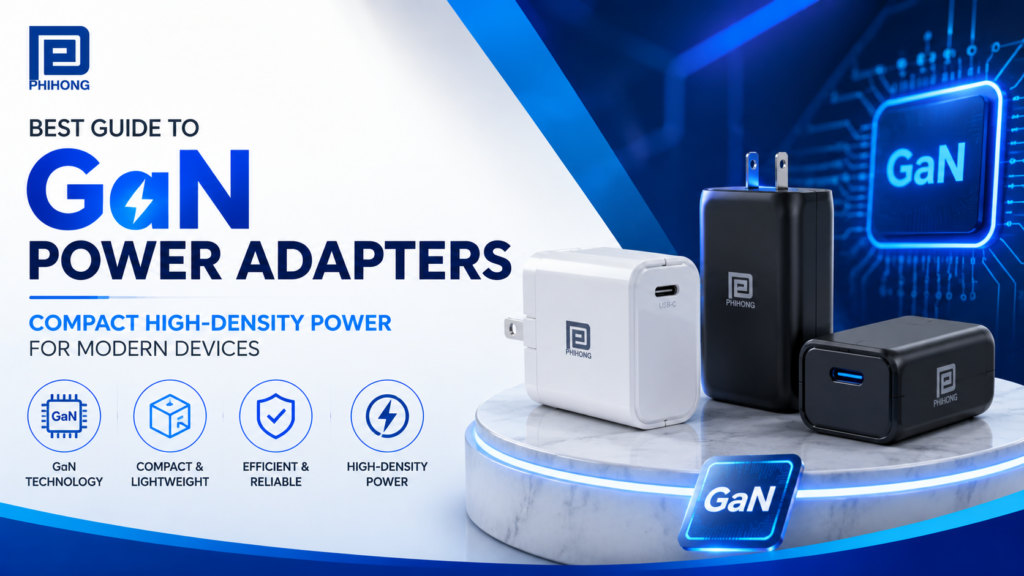
Why are GaN power adapters becoming the next generation of power delivery?
For decades, silicon has been the foundation of power conversion technology. While silicon-based power supplies helped drive the growth of consumer electronics, computing devices, networking equipment, and industrial products, device requirements have changed dramatically. Modern products require more power, faster charging, smaller footprints, lower heat generation, and greater energy efficiency than traditional architectures can easily deliver.
Gallium Nitride, commonly known as GaN, has emerged as one of the most important developments in power electronics because it allows manufacturers to deliver higher power density within a much smaller footprint. Compared to traditional silicon designs, GaN devices switch faster, generate less heat, and support more compact power architectures. These characteristics make GaN especially attractive for laptops, USB-C devices, displays, docking stations, networking equipment, robotics, and many other connected products.
As device makers continue to reduce product size while increasing performance expectations, GaN technology is becoming less of a premium feature and more of a strategic design choice. Many OEMs are now evaluating whether future product platforms should transition from traditional silicon-based adapters to newer high-density GaN architectures.
Why This Matters
• Device manufacturers need higher power density without increasing enclosure size.
• Thermal efficiency is becoming a major product design challenge.
• Fast charging and USB-C adoption continue to increase power delivery demands.
What OEMs Should Do Now
• Evaluate where power density constraints exist within current products.
• Compare long-term platform requirements against traditional silicon limitations.
• Review emerging GaN power architectures before future product roadmaps are finalized.
Mini Q&A
What is a GaN power adapter?
A GaN power adapter uses Gallium Nitride semiconductor technology instead of traditional silicon switching components to improve efficiency and power density.
Why are GaN adapters smaller?
Because GaN switches operate more efficiently and generate less heat, allowing engineers to reduce component size and cooling requirements.
Is GaN replacing silicon completely?
Not yet. Many applications still use silicon, but GaN adoption continues to grow across higher-performance power applications.
Modern devices are demanding more power from less space, and GaN technology is helping make that possible.
Useful Links
GaN Power Adapter Products: www.phihong.com/products/adapters/
AQ65A 65W GaN Adapter: www.phihong.com/products/adapters/aq65a-59fkb-r/
AQ65E 65W GaN Adapter: www.phihong.com/products/adapters/aq65e-59fkb-r/
Related Links
GaN Charging vs Silicon Chargers: www.phihong.com/gan-charging-why-are-gan-chargers-better-than-silicon-based-chargers/
GaN Power Supply Manufacturing: www.phihong.com/gan-power-supply-manufacturing-how-gallium-nitride-is-revolutionizing-efficiency-and-performance-for-oems/
Future of Fast Charging: www.phihong.com/gan-charger-the-future-of-fast-charging-electronic-devices/
How do GaN power adapters differ from traditional silicon chargers?
Traditional silicon power supplies have been the industry standard for decades because they provide reliable power conversion at a reasonable cost. However, as device power requirements continue to increase, silicon technology faces growing challenges related to efficiency, heat generation, and physical size.
GaN technology changes this equation because Gallium Nitride semiconductors can switch power much faster than silicon devices. Faster switching allows designers to reduce the size of transformers, capacitors, and supporting components while maintaining or increasing power output. The result is a power adapter that delivers comparable or higher output in a significantly smaller package.
This difference is especially important in USB-C Power Delivery environments where users increasingly expect a single compact adapter to power laptops, tablets, smartphones, displays, docking stations, and other connected devices. Smaller size, lower heat generation, and improved efficiency are helping drive adoption across both commercial and consumer markets.
Why This Matters
• Faster switching enables higher power density.
• Reduced heat supports smaller enclosure designs.
• Multi-device charging requirements continue to grow.
What OEMs Should Do Now
• Compare thermal performance between silicon and GaN platforms.
• Review packaging opportunities enabled by higher-density power designs.
• Evaluate long-term product roadmaps for USB-C Power Delivery compatibility.
Mini Q&A
Are GaN chargers more efficient than silicon chargers?
Generally yes. GaN devices typically generate less heat and support higher power density.
Why are GaN chargers becoming popular for USB-C devices?
Because USB-C Power Delivery often benefits from compact, higher-output designs.
Do GaN adapters support higher wattages?
Yes. GaN technology is increasingly used across both mid-power and high-power applications.
Higher power density is one of the main reasons GaN technology is changing adapter design.
Useful Links
Power Adapter Product Line: www.phihong.com/products/adapters/
AQ65A 65W GaN Adapter: www.phihong.com/products/adapters/aq65a-59fkb-r/
330W GaN Power Adapter: www.phihong.com/press-release/phihong-releases-330w-gan-technology-low-profile-single-output-power-adapter/
Related Links
GaN Charging vs Silicon Chargers: www.phihong.com/gan-charging-why-are-gan-chargers-better-than-silicon-based-chargers/
Future of Fast Charging: www.phihong.com/gan-charger-the-future-of-fast-charging-electronic-devices/
Top GaN Power Device Manufacturers: www.phihong.com/top-5-gan-power-device-manufacturers-leading-the-future-of-high-efficiency-power-solutions/
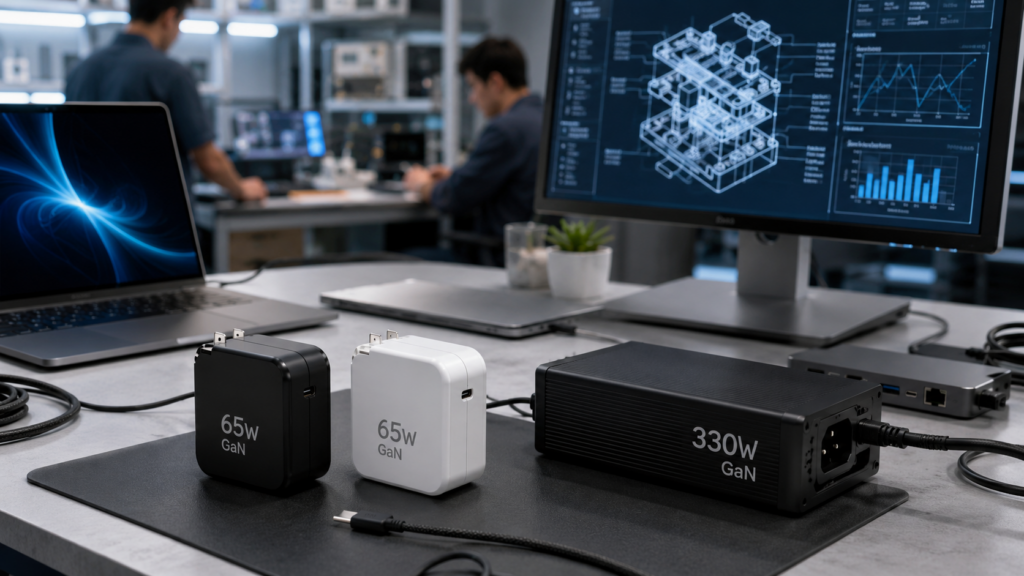
Why are OEMs adopting high-density GaN power adapters for modern products?
Many OEM teams are facing the same challenge: customers expect smaller devices, longer battery life, faster charging, and fewer cables. These expectations place increasing pressure on power architecture decisions.
GaN technology helps address these challenges by enabling compact power adapter design without sacrificing output capability. This is especially valuable for commercial laptops, docking stations, displays, networking products, robotics equipment, industrial handheld devices, and other products where space efficiency directly affects product design.
For startups and product managers, GaN can also support competitive differentiation. A smaller adapter, lower operating temperature, or improved charging experience can significantly influence customer perception and product adoption.
Why This Matters
• Product miniaturization continues across nearly every device category.
• Customers increasingly expect fast charging and USB-C compatibility.
• Power adapter size has become part of the overall product experience.
What OEMs Should Do Now
• Evaluate whether current power architectures limit future product goals.
• Review opportunities for higher-density power delivery.
• Consider how power adapter design affects user experience and product positioning.
Mini Q&A
Why are OEMs interested in GaN technology?
Because it helps reduce size while maintaining performance.
Is GaN only useful for consumer electronics?
No. Commercial, industrial, networking, and robotics applications are increasingly adopting GaN as well.
Can adapter size affect product adoption?
Yes. Power accessories contribute directly to portability and overall user experience.
Smaller, cooler, and higher-density power delivery is becoming a competitive advantage.
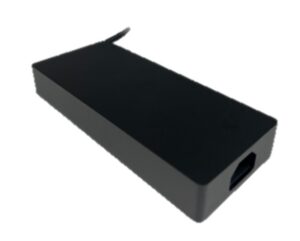
FEATURED PRODUCTS
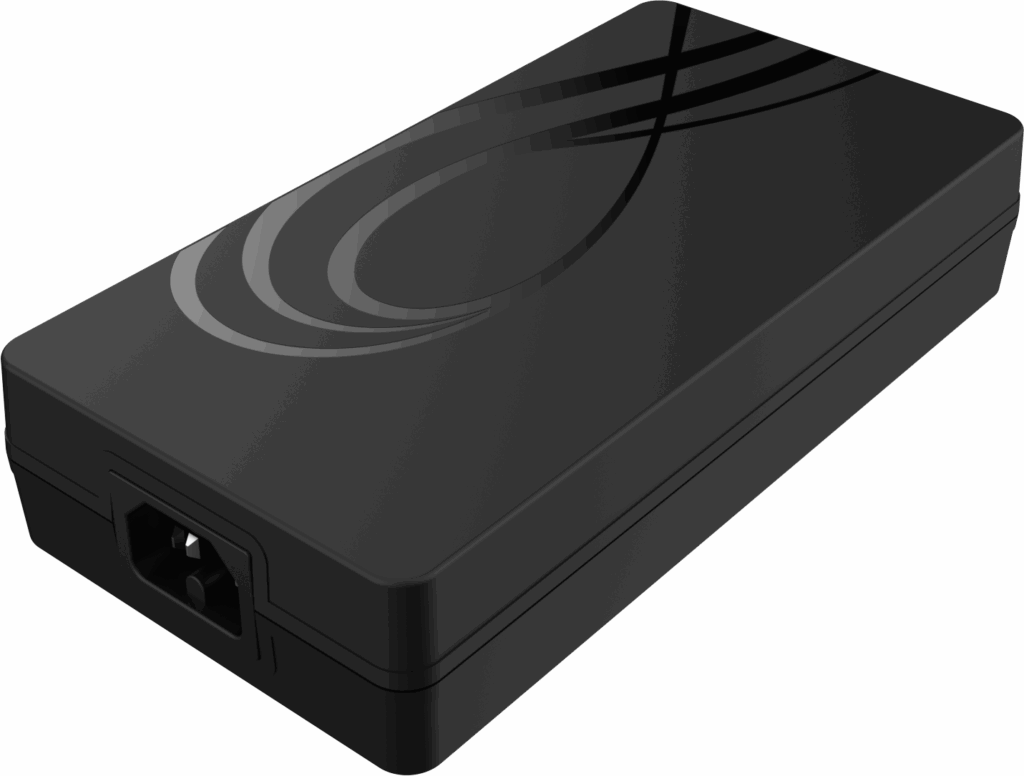
AM250U-540AP-R
- Output Power - 250W
- Output Volt - 54V
- Output Current - 4.63A
- Features - Class B EMI , US DoE Level VI Efficiency compliance, EU CoC Ver 5 Tier 2 Compliance, Over-Voltage, Over-Current, Short Circuit, & Over-Temperature Protection, 5,000 Meters Operating Altitude
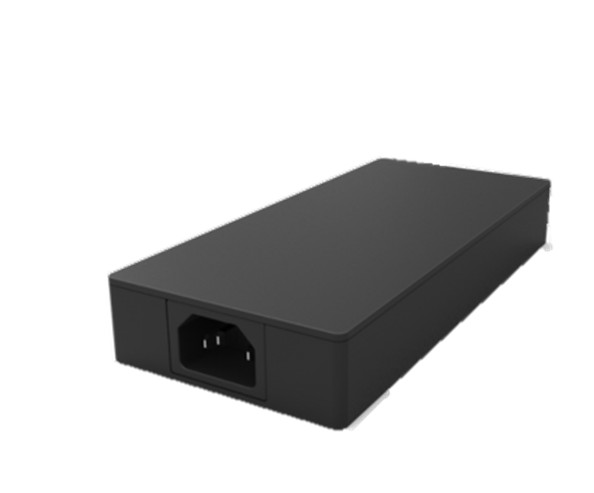
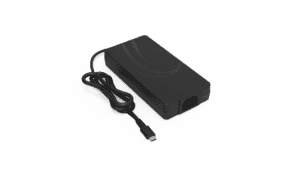
AA240U-200A-R
- Output Power - 240W
- Output Volt - 20V
- Output Current - 12A
- Features - high-efficiency desktop power supply designed for multiple applications, delivering a reliable 240W single output with advanced GaN technology for compact performance. Ideal for powering high-demand gaming systems etc with reduced heat and improved energy conversion.
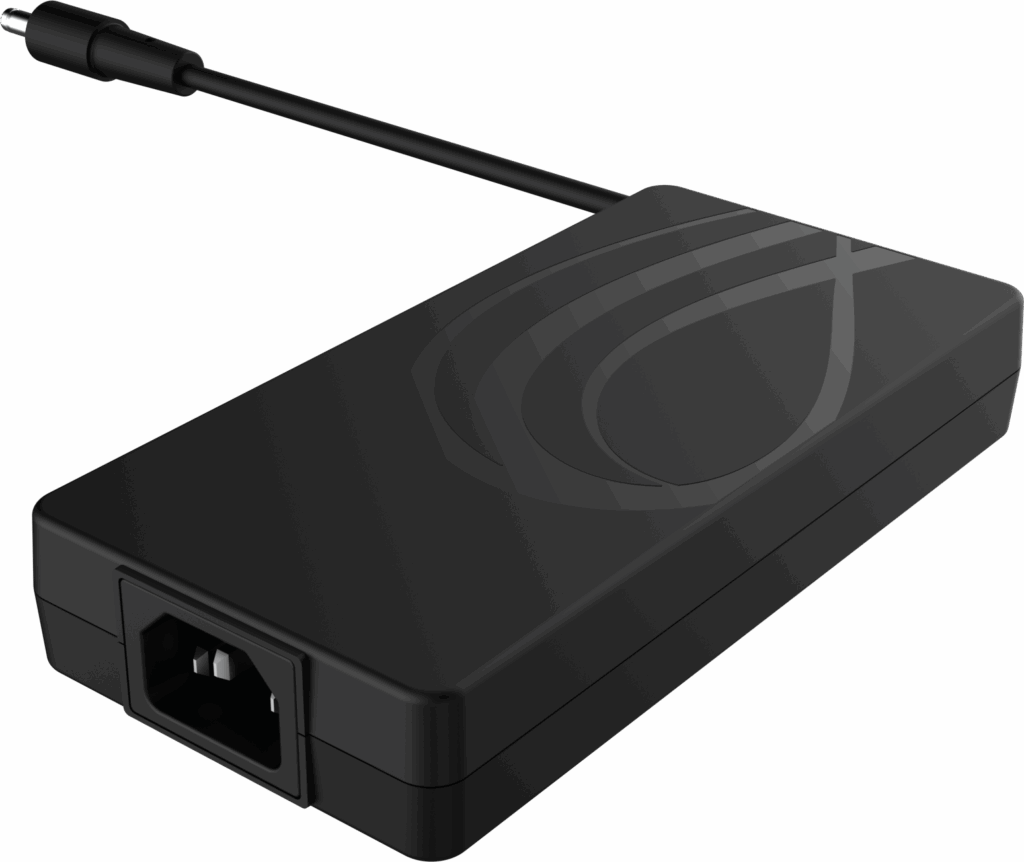
AA240U-200B-R
- Output Power - 240W
- Output Volt - 20V
- Output Current - 12A
- Features - This 240-watt GaN Series Desktop C14 Adapter delivers high power in a compact, efficient design, ideal for demanding professional and industrial applications. Its GaN technology ensures cooler operation, reliability, and space-saving performance.
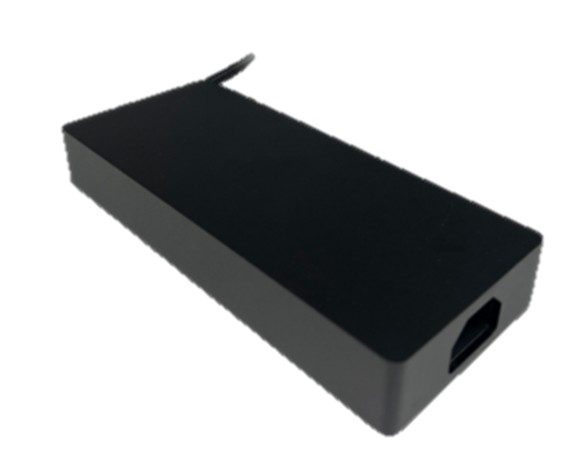
AA280U-200B-R
- Output Power - 280W
- Output Volt - 20V
- Output Current - 14A
- Features - high-efficiency desktop power supply designed for multiple applications, delivering a reliable 240W single output with advanced GaN technology for compact performance. Ideal for powering high-demand gaming systems etc with reduced heat and improved energy conversion.
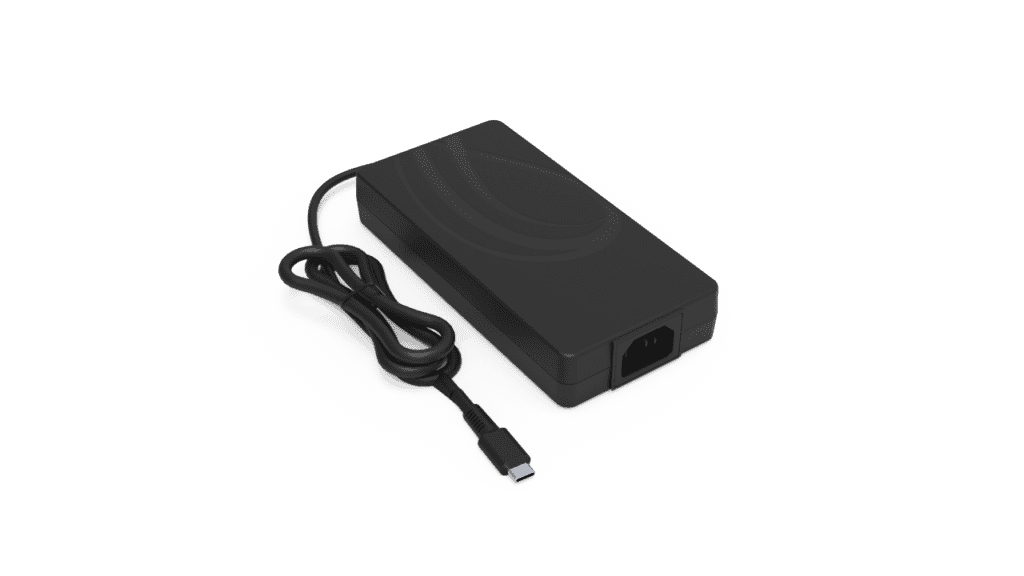
AA240U-59FKEA-R
- Output Power - 240 Watt
- Output Volt - 5Vdc/ 9Vdc/ 15Vdc/ 20Vdc/ 28V/ 36V/ 48V
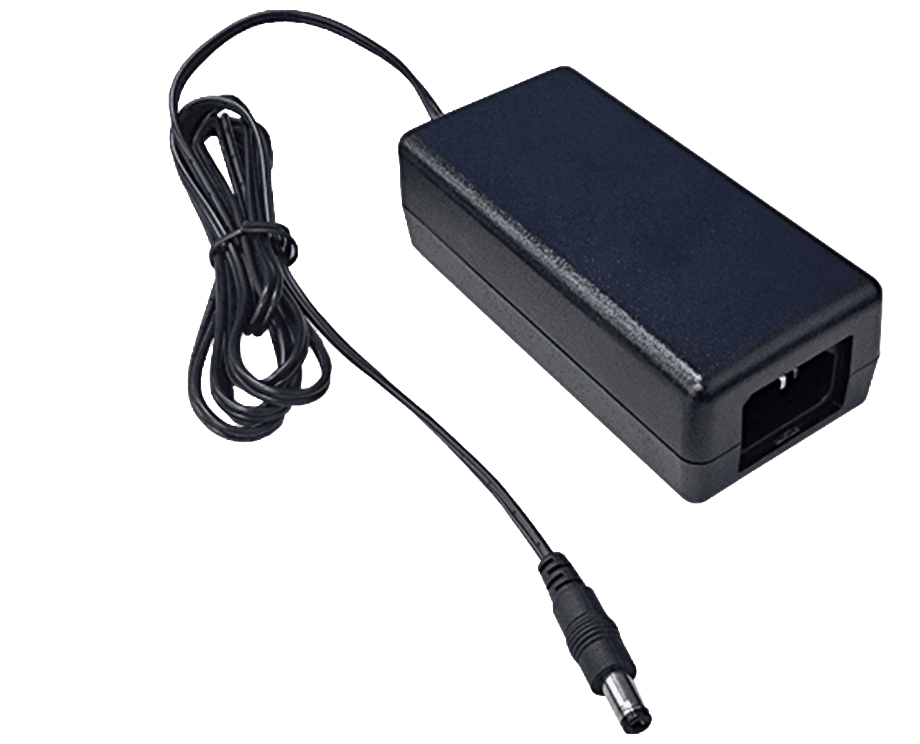
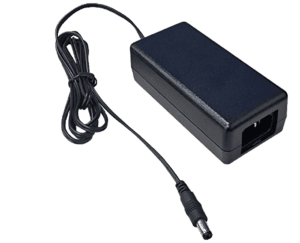
AA36U-240B-R
- Output Power - 36W
- Output Volt - 24V
- Output Current - 1.5A
- Features - C14 Inlet Receptacle, US DoE Level VI & NRCan Compliance, EU Ecodesign 2019/1782 Compliance, CoC V5 Tier 2 Compliance, Operating Altitude to 5,000 Meters, and Protections from Short Circuit, Over-Current and Over-Voltage

CLIENT'S QUOTE
Phihong’s custom OEM power solutions have transformed our product development, boosting performance and reducing overhead. Their expert engineering support has simplified both the design and manufacturing phases.
Why are 65W GaN power adapters becoming the new standard for commercial laptops, monitors, and USB-C devices?
The 65W category has become one of the most important segments in the power adapter market because it sits at the intersection of portability, performance, and broad device compatibility. Many modern business laptops, USB-C monitors, docking stations, tablets, and productivity devices operate comfortably within the 45W–65W power range, making 65W adapters an attractive universal solution.
For OEMs, the shift toward 65W GaN power adapters is not only about faster charging. It is about creating a power platform that can support multiple device categories while maintaining a compact form factor. Traditional silicon adapters often become larger and heavier as output requirements increase. GaN technology allows manufacturers to maintain or improve performance while reducing size and thermal burden.
The growth of USB-C Power Delivery has accelerated this trend. Many organizations now want a single adapter architecture capable of supporting multiple products across their ecosystem. A well-designed 65W GaN platform can reduce accessory complexity while improving portability and user convenience.
Why This Matters
• 65W supports a wide range of commercial and productivity devices.
• USB-C Power Delivery continues to standardize charging requirements.
• Compact power solutions improve portability and user experience.
What’s Driving This Shift
• Business laptops increasingly support USB-C charging.
• Organizations want fewer charger types across device fleets.
• GaN technology makes higher-density 65W designs more practical.
What OEMs Should Do Now
• Review whether multiple products can share a common 65W power platform.
• Evaluate USB-C PD compatibility across current and future devices.
• Consider adapter size and portability as part of the overall product experience.
Mini Q&A
Why is 65W such an important power category?
Because it covers many laptops, monitors, docking stations, and professional productivity devices.
Can a 65W adapter replace multiple chargers?
In many cases yes, especially when USB-C Power Delivery is supported.
Why is GaN particularly useful at 65W?
Because it enables compact designs while maintaining efficient power delivery.
The 65W segment has become one of the strongest examples of where GaN technology delivers practical value.
Useful Links
AQ65A 65W GaN Adapter: www.phihong.com/products/adapters/aq65a-59fkb-r/
AQ65E 65W GaN Adapter: www.phihong.com/products/adapters/aq65e-59fkb-r/
Power Adapter Product Line: www.phihong.com/products/adapters/
Related Links
GaN Charging vs Silicon Chargers: www.phihong.com/gan-charging-why-are-gan-chargers-better-than-silicon-based-chargers/
Future of Fast Charging: www.phihong.com/gan-charger-the-future-of-fast-charging-electronic-devices/
GaN Power Supply Manufacturing: www.phihong.com/gan-power-supply-manufacturing-how-gallium-nitride-is-revolutionizing-efficiency-and-performance-for-oems/
How are high-wattage GaN power adapters changing mobile workstations, gaming systems, and AI devices?
The conversation around GaN technology often starts with compact laptop chargers, but some of the most significant developments are happening at much higher power levels. Modern mobile workstations, gaming systems, edge AI devices, professional content creation platforms, and high-performance computing products increasingly require significantly more power than traditional consumer electronics.
Historically, higher wattage meant larger adapters, heavier power bricks, and more thermal management challenges. GaN technology changes that equation by allowing higher output power within smaller physical footprints. As power density increases, manufacturers gain more flexibility in how they package and deploy high-performance systems.
For OEMs, this is especially relevant because performance expectations continue to rise. AI workloads, advanced graphics processing, edge computing, and high-speed connectivity all increase power requirements. A compact high-wattage power solution can improve deployment flexibility while supporting next-generation product designs.
Why This Matters
• High-performance devices continue to demand more power.
• Traditional adapter size becomes a limitation at higher wattages.
• GaN technology enables more compact high-output designs.
What’s Driving This Shift
• AI and edge computing applications continue to expand.
• Mobile workstations require desktop-level performance.
• Gaming and content creation systems continue to increase power requirements.
What OEMs Should Do Now
• Evaluate future power requirements rather than only current needs.
• Review how adapter size affects deployment and mobility.
• Consider high-density power platforms for future product generations.
Mini Q&A
Can GaN support very high power levels?
Yes. GaN technology is increasingly being used in higher-output power architectures.
Why does adapter size matter for professional devices?
Because portability, deployment flexibility, and workspace efficiency all matter to end users.
Are AI devices increasing power requirements?
Many are. AI processing often requires higher-performance hardware and greater power delivery capability.
Higher-output GaN power platforms are helping support the next generation of computing devices.
Useful Links
330W GaN Power Adapter: www.phihong.com/press-release/phihong-releases-330w-gan-technology-low-profile-single-output-power-adapter/
Power Adapter Product Line: www.phihong.com/products/adapters/
OEM Power Solutions: www.phihong.com/
Related Links
GaN Power Supply Manufacturing: www.phihong.com/gan-power-supply-manufacturing-how-gallium-nitride-is-revolutionizing-efficiency-and-performance-for-oems/
Future of Fast Charging: www.phihong.com/gan-charger-the-future-of-fast-charging-electronic-devices/
Top GaN Power Device Manufacturers: www.phihong.com/top-5-gan-power-device-manufacturers-leading-the-future-of-high-efficiency-power-solutions/
What modern device categories will benefit most from GaN power over the next decade?
GaN adoption is still in its early stages compared to the broader power electronics industry. While laptops, smartphones, tablets, and docking stations helped drive initial growth, many emerging device categories are beginning to benefit from compact, high-density power architectures.
Future growth is expected across AI hardware, robotics, industrial automation, networking infrastructure, edge computing systems, smart displays, digital signage, healthcare equipment, and many other connected products. These devices often share similar design pressures: limited space, growing performance expectations, thermal constraints, and the need for greater efficiency.
For OEMs, this means GaN should not be viewed as a short-term charging trend. Instead, it represents a broader shift in how power delivery is designed across multiple industries. Companies that evaluate GaN early may gain more flexibility as future device requirements continue to evolve.
Why This Matters
• Future products will require more power within smaller footprints.
• Efficiency and thermal performance remain critical design priorities.
• GaN adoption continues expanding beyond consumer electronics.
What’s Driving This Shift
• AI infrastructure is increasing power density requirements.
• Robotics and automation systems need compact power architectures.
• Edge computing and networking equipment continue to expand globally.
What OEMs Should Do Now
• Evaluate future product roadmaps against long-term power requirements.
• Review whether current silicon architectures support future scaling needs.
• Consider how compact power delivery may influence future product differentiation.
Mini Q&A
Is GaN only for chargers?
No. GaN technology is increasingly used across many power conversion applications.
Which industries may benefit most from GaN?
AI, robotics, networking, healthcare, industrial automation, and commercial electronics are all seeing growing interest.
Will GaN eventually replace silicon?
Silicon will remain important, but GaN adoption is expected to continue expanding where power density and efficiency matter most.
The future of power delivery is increasingly tied to efficiency, density, and thermal performance.
Useful Links
Power Adapter Product Line: www.phihong.com/products/adapters/
GaN Power Device Manufacturers: www.phihong.com/top-5-gan-power-device-manufacturers-leading-the-future-of-high-efficiency-power-solutions/
OEM Power Solutions: www.phihong.com/
Related Links
Future of Fast Charging: www.phihong.com/gan-charger-the-future-of-fast-charging-electronic-devices/
GaN Power Supply Manufacturing: www.phihong.com/gan-power-supply-manufacturing-how-gallium-nitride-is-revolutionizing-efficiency-and-performance-for-oems/
GaN Charging vs Silicon Chargers: www.phihong.com/gan-charging-why-are-gan-chargers-better-than-silicon-based-chargers/
How Phihong supports GaN power adapter development for modern devices
Phihong’s GaN portfolio demonstrates how Gallium Nitride technology is being applied across both compact and higher-output power solutions. The company’s adapter portfolio includes 65W GaN solutions and high-output GaN platforms that support evolving power requirements across commercial, industrial, and consumer applications.
Beyond products, Phihong provides educational resources that help OEMs understand the broader transition from silicon-based architectures to modern GaN power systems. These resources cover manufacturing, performance, charging trends, and broader industry developments that influence product design decisions.
For OEMs, startups, engineers, and product managers, the most effective approach is to evaluate GaN not as a standalone feature, but as part of a larger power architecture strategy that supports future device requirements.
Why This Matters
• Product requirements continue evolving toward higher-density power delivery.
• GaN technology supports both compact and higher-output applications.
• Educational resources help OEMs evaluate long-term technology direction.
What OEMs Should Do Now
• Compare current silicon designs against future platform requirements.
• Evaluate GaN options for both compact and high-performance products.
• Consider long-term scalability when making power architecture decisions.
Mini Q&A
Does Phihong offer GaN adapter solutions today?
Yes. Phihong currently offers GaN-based adapter products within its portfolio.
Why should OEMs evaluate GaN now?
Because future device requirements continue increasing while available space continues shrinking.
Is GaN mainly about charging speed?
No. It also affects power density, thermal behavior, efficiency, and future product flexibility.
A stronger power architecture today often creates a more competitive device tomorrow.
GaN technology is no longer an emerging concept. It is becoming a practical design tool for OEMs building the next generation of connected devices, commercial electronics, AI systems, and high-performance computing platforms.
As device requirements continue evolving, manufacturers that understand the relationship between efficiency, thermal performance, and power density will be better positioned to create products that remain competitive for years to come.
FAQ
What is a GaN power adapter?
A GaN power adapter uses Gallium Nitride semiconductor technology instead of traditional silicon switching devices. GaN allows higher switching frequencies, reduced heat generation, and higher power density, enabling smaller and more efficient power adapters.
Why are GaN chargers smaller than traditional silicon chargers?
Because GaN devices switch more efficiently, engineers can reduce the size of supporting components such as transformers and capacitors. This allows the overall adapter to become smaller while maintaining similar or higher output power.
Are GaN power adapters more efficient?
In many applications, yes. Reduced switching losses and lower heat generation help improve overall efficiency and thermal performance compared to traditional silicon-based designs.
Why are 65W GaN adapters becoming so popular?
The 65W category supports many modern laptops, monitors, docking stations, tablets, and USB-C devices. It provides a useful balance between portability and performance.
Will GaN eventually replace silicon in power supplies?
Silicon will continue to play an important role, but GaN adoption is expected to expand in applications where efficiency, power density, and compact design are major priorities.

CONTACT US TODAY
From concept to production, Phihong delivers custom OEM power solutions tailored to your specifications.
POE technology supports the centralization of power

AC Adapter Guide: Everything You Need to Know
Moreover, PoE technology supports the centralization of power management. By powering devices through a PoE-enabled network …
AC DC Power Chargers and How They Work: A Comprehensive Technical Breakdown
Moreover, PoE technology supports the centralization of power management. By powering devices through a PoE-enabled network …

USB-C Charger: Shaping the Future of the Tech World
Moreover, PoE technology supports the centralization of power management. By powering devices through a PoE-enabled network …

AC Adapter Guide: Everything You Need to Know
Moreover, PoE technology supports the centralization of power management. By powering devices through a PoE-enabled network …

AC DC Power Chargers and How They Work: A Comprehensive Technical Breakdown
Moreover, PoE technology supports the centralization of power management. By powering devices through a PoE-enabled network …

USB-C Charger: Shaping the Future of the Tech World
Moreover, PoE technology supports the centralization of power management. By powering devices through a PoE-enabled network …