










BLOG
Power Supply Test Loads: When Should Engineers Use Electronic or Resistive Loads?
QUICK LINKS
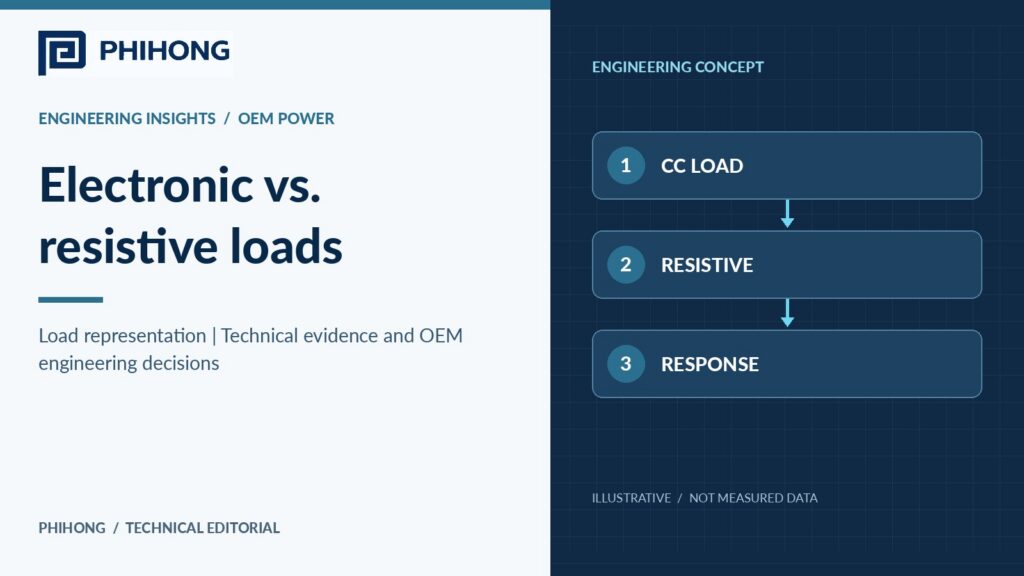
Quick answer: An electronic load and a resistive load can present different voltage-current relationships to a power supply. Select the load method according to the behavior being represented, the relevant test requirement and the ability to reproduce the intended stimulus. A July 2026 academic thesis comparing controlled-current and switched-resistance simulation models illustrates this distinction without establishing that one physical instrument is universally better.
Why This Topic Matters Now
A dynamic load test is only as meaningful as the load behavior it represents. A resistive element changes current as the supply voltage changes. An electronic load configured for constant current attempts to maintain its demand within its operating limits. Actual equipment may instead behave like a regulated converter, an actuator with control electronics or a more complex time-dependent system. The test method should match the question. Using the same numerical current at the initial voltage does not establish that two load types exercise the source equivalently during a disturbance.
Source context: Politecnico di Milano research repository: load-model study.
How Do Constant Resistance and Constant Current Differ?
An illustrative 4.8-ohm resistance draws 5A at 24V. If the voltage drops to 22V, it draws approximately 4.58A. An ideal constant-current load set to 5A would continue demanding 5A within its compliance range. The calculations demonstrate the distinct behavior, not the performance of a real test instrument or a Phihong supply. A constant-power load can introduce yet another response because it may request more current as voltage falls. The applicable operating range and control limits matter for all active loads.
Engineering workflow: Load representation
- 01
Identify workload - 02
Select load model - 03
Verify actual current - 04
Observe voltage - 05
Document equivalence
What Did the 2026 Thesis Compare?
The Politecnico di Milano repository describes a master's thesis on simulation models for AI infrastructure load profiles. The author compared an active controlled-current implementation with a passive switched-resistance implementation, reporting advantages for the active model on rapid slew-rate-limited cases. These findings concern the models and reference profiles used in the research. They should not be represented as a universal laboratory comparison or as independent product certification. The broader implication for an OEM is to document the load model and verify the actual stimulus rather than assume that nominal settings define equivalent tests.
When Is a Resistive Load Useful?
A resistor can represent a voltage-dependent electrical demand or provide a simple reference operating condition. Its behavior may be suitable for a particular specified test, and its physical arrangement has to be rated for the dissipated power. However, a switched resistive arrangement may have its own transition characteristics and parasitic elements. When it is used to represent a regulated device, the differences should be considered explicitly. Record the actual resistance and its relevant conditions, and measure the applied current rather than relying only on a calculation at nominal output voltage.
When Is an Electronic Load Useful?
An active test load can be valuable when a specified current or time-dependent profile must be reproduced. Its modes, compliance limits, bandwidth and control behavior still need to be considered. A programmed pulse may differ from the measured pulse if the instrument reaches a limit or interacts with the source. The qualification record should identify the load mode and actual observed behavior. For a real application with a downstream switching converter, a simple constant-current emulation may be an incomplete representation. A validated model or representative equipment test can complement the controlled bench condition.
How Can OEMs Compare Results Without Confusing Test Methods?
Include the load mode, source configuration, actual applied current, measurement point and applicable acceptance criterion in the report. If a different load method is used for supplier comparison, establish whether it is equivalent for the required question. Do not compare the voltage response of a constant-current event with a resistive event as though only the power supply changed. Procurement should retain the test method alongside the result. When the real equipment behavior is uncertain, document that uncertainty and ask engineering to identify a representative profile before issuing a final qualification decision.
Review the relevant documentation
Compare the exact model, operating conditions and revision before drawing conclusions for an OEM application.
Worked Example: Distinguish Three Idealized Load Relationships
At 24V, a 120W idealized demand corresponds to 5A. A 4.8-ohm resistor also draws 5A at that voltage. If the voltage changes to 22V, the resistor draws about 4.58A, an ideal constant-current load remains at 5A within its range, and an ideal constant-power load would draw about 5.45A. At the original voltage all three conditions look identical in a current reading, yet their responses to a change in voltage are different. These are mathematical examples, not instrument performance claims or operating recommendations. Actual active loads and equipment have operating limits and control characteristics.
The distinction is particularly relevant during a transient. A voltage-dependent load may reduce its demand as voltage falls. A regulated downstream converter can behave differently over the range in which its own control system operates. The test owner must decide whether a particular emulation represents the application or an independently specified source test. A successful result using one model is not necessarily evidence for another. The test report should state the selected mode and why it was appropriate for the intended requirement.
Distinguish a Physical Load From a Simulation Model
The 2026 thesis compares simulation approaches used to reproduce dynamic demands. Its observations concern the modeled behavior, not a comprehensive comparison of every commercial electronic load and resistor. A simulation may help establish the load profile, examine the expected behavior or evaluate whether a model captures relevant characteristics. The model still needs an appropriate connection to the actual equipment and qualification question. A laboratory instrument introduces its own compliance range, control response and fixture considerations.
When interpreting research, identify which part of the conclusion is supported by its methodology. An active controlled-current model that performs well for a defined transient does not establish that any physical electronic load can reproduce that transition. Similarly, a simple switched resistance can be suitable for a defined test even if it does not model a more complex regulated load. The engineering value is in matching the method to the question and verifying the actual stimulus, not ranking load categories universally.
How Should a Representative Equipment Profile Be Chosen?
Start with the operating state that matters to the source and the location at which the demand is measured. The current at a downstream device can differ from the current drawn from an upstream supply. If the equipment uses local conversion or energy storage, identify whether the proposed bench model includes those effects. A representative load can be a useful simplification, provided the relevant characteristics and limitations are documented. Avoid assuming that a nominal motor or processor rating defines the dynamic source requirement.
An application team may need more than one evaluation. A defined constant-current source test can establish performance under a particular condition, while a representative equipment test can address a different system-level question. Both can be valid without being equivalent. Record which acceptance criterion each result addresses. The related pulse-load article provides a framework for characterizing the event, and the test-report article discusses comparability when the selected methods differ.
Procurement Comparison: Ask What the Test Was Designed to Prove
Request the load mode, actual applied current profile, relevant output and measurement location, and applicable test definition. If two suppliers use different loads, ask the engineering owner whether the results address the same requirement. A smaller observed voltage deviation does not necessarily identify the more capable product when the stimulus changes as voltage changes. The proper conclusion may be that the evidence is not yet comparable.
For a model-specific Phihong selection, use the documented operating and test conditions for the exact product. If the proposed application requires an emulation beyond those conditions, treat it as a new qualification question. Do not attribute a third-party simulation result to a product whose behavior was not evaluated in that study. A clear evidence boundary enables the OEM to use research productively without converting it into an unsupported manufacturer performance claim.
What Evidence Belongs in the OEM Release Record?
When two laboratories use different load methods, the comparison begins with the question each test was intended to answer. A resistive load can offer a clear physical relationship between voltage and current, while a controlled electronic load can represent a different specified stimulus. Neither is automatically equivalent to an actual subsystem whose input converter changes its behavior during a disturbance. If the workload model is selected from a simulation study, document the assumptions and validate the relevant observations with an appropriate physical test. A procurement specification can request the load mode, actual current trace and operating conditions without dictating an unsuitable universal fixture. Keep the model limitations in the final evidence record.
| Review item | Evidence to retain | Decision criterion |
|---|---|---|
| Application question | Constant-current, resistive or other representative behavior | State why the selected load represents the workload |
| Stimulus record | Actual current and voltage throughout the event | Do not assume equal final current means equal dynamics |
| Equipment boundary | Source terminals, cable and local energy storage | Identify which parts are represented and which are omitted |
| Comparison | Acceptance criterion and model limitations | Distinguish a simulation result from physical test evidence |
Key Takeaways
- Application question: State why the selected load represents the workload
- Stimulus record: Do not assume equal final current means equal dynamics
- Equipment boundary: Identify which parts are represented and which are omitted
- Comparison: Distinguish a simulation result from physical test evidence
Frequently Asked Questions
Is an electronic load always the better choice?
No. Use the method appropriate to the test objective and application.
Does equal starting current mean equivalent load behavior?
No. The current can respond differently as voltage changes.
Does simulation research qualify a physical supply?
No. It supports modeling decisions within its scope.
Should constant-power emulation be assumed equivalent to constant current?
No. Their voltage-current responses differ.
Related Articles and OEM Resources
- Phihong BI240-240A-R product documentation
- USB-C EPR transient testing
- Phihong technical documentation
- Phihong product portfolio
- Contact Phihong
Technical References
- Politecnico di Milano research repository: load-model study
- Advanced Energy Open Rack V3 power system reference note
Discuss your OEM power supply requirements
Share the intended workload, application conditions, relevant revision and unresolved technical evidence with Phihong. Confirm exact product capabilities against current model documentation.