









BLOG
Power Supply Overcurrent Protection: How Should OEMs Document Permitted Power Excursions and Protection Limits?
QUICK LINKS
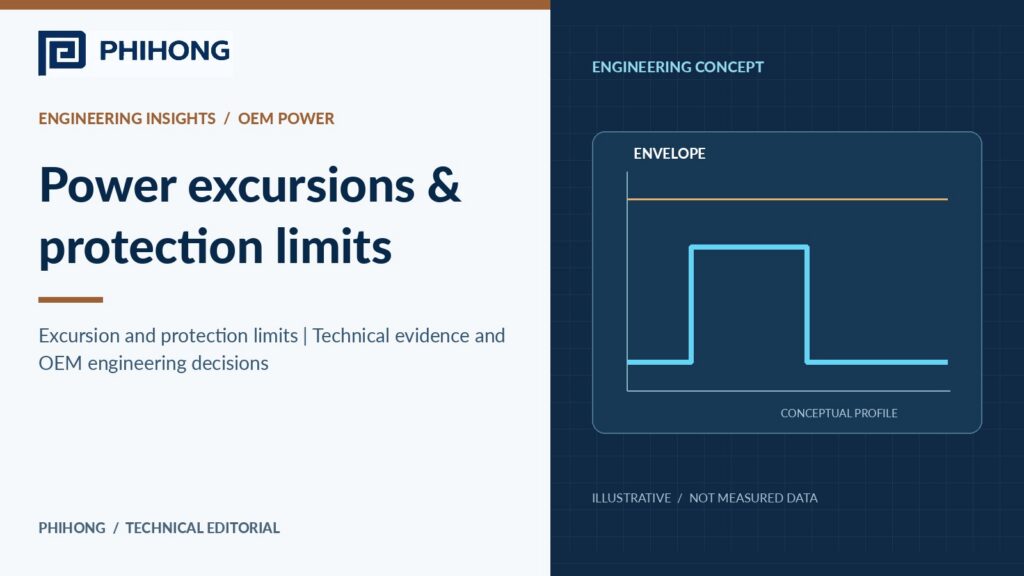
Quick answer: Permitted power excursions and overcurrent protection address distinct parts of a power supply's operating envelope. An OEM should document the conditions under which an excursion is allowed and the conditions under which protection is expected to intervene. A peak rating alone is not enough to define the boundary, and a protection threshold is not an authorization to operate continuously near that threshold.
Why This Topic Matters Now
Modern equipment can demand brief increases in output current during application transitions. A supply may be designed to support a specific excursion while also protecting itself and connected equipment under abnormal conditions. If the two requirements are combined into a single maximum-current figure, the test plan may treat permitted behavior as a fault or treat a protection boundary as a normal rating. This article focuses on documenting and coordinating evidence, not repeating the existing model-specific ten-second boost and fault-recovery articles.
Source context: TI high-speed current sensing application brief.
How Do Continuous Ratings, Excursions and Protection Differ?
The continuous rating defines a declared operating capability under applicable conditions. A permitted excursion is an additional time-dependent capability when explicitly documented. Protection behavior concerns a different condition in which the supply detects an abnormal or limiting state and responds as specified. The applicable thresholds, durations and recovery behavior can be implementation-specific. Keep normal operating requirements separate from fault requirements. Do not infer a usable operating region from an absolute maximum or protection trip value. The exact supplier documentation and the equipment requirements establish the appropriate boundary.
Engineering workflow: Excursion and protection limits
- 01
Continuous operating envelope - 02
Declared excursion - 03
Applicable protection - 04
Observed response - 05
Acceptance decision
What Does the TI Current-Sensing Brief Illustrate?
TI's April 2026 application brief, revised in August, discusses current-sensing requirements in high-power server architectures and presents a particular sensing design example. It illustrates how sensing and protection response can be a system-level engineering question. Its values are tied to the architecture and requirements described in the brief, not universal trip times for industrial or external adapters. When citing a technical example, distinguish the source's design assumptions from the OEM's actual protection and load requirements. Do not extrapolate the example to another power supply.
Why Must the Load Profile and Protection Evidence Be Kept Together?
A measured current above a nominal continuous rating is not automatically permitted or prohibited. The duration, initial conditions and documented capability matter. An observed shutdown may represent intended protection, a test outside the approved envelope or an unexpected interaction with the equipment. Preserve the applied stimulus, the operating state and the observed response. For a permitted excursion, verify that the applicable electrical and thermal conditions remain within the defined acceptance boundary. For a protection case, use the appropriate controlled qualification procedure and do not treat uncontrolled overload as an ordinary operating test.
How Should Model-Specific Product Evidence Be Described?
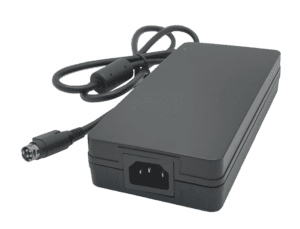
The published BI240-240ASPR-R product page identifies 240W output and a time-limited peak-power feature. This is a documented capability of that model subject to its full conditions, not a basis for assuming unrestricted repetition, a particular current-sense implementation or identical behavior across the family. The related BI240-240A-R product page documents its own 24V rating and characteristics. Use each model's exact datasheet and obtain clarification of any unresolved excursion and protection boundary. Keep any application example clearly separate from a manufacturer qualification claim.
What Should a Release Document Specify?
Maintain separate entries for continuous operation, permitted transient or peak operation, and abnormal-condition protection. Each entry should identify its source, applicable conditions, evidence and disposition. Include the expected system response and recovery requirements where relevant. If the application needs an excursion beyond the documented operating envelope, treat it as an unresolved design requirement rather than approving it based on a protection threshold. This structure helps procurement compare declared capabilities while preserving the engineering distinction between normal operation and protective behavior.
Review the relevant documentation
Compare the exact model, operating conditions and revision before drawing conclusions for an OEM application.
Worked Example: Distinguish Operating Power From a Protection Boundary
Consider a hypothetical supply rated for 240W under defined continuous conditions. At a nominal 24V output, that corresponds to 10A. A separately documented time-limited capability, if present, would have its own conditions. A protection threshold would answer another question: how the device responds to a particular abnormal or limiting condition. The presence of a higher current figure in a protection description does not establish that the supply may be used continuously at that current. The complete operating and protection definitions matter.
Suppose a load profile includes a brief elevated state. The engineer should compare its magnitude, duration, repetition and initial conditions with the exact declared capability. If the profile is outside that evidence, the appropriate disposition is an unresolved qualification question, not a conclusion that the load is acceptable because it is below an assumed protection threshold. Likewise, a shutdown during an uncontrolled test does not automatically identify a defect. The test may have exceeded a permitted condition or exercised a protection response. Preserve the stimulus and observed behavior before deciding what the result means.
Why Can Sensing and Protection Evidence Be Architecture-Specific?
The TI current-sensing application brief discusses a particular design context for server power architectures. Its value is in showing that protection behavior depends on the sensing and system requirements under consideration. Different implementations can use different mechanisms, limits and response definitions. A result in one reference architecture does not establish the response time or threshold of an unrelated commercial model. Keep the actual source and design assumptions with any technical example. A buyer should request the evidence for the exact product and application requirement rather than transfer a number from a reference circuit.
The relevant observation may also be different from an ordinary load measurement. A protection evaluation may need to establish the applied abnormal condition, the source's documented response and the equipment's expected state. A normal operating evaluation instead asks whether the source supports a defined permitted condition. These purposes should not be combined in a single uncontrolled overload experiment. Use the applicable approved test procedure and equipment safety requirements.
Separate Permitted Excursions From Repetitive Operation
A time-limited power feature does not necessarily describe every repetition pattern. Two profiles with the same nominal peak may differ in duration, low-load interval and accumulated thermal state. Review the actual timing conditions and any recovery restrictions in the product documentation. If the application needs repeated events, state that requirement explicitly and obtain the appropriate evidence. Do not derive a universal duty cycle from a single documented duration or from a protection limit. The related pulse-load and thermal articles discuss those distinctions in greater detail.
For a BI240 series selection, use the exact variant's documentation, not the most favorable value found across several related models. The published BI240-240ASPR-R capability is a starting point for a model-specific discussion under its stated conditions. It is not evidence of unrestricted repetitive operation or a universal protection implementation. A procurement record should distinguish what is declared, what the project requires and what still needs review.
Record Both the Expected Operating Result and the Expected Protection Result
A useful release matrix has separate rows for continuous operation, permitted excursions and applicable abnormal-condition response. Each row identifies the requirement source, exact model, relevant conditions, supporting evidence and disposition. The engineering owner should establish the acceptance boundary and approved test procedure. Include any relevant recovery or system behavior requirement where it is part of the application. A generic notation that a source supports overload protection is not sufficient to define the equipment's operating envelope.
When comparing suppliers, request the actual conditions and evidence rather than treating a larger peak number or higher protection threshold as inherently preferable. A suitable protection response depends on the intended equipment design and applicable requirements. If an excursion or abnormal condition is not addressed by the available documents, retain the gap for engineering review. The final purchasing decision should connect the documented capability to the intended application without converting a protection feature into a performance guarantee.
What Evidence Belongs in the OEM Release Record?
A protection threshold and a permitted operating excursion are different evidence categories. A threshold does not establish that the source is rated to operate continuously at that value, and absence of a trip does not establish that a repetitive workload is acceptable. Record the permitted excursion conditions and the required protection outcome separately. A qualification team can then evaluate the operating profile within the declared envelope and review protection evidence using the applicable model documentation and approved test procedure. Avoid extrapolating a threshold or timing value from a third-party sensing design to a different supply. Where the supplier does not specify the requested operating behavior, retain that uncertainty in the procurement record and request model-specific clarification before approving the application.
| Review item | Evidence to retain | Decision criterion |
|---|---|---|
| Continuous envelope | Model-specific rating and conditions | Do not infer temporary capability from the continuous label |
| Excursion | Permitted current/power, duration and recurrence | Identify the exact declared operating condition |
| Protection response | Applicable limits and documented outcome | Distinguish allowed operation from a protective response |
| System acceptance | Load requirements and observed recovery | Confirm the complete equipment behavior within its approved conditions |
Key Takeaways
- Continuous envelope: Do not infer temporary capability from the continuous label
- Excursion: Identify the exact declared operating condition
- Protection response: Distinguish allowed operation from a protective response
- System acceptance: Confirm the complete equipment behavior within its approved conditions
Frequently Asked Questions
Is an overcurrent trip threshold a usable output rating?
No. It defines a protection boundary, not a continuous rating.
Does a peak rating permit arbitrary duration?
No. Review the exact documented conditions.
Are server current-sensing response times universal?
No. They depend on the relevant architecture and requirements.
Can a fault test be treated as normal operating qualification?
No. Document the distinct purpose and applicable procedure.
Related Articles and OEM Resources
- Phihong BI240-240ASPR-R datasheet
- Phihong BI240-240A-R product documentation
- USB-C EPR transient testing
- Phihong technical documentation
- Phihong product portfolio
- Contact Phihong
Technical References
- TI high-speed current sensing application brief
- Advanced Energy Open Rack V3 power system reference note
Discuss your OEM power supply requirements
Share the intended workload, application conditions, relevant revision and unresolved technical evidence with Phihong. Confirm exact product capabilities against current model documentation.