






BLOG
What Compliance Engineers Look For in Internal PSUs: EMI, EMS, and Safety Basics
QUICK LINKS
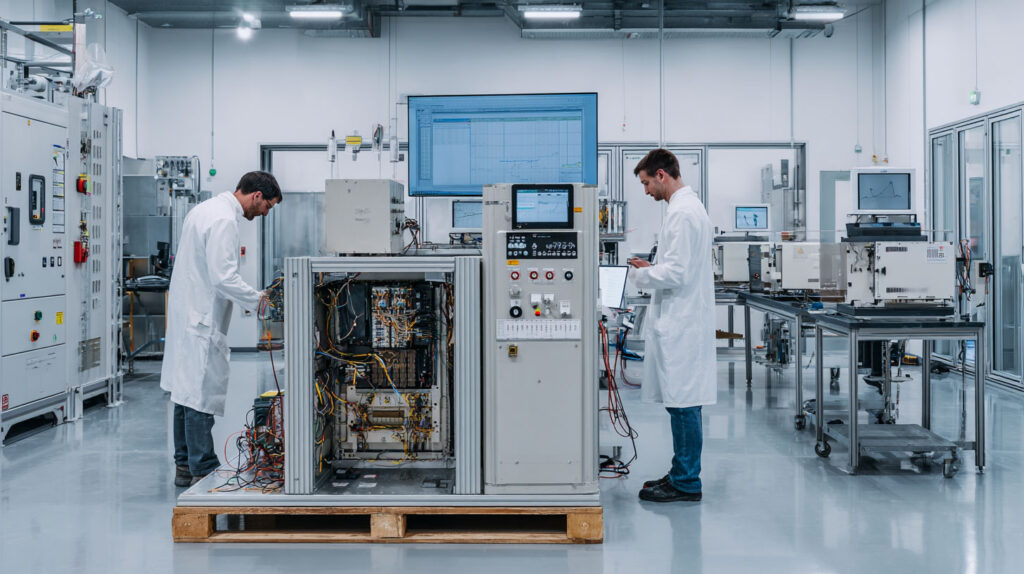
Why Do Compliance Engineers Scrutinize Internal Power Supplies So Closely?
Compliance engineers scrutinize internal power supplies because PSUs are one of the most common root causes of regulatory failures in industrial systems. Internal PSUs interface directly with AC mains, generate high-frequency switching noise, and influence grounding, insulation, and fault behavior throughout the product. Even when the rest of the system is well designed, PSU-related issues can cause EMI, safety, or immunity test failures.
From a compliance perspective, internal PSUs are not isolated components. They interact with enclosure design, cable routing, grounding topology, and system load behavior. Noise coupling, leakage current paths, and transient susceptibility often originate in the power stage and propagate outward. This makes the PSU a focal point during EMI, EMS, and safety evaluation.
Compliance engineers therefore look beyond datasheet claims or component certifications. They assess how the PSU behaves once integrated into the final product, under worst-case operating conditions. OEMs that understand this perspective can avoid repeated test failures and late-stage redesigns.
Top Benefits
• Reduces risk of EMI and safety failures during certification
• Improves first-pass compliance success
• Shortens approval and time-to-market cycles
Best Practices
• Treat PSU selection as a compliance-critical decision
• Validate PSU behavior in the final system configuration
• Involve compliance engineers early in power design reviews
Helpful Tips
• Do not assume component certification guarantees system compliance
• Review historical PSU-related failure modes
• Align PSU design with enclosure and grounding strategy
Mini Q&A
Why do PSUs cause so many compliance issues?
Because they generate switching noise and interface with mains power.
Are compliance failures usually system-level or component-level?
Most are system-level integration issues.
Should compliance be addressed late in development?
No, early planning reduces rework.
Understanding why compliance engineers focus on PSUs helps OEMs design for approval rather than correction.
(Suggested Links: Internal Power Supplies | Industrial Power Supplies)
What EMI Characteristics of Internal PSUs Raise Red Flags During Testing?
EMI is one of the first areas compliance engineers evaluate when reviewing internal power supplies. Switching power supplies inherently generate conducted and radiated emissions due to high-frequency switching, fast edge rates, and parasitic coupling. When poorly controlled, this noise can exceed regulatory limits or interfere with nearby circuitry.
Conducted EMI is a common failure point. Noise traveling back onto AC lines can violate emission limits and affect other equipment on the same circuit. Radiated EMI, often caused by cable coupling or poor enclosure bonding, can also push emissions beyond acceptable thresholds. Internal PSU layout, filtering design, and grounding strategy all influence EMI behavior.
Compliance engineers assess EMI under worst-case conditions. This includes maximum load, long cable configurations, and real enclosure geometry. PSUs that appear compliant on a bench can fail once integrated, making enclosure-level testing essential.
Top Benefits
• Reduces risk of conducted and radiated EMI failures
• Improves system-level noise control
• Supports smoother EMI certification
Best Practices
• Validate EMI with final cable routing and enclosure design
• Use proper input filtering and grounding techniques
• Test EMI at multiple load conditions
Helpful Tips
• Keep high-frequency loops short and well-contained
• Avoid floating metal parts near PSU switching nodes
• Re-test EMI after mechanical or wiring changes
Mini Q&A
Is conducted EMI more common than radiated EMI failures?
Yes, conducted EMI is often the first issue detected.
Can enclosure design affect EMI results?
Yes, bonding and shielding strongly influence emissions.
Should EMI testing include worst-case cabling?
Absolutely, cable length changes emission behavior.
Controlling EMI at the PSU level is essential for compliance success.
(Suggested Links: Internal Power Supplies | Power Supply)
How Do EMS and Immunity Requirements Influence Internal PSU Design?
EMS, or electromagnetic susceptibility, evaluates how well a product withstands external electrical disturbances without malfunction. Internal PSUs play a major role in immunity performance because they are the primary entry point for transients, surges, and conducted disturbances from the mains.
Compliance engineers examine how PSUs respond to events such as EFT, surge, voltage dips, and conducted RF. Poor transient handling can cause resets, output instability, or permanent damage. Even if a PSU survives a test, unacceptable functional disruption can still result in failure.
Internal PSU design choices such as input protection, bulk capacitance, control loop stability, and grounding paths all influence immunity. Compliance engineers look for predictable, graceful behavior under stress rather than absolute immunity at any cost.
Top Benefits
• Improves system robustness against electrical disturbances
• Reduces functional failures during immunity testing
• Supports reliable operation in noisy industrial environments
Best Practices
• Validate PSU behavior during surge and EFT testing
• Design control loops to tolerate input disturbances
• Coordinate immunity strategy with system grounding
Helpful Tips
• Monitor output stability during immunity tests
• Avoid relying solely on external protection devices
• Validate immunity at both minimum and maximum load
Mini Q&A
Can a PSU pass EMI but fail EMS tests?
Yes, emission and immunity are separate evaluations.
Are immunity failures always destructive?
No, functional disruption alone can cause failure.
Should immunity be tested early?
Yes, late fixes are difficult.
Designing PSUs for immunity is essential for industrial reliability and compliance.
(Suggested Links: Industrial Power Supplies | Internal Power Supplies)
CLIENT'S QUOTE
Phihong's Power-Over-Ethernet solutions have transformed our network, boosting efficiency and reducing costs. Their seamless integration has simplified both installation and maintenance.
What Safety Fundamentals Compliance Engineers Verify in Internal PSUs
Safety fundamentals are a primary focus for compliance engineers because internal power supplies interface directly with hazardous voltages. Engineers evaluate whether the PSU design provides adequate protection against electric shock, fire, and fault conditions once integrated into the final product. Component-level certification alone is not sufficient; the complete system must demonstrate safe behavior under normal and abnormal operation.
Key safety elements include insulation systems, creepage and clearance distances, protective earth integrity, and fault containment. Compliance engineers assess whether insulation barriers are appropriate for the intended overvoltage category and pollution degree. They also examine how the PSU behaves during single-fault conditions, such as component failure or grounding loss.
Internal PSUs must also align with the product’s safety class. Whether a system is Class I or Class II affects grounding strategy, leakage limits, and enclosure design. Safety fundamentals must be validated in the final configuration to avoid late-stage certification failures.
Top Benefits
• Reduces risk of electrical shock and fire hazards
• Improves first-pass safety certification success
• Ensures safe behavior under fault conditions
Best Practices
• Validate creepage and clearance at the system level
• Design clear protective earth paths for Class I products
• Review fault scenarios during safety assessment
Helpful Tips
• Avoid assuming PSU insulation is sufficient for the final system
• Confirm enclosure materials meet flammability requirements
• Document safety assumptions early
Mini Q&A
Do safety tests evaluate normal operation only?
No, fault conditions are also evaluated.
Is PSU safety certification enough by itself?
No, the full product must meet safety requirements.
Does safety class affect PSU design?
Yes, grounding and insulation depend on it.
Strong safety fundamentals are essential for compliance approval and user protection.
(Suggested Links: Internal Power Supplies | Industrial Power Supplies)
How Leakage Current and Grounding Affect Safety Compliance
Leakage current and grounding are closely examined during safety compliance testing because they directly impact user protection. Leakage current flows through insulation, filters, and parasitic paths, and excessive leakage can pose shock risks or cause test failures. Internal PSUs are a common source of leakage due to EMI filters and high-frequency switching.
Compliance engineers evaluate leakage current under normal and worst-case conditions, including elevated line voltage and environmental stress. Grounding strategy influences where leakage current flows and how it is safely dissipated. Poor grounding can increase touch current or introduce unpredictable behavior during testing.
OEMs must coordinate PSU grounding with enclosure bonding and system layout. A well-defined grounding strategy ensures leakage currents remain within allowable limits and supports both safety and EMI performance.
Top Benefits
• Reduces risk of touch current violations
• Improves grounding predictability
• Supports combined EMI and safety compliance
Best Practices
• Measure leakage current in the final assembled product
• Design low-impedance protective earth connections
• Coordinate EMI filter design with leakage limits
Helpful Tips
• Avoid long or floating ground paths
• Re-test leakage after EMI filter changes
• Verify grounding continuity across assemblies
Mini Q&A
Does EMI filtering increase leakage current?
Yes, EMI capacitors contribute to leakage.
Can grounding issues cause safety failures?
Yes, improper grounding is a common root cause.
Is leakage current tested at different voltages?
Yes, worst-case conditions are evaluated.
Managing leakage and grounding correctly is critical for passing safety tests.
(Suggested Links: Industrial Power Supplies | Internal Power Supplies)
Why Compliance Engineers Evaluate PSU Behavior Under Fault and Stress Conditions
Compliance engineers evaluate PSU behavior under fault and stress conditions to ensure failures do not create unsafe or unstable outcomes. This includes short circuits, overloads, thermal stress, and transient events. The goal is not just survival, but predictable, controlled behavior during abnormal conditions.
Internal PSUs must demonstrate that faults do not propagate into fire hazards, exposed voltages, or uncontrolled output behavior. Thermal protection, current limiting, and shutdown mechanisms are evaluated for effectiveness and repeatability. Compliance engineers also observe recovery behavior after faults are cleared.
Stress conditions such as elevated ambient temperature or prolonged overload may reveal weaknesses not visible during normal operation. PSUs that degrade gracefully and recover cleanly are favored over designs that behave erratically or require manual reset.
Top Benefits
• Improves product safety under abnormal conditions
• Reduces risk of catastrophic failure
• Supports robust industrial operation
Best Practices
• Validate fault response and recovery behavior
• Test protection circuits under worst-case stress
• Confirm safe shutdown during overload or overtemperature
Helpful Tips
• Observe output behavior during fault clearing
• Avoid designs that latch unpredictably
• Document protection behavior clearly
Mini Q&A
Are fault tests destructive?
Not necessarily, many evaluate functional behavior.
Is recovery behavior part of compliance testing?
Yes, predictable recovery is important.
Can thermal stress expose hidden issues?
Yes, prolonged heat reveals weaknesses.
Evaluating PSU behavior under stress ensures compliance and long-term reliability.
(Suggested Links: Power Supply | Internal Power Supplies)
How Phihong Designs Internal PSUs to Meet EMI, EMS, and Safety Expectations
Phihong designs internal power supplies with compliance as a system-level requirement, not a late-stage checkbox. EMI, EMS, and safety performance are addressed together through input filtering strategy, grounding architecture, insulation design, and controlled fault behavior. This integrated approach reduces the risk of passing one compliance domain while failing another once the PSU is installed in the final product.
Internal PSUs are evaluated under worst-case operating conditions, including maximum load, elevated ambient temperature, and realistic enclosure integration. Phihong emphasizes predictable behavior during disturbances such as surge, EFT, and voltage dips, as well as controlled shutdown and recovery under fault conditions. These characteristics are critical to first-pass compliance success in industrial environments.
As a long-term manufacturing partner, Phihong also supports OEMs with documentation continuity, certification alignment, and lifecycle stability. By designing internal PSUs with compliance engineers’ expectations in mind, Phihong helps OEMs reduce redesign cycles, shorten certification timelines, and deploy industrial systems with confidence.

FEATURED RESOURCE
Phihong's Power-Over-Ethernet solutions have transformed our network, boosting efficiency and reducing costs.
FAQ
What is the most common reason internal PSUs fail EMI testing?
The most common reason is system-level integration rather than the PSU itself. Cable routing, grounding paths, enclosure bonding, and placement of EMI filters can significantly alter emission behavior. A PSU that passes bench tests may fail once integrated into the final product.
Early enclosure-level EMI validation helps prevent this issue.
How are EMI and EMS different in compliance testing?
EMI measures how much noise a product emits into its environment, while EMS evaluates how well the product tolerates external electrical disturbances. A system can pass EMI tests but fail EMS if it is sensitive to surges, EFT, or conducted RF.
Both must be addressed independently and together.
Why do compliance engineers focus on leakage current in internal PSUs?
Leakage current affects user safety and is influenced by EMI filtering and grounding design. Excessive leakage can cause safety test failures or unacceptable touch current. Internal PSUs are a primary contributor to leakage paths.
Leakage must be evaluated in the fully assembled product under worst-case conditions.
Can internal PSUs pass safety tests but still be unsafe in the final product?
Yes. PSU certification does not guarantee system safety. Creepage, clearance, grounding, and enclosure design all affect the final safety outcome. Compliance engineers evaluate the complete product, not just the PSU.
System-level validation is essential.
When should OEMs involve compliance engineers in PSU selection?
Compliance engineers should be involved early, ideally during power architecture and enclosure planning. Early input helps prevent design choices that are difficult or expensive to correct later.
POE technology supports the centralization of power

AC Adapter Guide: Everything You Need to Know
Moreover, PoE technology supports the centralization of power management. By powering devices through a PoE-enabled network …
AC DC Power Chargers and How They Work: A Comprehensive Technical Breakdown
Moreover, PoE technology supports the centralization of power management. By powering devices through a PoE-enabled network …

USB-C Charger: Shaping the Future of the Tech World
Moreover, PoE technology supports the centralization of power management. By powering devices through a PoE-enabled network …

AC Adapter Guide: Everything You Need to Know
Moreover, PoE technology supports the centralization of power management. By powering devices through a PoE-enabled network …

AC DC Power Chargers and How They Work: A Comprehensive Technical Breakdown
Moreover, PoE technology supports the centralization of power management. By powering devices through a PoE-enabled network …

USB-C Charger: Shaping the Future of the Tech World
Moreover, PoE technology supports the centralization of power management. By powering devices through a PoE-enabled network …