









BLOG
Why 12V Main and 5V Standby Power Matter for Rack System Management
QUICK LINKS
Why do rack systems need both 12V main power and 5V standby power?
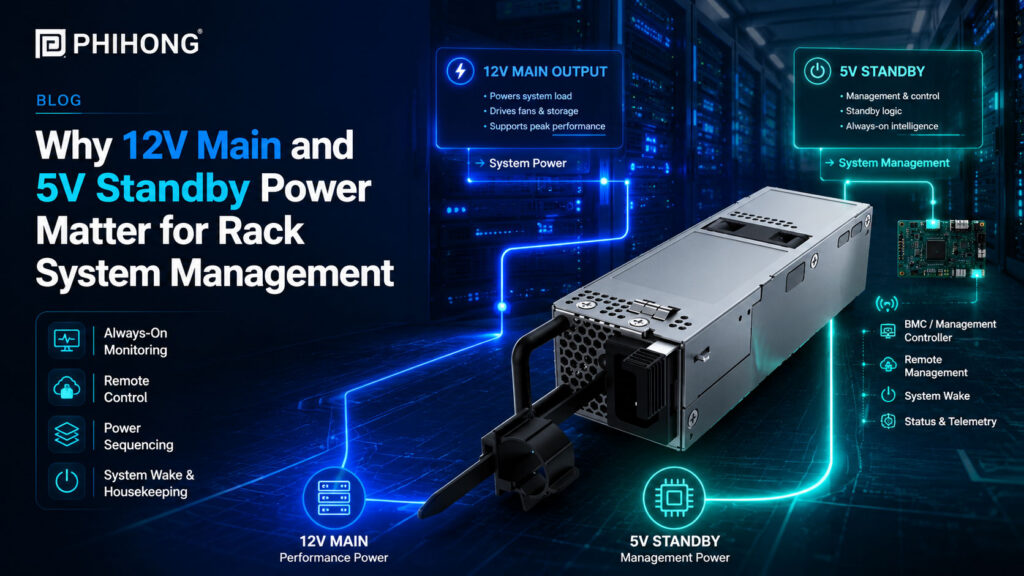
Rack systems often need two different power states: one for the main operating load and one for the management layer that remains available before, during, or after the main system turns on. The 12V main output typically supports the primary system load, while 5V standby power can support lower-power control, monitoring, startup, or management functions. For OEMs, this distinction matters because intelligent rack systems are not always fully off or fully on. They may need to sense, communicate, prepare, or respond before the main rail is enabled.
Phihong’s PA350R-212A-R is a product-specific example of this architecture. It provides 350W of 12Vdc main power and 5Vdc standby power in a front-end rack power supply design. In a rack system, that combination can help support system controllers, management circuits, power sequencing, PMBus-related monitoring and service functions. The goal is not simply to add another output. The goal is to give the rack system a power structure that supports both high-load operation and low-power control behavior.
| Power Output | Role in Rack System Management | What OEM Teams Should Review |
|---|---|---|
| 12V main output | Supports the primary load during normal system operation. | Total load, current demand, downstream conversion, current sharing and redundancy model. |
| 5V standby output | Supports management or control functions before the main rail is active. | Standby load, controller needs, startup logic, monitoring circuits and sequencing. |
| Main plus standby architecture | Allows the system to separate full-load operation from management behavior. | Power states, firmware control, PMBus monitoring and service workflow. |
| Front-end PSU integration | Connects output power with rack control, signals and backplane design. | Connector mapping, PS_ON, PW_OK, status signals and system controller behavior. |
Why This Matters
• 12V main power and 5V standby power support different parts of rack system behavior.
• Standby power can keep management functions available even when the main output is not fully enabled.
What OEMs Should Do Now
• Separate the main system load budget from the standby management load budget during architecture planning.
• Validate startup sequencing, controller behavior, standby load and main-output enable logic before production design.
Useful Links
PA350R-212A-R Product Page: www.phihong.com/products/adapters/pa350r-212a-r/
PA350R-212A-R 350W Front-End Power Supply Datasheet: www.phihong.com/wp-content/uploads/New-datasheet-PA350R-212A-R-09082025.pdf
Open-Frame / Internal PSU Product Line: www.phihong.com/products/open-frame-internal-psu/
Related Links
Best Guide to Intelligent Rack Power Supplies: PMBus, Redundancy, and Digital Front-End Power: www.phihong.com/best-guide-to-intelligent-rack-power-supplies-pmbus-redundancy-and-digital-front-end-power/
What Is PMBus and Why Does It Matter in Front-End Power Supplies?: www.phihong.com/what-is-pmbus-and-why-does-it-matter-in-front-end-power-supplies/
FEATURED PRODUCTS
AM250U-540AP-R
AA240U-200A-R
AA240U-200B-R
AA280U-200B-R
AA240U-59FKEA-R
AA36U-240B-R

How does 5V standby power support startup, monitoring, and controller logic?
5V standby power can support the parts of a rack system that need to remain alive before the main 12V rail is enabled. This may include a management controller, housekeeping logic, signal monitoring, enable circuits, communication interfaces, or standby status functions. In intelligent rack equipment, those functions can be important because the system may need to verify conditions, listen for commands, report status, or prepare startup sequencing before the main power rail turns on.
This is especially useful in systems that use PMBus or other power-management logic. A controller may need standby power so it can monitor PSU presence, read status signals, manage PS_ON behavior, detect alerts, or coordinate redundant power modules. Without a standby rail, the system may have less ability to manage power state transitions. For OEM teams, the 5V standby output should be treated as part of the rack control architecture, not an afterthought.
| Standby Function | Why It Matters | What OEM Teams Should Review |
| Management controller power | Keeps the controller available before the main system turns on. | Standby current, boot timing, controller load and firmware readiness. |
| Startup sequencing | Helps coordinate when the main 12V output should enable. | PS_ON logic, power-good timing, dependencies and safe startup order. |
| Status monitoring | Allows the system to check PSU condition before full operation. | PRESENT, AC_OK, PW_OK, SMB_ALERT and PMBus polling behavior. |
| Service readiness | Supports diagnostics during maintenance or module replacement. | LED behavior, fault logging, standby diagnostics and field procedure. |
Why This Matters
• 5V standby power can support the rack management layer before the main 12V system load is active.
• Standby output affects startup sequencing, monitoring, diagnostics and power-control behavior.
What OEMs Should Do Now
• Define which circuits must remain active on standby power and how much current they require.
• Test standby behavior during startup, shutdown, power interruption, PSU replacement and fault scenarios.
Useful Links
PA350R-212A-R Product Page: www.phihong.com/products/adapters/pa350r-212a-r/
PA350R-212A-R 350W Front-End Power Supply Datasheet: www.phihong.com/wp-content/uploads/New-datasheet-PA350R-212A-R-09082025.pdf
Product Finder: www.phihong.com/product-finder/
Related Links
What Is PMBus and Why Does It Matter in Front-End Power Supplies?: www.phihong.com/what-is-pmbus-and-why-does-it-matter-in-front-end-power-supplies/
The Power Supply Decisions OEMs Regret Most and Why They’re Hard to Fix Later: www.phihong.com/the-power-supply-decisions-oems-regret-most-and-why-theyre-hard-to-fix-later/
Why does 12V main output remain central to rack power architecture?
12V main output remains central because many rack systems use 12V as the primary distribution rail before converting power to lower internal voltages. Processors, communication boards, storage modules, fans, control electronics and other subsystems may rely on downstream DC/DC conversion from a 12V source. In this architecture, the front-end PSU provides the main 12V bus, while the rack system distributes or converts that power where needed.
For the PA350R-212A-R, the 12V main output is the high-power rail, while the 5V standby output supports management functions. OEM teams should review this relationship carefully because the 12V rail carries the main load responsibility. That includes current demand, voltage regulation, load transients, current sharing, redundancy behavior, airflow, cable or backplane losses and PMBus telemetry. A rack system may depend on 12V output for normal operation, but the system controller may depend on 5V standby to manage when and how that 12V rail comes online.
| 12V Main Power Area | Why It Matters in Rack Systems | What OEM Teams Should Review |
| Primary system load | The 12V rail supports the main operating power budget. | Output current, full-load behavior, margin and downstream conversion. |
| Downstream rails | Lower-voltage subsystems may be generated from the 12V bus. | DC/DC converter design, efficiency, sequencing and transient response. |
| Redundant power architecture | Multiple PSUs may share the 12V load in rack systems. | Current sharing, load balance, maximum PSU count and fault behavior. |
| System telemetry | 12V behavior may need to be monitored by the rack controller. | PMBus readings, power-good status, warning thresholds and event logs. |
Why This Matters
• 12V main output is often the central power rail for rack equipment and downstream conversion.
• The 12V rail should be reviewed together with redundancy, current sharing, thermal behavior and monitoring needs.
What OEMs Should Do Now
• Calculate the real 12V load across all boards, fans, modules, converters and operating modes.
• Validate 12V behavior under startup, full load, transient load, redundant operation and fault conditions.
Useful Links
PA350R-212A-R Product Page: www.phihong.com/products/adapters/pa350r-212a-r/
PA350R-212A-R 350W Front-End Power Supply Datasheet: www.phihong.com/wp-content/uploads/New-datasheet-PA350R-212A-R-09082025.pdf
Open-Frame / Internal PSU Product Line: www.phihong.com/products/open-frame-internal-psu/
Related Links
Best Guide to Intelligent Rack Power Supplies: PMBus, Redundancy, and Digital Front-End Power: www.phihong.com/best-guide-to-intelligent-rack-power-supplies-pmbus-redundancy-and-digital-front-end-power/
What Compliance Engineers Look for in Internal PSUs: EMI, EMS, and Safety Basics: www.phihong.com/what-compliance-engineers-look-for-in-internal-psus-emi-ems-and-safety-basics/
CLIENT'S QUOTE
Phihong’s custom OEM power solutions have transformed our product development, boosting performance and reducing overhead. Their expert engineering support has simplified both the design and manufacturing phases.
How do 12V main and 5V standby outputs affect redundancy and serviceability?
12V main and 5V standby outputs affect redundancy because rack systems often need to keep management functions available while the main power architecture changes state. If one front-end PSU is removed, replaced, faulted, or added back into a redundant system, the rack controller may still need standby power to detect the event, log status, manage signals and coordinate power behavior. This makes 5V standby power important for service workflows, not just startup.
The 12V main rail is also central to redundancy because it carries the primary operating load. In a redundant front-end PSU architecture, multiple supplies may share 12V output current so the system can continue operating when one unit is unavailable, depending on the overall system design. OEM teams should validate how standby logic, current sharing, PMBus monitoring, presence detection and power-good behavior interact during service events. A redundant system is only practical if it can handle real removal and replacement scenarios predictably.
| Service / Redundancy Area | Why Main and Standby Power Matter | What OEM Teams Should Review |
|---|---|---|
| PSU replacement | Standby power can help the system detect removal or replacement events. | PRESENT signal, PMBus slot mapping, service process and event logging. |
| Current sharing | 12V main power may be shared across multiple front-end PSUs. | I_Share behavior, load balance, redundancy target and full-load testing. |
| Fault response | Management logic may need standby power to report or respond to faults. | SMB_ALERT, fault registers, LED states, recovery behavior and controller action. |
| System continuity | The rack may need to keep monitoring functions alive during power-state changes. | Standby load, controller availability, remote alerts and service documentation. |
Why This Matters
• 5V standby power can support management and diagnostics during service, replacement and fault events.
• 12V main power and current sharing need validation in real redundant rack configurations.
What OEMs Should Do Now
• Test PSU removal, insertion, fault and recovery behavior with the rack controller powered from standby.
• Validate 12V current sharing and service behavior under realistic load and redundancy conditions.
Useful Links
PA350R-212A-R Product Page: www.phihong.com/products/adapters/pa350r-212a-r/
PA350R-212A-R 350W Front-End Power Supply Datasheet: www.phihong.com/wp-content/uploads/New-datasheet-PA350R-212A-R-09082025.pdf
Open-Frame / Internal PSU Product Line: www.phihong.com/products/open-frame-internal-psu/
Related Links
Best Guide to Intelligent Rack Power Supplies: PMBus, Redundancy, and Digital Front-End Power: www.phihong.com/best-guide-to-intelligent-rack-power-supplies-pmbus-redundancy-and-digital-front-end-power/
What Is PMBus and Why Does It Matter in Front-End Power Supplies?: www.phihong.com/what-is-pmbus-and-why-does-it-matter-in-front-end-power-supplies/
How Phihong supports 12V main and 5V standby rack power design
For OEM teams designing rack systems that depend on both main power and standby management behavior, Phihong’s PA350R-212A-R provides a focused product reference. It is a 350W front-end power supply with 12Vdc main output and 5Vdc standby output, along with PMBus support, AC/DC input capability, active current sharing, redundancy support and system status signals. These features make it relevant for rack equipment where power conversion, monitoring, control and serviceability must work together.
The strongest use case is a rack or modular system that needs a high-power 12V rail for primary operation and a lower-power standby rail for management functions. OEM teams should review the PA350R-212A-R datasheet against the system controller, backplane, startup sequence, PMBus monitoring needs, redundancy plan, airflow path, service procedure and compliance requirements. When those elements align, 12V main and 5V standby power can help create a more manageable rack power architecture.
| Phihong Product Area | Why It Helps OEM Teams | What Teams Should Review |
|---|---|---|
| PA350R-212A-R | Provides a 350W front-end PSU with 12V main and 5V standby outputs. | Output ratings, standby load, PMBus behavior, signals and protections. |
| 12V main output | Supports the primary rack system load and downstream conversion. | Full-load behavior, transient response, current sharing and redundancy. |
| 5V standby output | Supports management, monitoring and startup logic. | Controller load, sequencing, service states and standby diagnostics. |
| Digital rack integration | Connects power delivery with PMBus, status signals and system management. | Firmware behavior, backplane mapping, alerts and validation process. |
Why This Matters
• Product-specific review helps OEM teams connect 12V main and 5V standby outputs to real rack system management needs.
• Main and standby outputs should be validated with the final controller, backplane, firmware and service workflow.
What OEMs Should Do Now
• Start with the PA350R-212A-R datasheet and map 12V main, 5V standby, PMBus and signal behavior to the rack architecture.
• Validate startup, shutdown, full-load operation, standby management, redundancy and service conditions before production.
Useful Links
PA350R-212A-R Product Page: www.phihong.com/products/adapters/pa350r-212a-r/
PA350R-212A-R 350W Front-End Power Supply Datasheet: www.phihong.com/wp-content/uploads/New-datasheet-PA350R-212A-R-09082025.pdf
Open-Frame / Internal PSU Product Line: www.phihong.com/products/open-frame-internal-psu/
Related Links
Best Guide to Intelligent Rack Power Supplies: PMBus, Redundancy, and Digital Front-End Power: www.phihong.com/best-guide-to-intelligent-rack-power-supplies-pmbus-redundancy-and-digital-front-end-power/
What Is PMBus and Why Does It Matter in Front-End Power Supplies?: www.phihong.com/what-is-pmbus-and-why-does-it-matter-in-front-end-power-supplies/
12V main power and 5V standby power solve different rack-system problems. The 12V rail supports the primary operating load, while the 5V standby rail can keep controllers, monitoring circuits and power-management logic available during startup, shutdown, service and fault conditions.
For OEMs building intelligent rack equipment, these outputs should be planned together. The strongest rack power designs connect the front-end PSU, system controller, PMBus behavior, standby load, 12V power budget, redundancy model, airflow path and service workflow before the product enters validation.

CONTACT US TODAY
From concept to production, Phihong delivers custom OEM power solutions tailored to your specifications.
FAQ
What is 12V main power used for in rack systems?
12V main power is commonly used as the primary output rail in rack systems. It can support the main system load directly or feed downstream DC/DC converters that generate lower-voltage rails for processors, fans, communication boards, storage, control electronics and other modules. OEM teams should calculate the total 12V load across all operating modes and validate startup, full-load, transient and redundancy behavior.
What is 5V standby power used for in rack equipment?
5V standby power can support lower-power management functions before the main 12V rail is enabled. This may include a system controller, monitoring circuits, power sequencing logic, PMBus communication, status detection or service diagnostics. In intelligent rack systems, standby power helps the system remain aware of power status and respond to events even when the main output is not fully active.
Why do rack systems need standby power?
Rack systems need standby power when management or control functions must operate independently of the main load. For example, a controller may need to detect PSU presence, monitor alerts, receive commands, log faults, or enable the main 12V output. Without standby power, the system may have less ability to manage startup, shutdown, remote monitoring or service events.
How do 12V main and 5V standby outputs work with PMBus?
PMBus can help the system controller monitor PSU status, warnings, telemetry and faults. The 5V standby output may power the controller or related logic that uses PMBus, while the 12V main output supports the primary system load. Together, they can help the rack system manage startup sequencing, fault reporting, redundancy and service diagnostics more intelligently.
What should OEMs validate before using 12V main and 5V standby outputs?
OEMs should validate standby load, controller startup, PS_ON behavior, power-good timing, 12V load demand, current sharing, redundancy behavior, PMBus communication, fault response and service events. Testing should include startup, shutdown, full-load operation, PSU removal, PSU replacement and abnormal conditions. The outputs should be validated with the final controller, backplane and firmware design.
POE technology supports the centralization of power

AC Adapter Guide: Everything You Need to Know
Moreover, PoE technology supports the centralization of power management. By powering devices through a PoE-enabled network …
AC DC Power Chargers and How They Work: A Comprehensive Technical Breakdown
Moreover, PoE technology supports the centralization of power management. By powering devices through a PoE-enabled network …

USB-C Charger: Shaping the Future of the Tech World
Moreover, PoE technology supports the centralization of power management. By powering devices through a PoE-enabled network …

AC Adapter Guide: Everything You Need to Know
Moreover, PoE technology supports the centralization of power management. By powering devices through a PoE-enabled network …

AC DC Power Chargers and How They Work: A Comprehensive Technical Breakdown
Moreover, PoE technology supports the centralization of power management. By powering devices through a PoE-enabled network …

USB-C Charger: Shaping the Future of the Tech World
Moreover, PoE technology supports the centralization of power management. By powering devices through a PoE-enabled network …