










BLOG
Best Guide to 24V Power Adapters for Smart Home, Telecom, Networking, Audio, and Office Equipment
QUICK LINKS
Why are 24V power adapters so common in commercial electronic equipment?
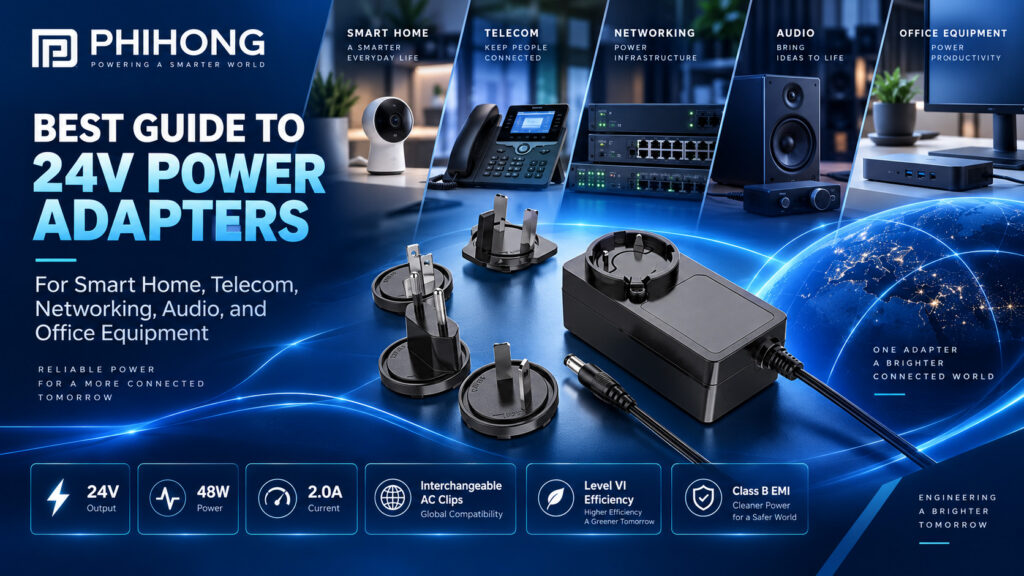
24V power adapters occupy an important middle ground in commercial electronics. They provide substantially more voltage than traditional 5V or 12V supplies while remaining practical for external AC/DC adapter designs used with networking equipment, smart home systems, audio products, office equipment, peripheral devices and other electronics. For OEM teams, 24V can provide a useful balance between available power, cable current, connector design and system architecture.
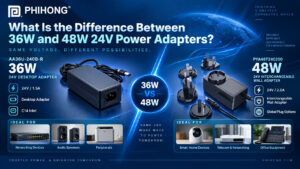
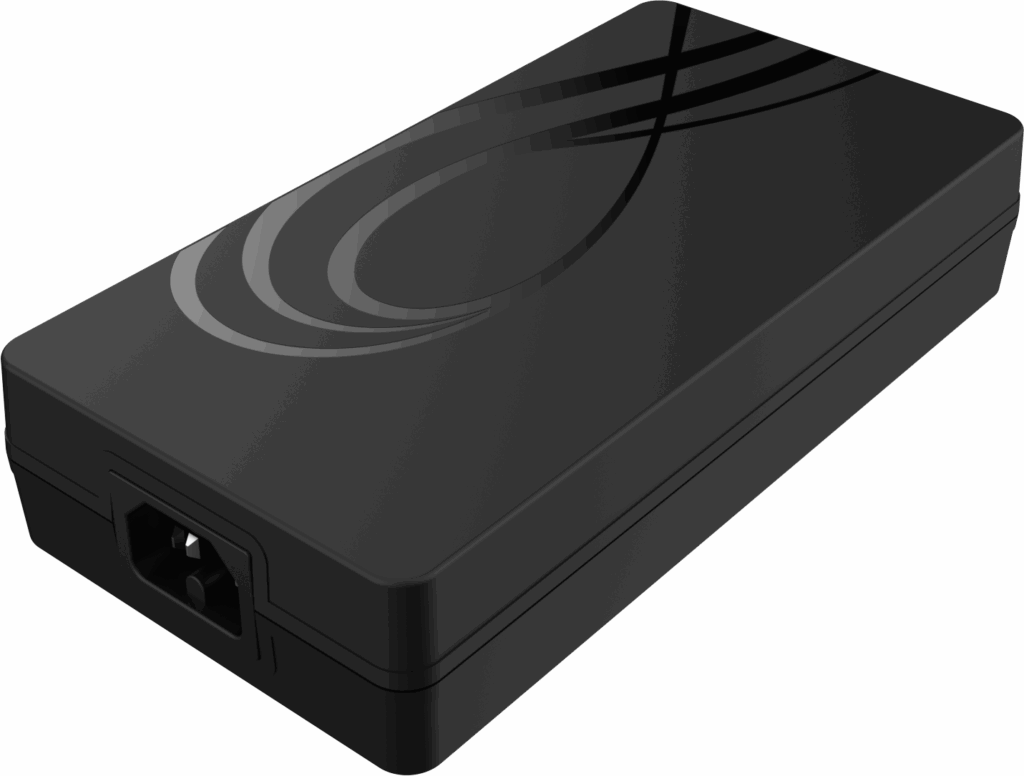
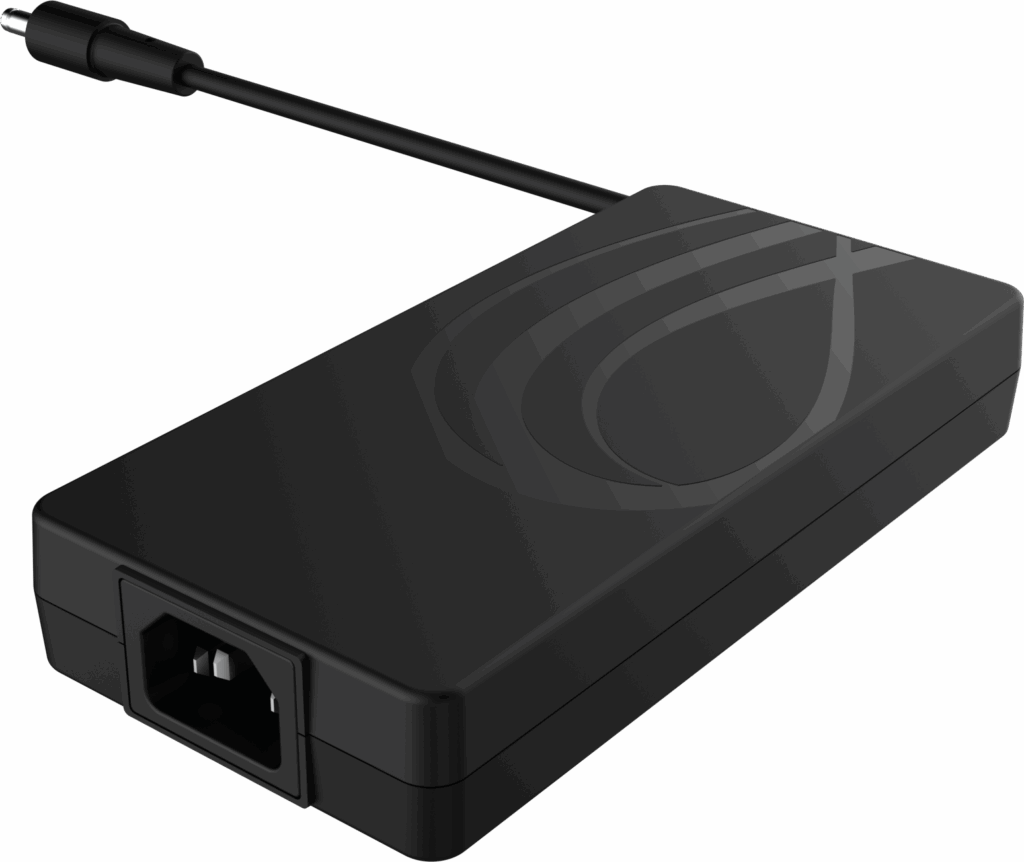
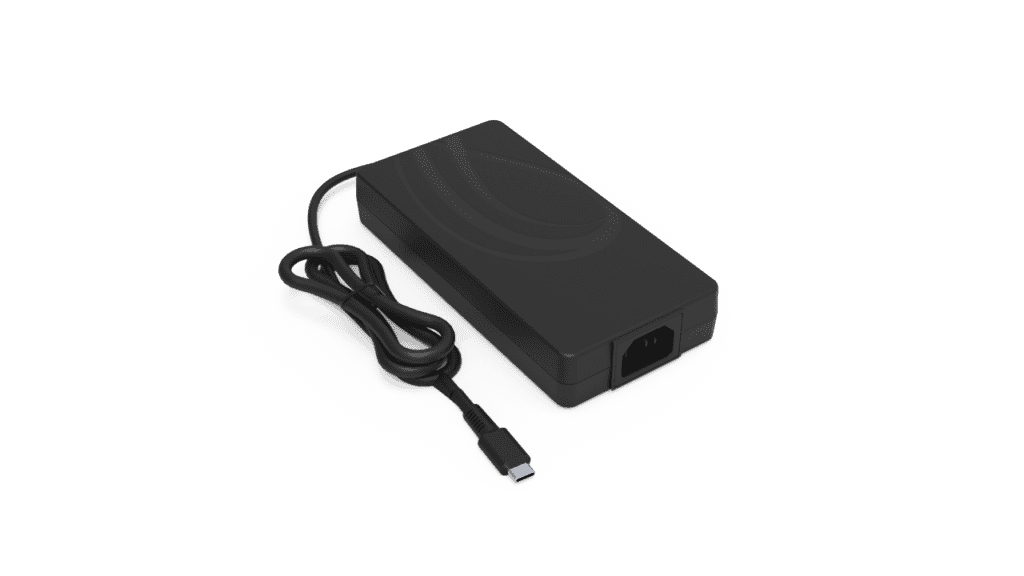
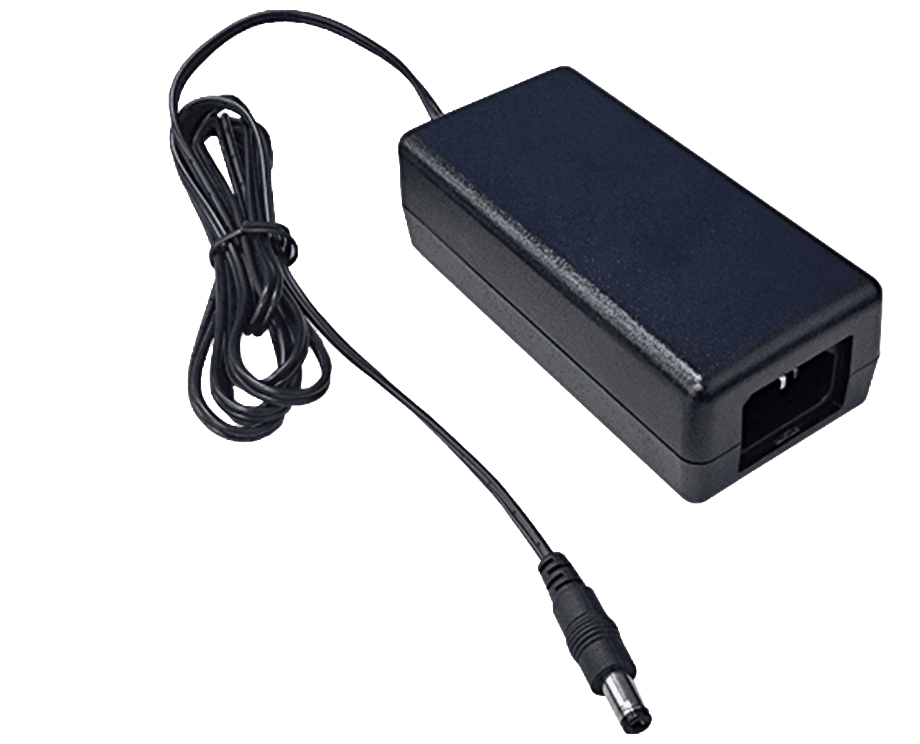
The important point is that not all 24V adapters are interchangeable. A product may need 24V, but it also has a specific current requirement, connector, polarity, input format, efficiency target, operating temperature range, EMI requirement and mechanical installation environment. Phihong’s AA36U-240B-R and PYA48T240200 illustrate two different approaches: a 36W desktop adapter with a C14 inlet and a 48W wall-mount adapter with interchangeable AC plugs.
| 24V Adapter Consideration | Why It Matters | What OEM Teams Should Review |
|---|---|---|
| Output voltage | Device electronics are designed around a specific input voltage. | Confirm 24V input tolerance, regulation and polarity. |
| Output current | Determines how much load the adapter can support. | Continuous current, startup demand and system margin. |
| Adapter format | Wall-mount and desktop formats affect installation and handling. | Outlet location, cord routing, international deployment and packaging. |
| Connector | Barrel dimensions and polarity must match the device. | Connector size, retention, cable length and field replacement. |
Why This Matters
• “24V adapter” describes only one part of the power requirement. Current, connector, format and compliance matter just as much.
• Commercial equipment often operates for long periods, making efficiency, thermal behavior and reliability important selection criteria.
What OEMs Should Do Now
• Document the device’s 24V input tolerance, current demand, connector and operating environment before selecting an adapter.
• Compare wall-mount and desktop formats based on the actual installation rather than choosing only by wattage.
Useful Links
Power Adapter Product Line: www.phihong.com/products/adapters/
Product Finder: www.phihong.com/product-finder/
Contact Phihong: www.phihong.com/contact
FEATURED PRODUCTS
AM250U-540AP-R
AA240U-200A-R
AA240U-200B-R
AA280U-200B-R
AA240U-59FKEA-R
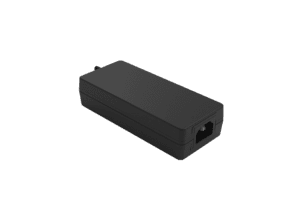
AA36U-240B-R

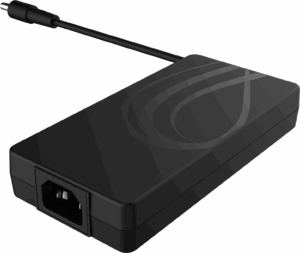
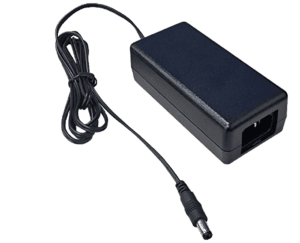
What devices typically use 24V AC/DC power adapters?
24V power adapters are used across a broad range of electronics because many systems need more power than a small USB or 12V supply can conveniently provide but do not require a large internal power supply. Phihong specifically identifies smart home devices, telecommunications equipment, office equipment and audio devices for the PYA48T240200. The AA36U series is positioned for portable devices, peripheral devices, networking devices and audio speakers.
That overlap is useful for OEM teams because it shows that the same 24V nominal voltage can support very different products. A networking device may emphasize EMI, uptime and cable placement. An audio product may care about noise and regulation. A smart home device may need compact wall mounting and international deployment. Office equipment may prioritize simple installation and replacement. The electrical requirement starts at 24V, but product selection still depends on how the equipment operates.
| Device Category | Why 24V May Fit | Key Selection Questions |
|---|---|---|
| Smart home equipment | Supports more capable hubs, controllers and connected hardware. | Wall-mount or desktop? Global plugs? Always-on efficiency? |
| Telecom equipment | Useful for communications and peripheral power architectures. | Load stability, EMI, surge environment and uptime. |
| Networking devices | Can support routers, gateways and related equipment. | Continuous load, connector, cable length and EMI. |
| Audio equipment | Common external power format for powered audio electronics. | Regulation, noise, connector polarity and thermal behavior. |
| Office equipment | External adapter keeps AC/DC conversion outside the device enclosure. | Installation, service replacement and regional deployment. |
Why This Matters
• Application category alone does not determine the correct adapter. Two 24V devices may require very different current and mechanical configurations.
• OEM teams should define the full load profile before assuming that any 24V adapter will work.
What OEMs Should Do Now
• Identify the equipment’s normal, maximum and startup current requirements.
• Review EMI, thermal, connector and installation requirements separately from nominal voltage.
Useful Links
PYA48T240200 Product Page: www.phihong.com/products/adapters/pya48t240200/
Power Adapter Product Line: www.phihong.com/products/adapters/
Contact Phihong: www.phihong.com/contact
Related Links
What Compliance Engineers Look for in Internal PSUs: EMI, EMS, and Safety Basics: www.phihong.com/what-compliance-engineers-look-for-in-internal-psus-emi-ems-and-safety-basics/
The Power Supply Decisions OEMs Regret Most and Why They’re Hard to Fix Later: www.phihong.com/the-power-supply-decisions-oems-regret-most-and-why-theyre-hard-to-fix-later/
How much wattage does a 24V device actually need?
The wattage requirement of a 24V device depends on the amount of current it draws. This is why OEM teams should avoid selecting an adapter from voltage alone. A 24V product drawing 1A needs far less power than a 24V product drawing 2A, even though both are described as “24V devices.” The adapter must be able to support the required current under real operating conditions without relying on the protection threshold as usable design margin.
Phihong’s two example products make this distinction easy to see. The AA36U-240B-R is rated at 24V, 1.5A and 36W. The PYA48T240200 is rated at 24V, 2.0A and 48W. The PYA48T datasheet also specifies ±5% load regulation and an output range of 22.8V to 25.2V under its listed conditions.
| Example | Output | Rated Current | Rated Power |
|---|---|---|---|
| AA36U-240B-R | 24VDC | 1.5A | 36W |
| PYA48T240200 | 24VDC | 2.0A | 48W |
OEM engineers should also leave appropriate design margin. If a device normally consumes 30W but periodically approaches its adapter limit during startup or full system activity, the team should evaluate the actual load waveform rather than assuming average consumption tells the full story. Protection features such as over-current protection are safeguards, not additional usable continuous output.
Why This Matters
• 24V alone does not define adapter capacity. Current determines how much power the system can draw.
• Selecting an adapter too close to the device’s maximum demand can reduce operating margin and create unnecessary thermal or stability concerns.
What OEMs Should Do Now
• Measure the device under startup, idle, normal operation and maximum expected load.
• Select the adapter from the actual current and power requirement rather than the product’s average consumption alone.
Useful Links
AA36U Series Datasheet: www.phihong.com/wp-content/uploads/AA36U.pdf
PYA48T240200 Datasheet: www.phihong.com/wp-content/uploads/New-datasheet-PYA48T240200-_08262025.pdf
Product Finder: www.phihong.com/product-finder/
Related Links
How to Validate Thermal Performance of Open-Frame Power Supplies in Real Enclosures: www.phihong.com/how-to-validate-thermal-performance-of-open-frame-power-supplies-in-real-enclosures/
Custom Power Supplies: How to Reduce OEM Time-to-Market With Custom Power Supply Manufacturing: www.phihong.com/custom-power-supplies-how-to-reduce-oem-timetomarket-with-custom-power-supply-manufacturing/
CLIENT'S QUOTE
Phihong’s custom OEM power solutions have transformed our product development, boosting performance and reducing overhead. Their expert engineering support has simplified both the design and manufacturing phases.
Wall-Mount vs Desktop 24V Adapters: Which Format Fits the Device Better?
Wall-mount and desktop adapters can both deliver 24V, but they solve different mechanical and deployment problems. A wall-mount adapter plugs directly into the AC outlet, reducing the number of separate cords. A desktop adapter uses an AC input cord and can be placed on a desk, shelf, equipment rack, cabinet, or other surface away from the wall.
Phihong’s two example products illustrate this difference clearly. The PYA48T240200 is a 48W wall-mount adapter with interchangeable AC plugs, while the AA36U-240B-R is a 36W desktop adapter with a C14 inlet. Neither format is universally better. The correct choice depends on installation, cable routing, regional deployment, packaging, serviceability, and how the end user interacts with the equipment.
| Format | Typical Advantage | What OEM Teams Should Review |
|---|---|---|
| Wall-mount | Fewer separate AC cords and compact installation | Outlet clearance, plug type, wall loading and regional plug strategy |
| Desktop | Flexible placement away from the outlet | AC cord length, cable routing, desk placement and service access |
| Interchangeable plug | Supports regional deployment from a shared adapter platform | Plug module retention, country kits, packaging and documentation |
| C14 desktop input | Supports standard detachable AC cord sets | Regional cord sets, cable management and field replacement |
Why This Matters
- Adapter format affects installation, customer handling, packaging and global deployment.
- Two adapters with the same nominal voltage can create very different product experiences.
What OEMs Should Do Now
- Decide where the adapter will physically sit during normal use.
- Include outlet location, cable routing, regional deployment and service replacement in the adapter selection process.
Useful Links
PYA48T240200 Product Page: www.phihong.com/products/adapters/pya48t240200/
Power Adapter Product Line: www.phihong.com/products/adapters/
Contact Phihong: www.phihong.com/contact
Related Links
Wall-Mount vs Desktop 65W USB-C Adapters: Which Format Fits Laptops, Monitors, and Docking Stations?: www.phihong.com/wall-mount-vs-desktop-65w-usb-c-adapters-which-format-fits-laptops-monitors-and-docking-stations/
The Power Supply Decisions OEMs Regret Most and Why They’re Hard to Fix Later: www.phihong.com/the-power-supply-decisions-oems-regret-most-and-why-theyre-hard-to-fix-later/
What Should Engineers Check in a 24V Adapter Connector and Cable?
The connector is one of the easiest parts of a 24V adapter specification to underestimate. A device may require exactly 24V and the correct wattage, but the system can still fail if the barrel connector dimensions, polarity, cable length, or mating fit do not match the device.
The PYA48T240200 uses a barrel-connector output, which makes connector verification part of the integration process. OEM engineers should confirm connector dimensions, center polarity, retention force, cable length, and mechanical durability against the final product. Cable resistance also matters because longer or undersized cables can increase voltage drop under load.
| Connector or Cable Area | Why It Matters | What OEM Teams Should Review |
|---|---|---|
| Barrel dimensions | Determines whether the plug mates correctly | Outer diameter, inner diameter and insertion depth |
| Polarity | Incorrect polarity can damage equipment | Center-positive or center-negative requirement |
| Cable length | Longer cables can increase voltage drop | Current draw, conductor size and installation distance |
| Strain relief | Repeated bending can weaken cable entry points | Flexing, pulling and field-use conditions |
| Connector retention | Loose connections can cause intermittent operation | Mating force, vibration and repeated connection cycles |
Why This Matters
- Voltage and wattage compatibility do not guarantee mechanical connector compatibility.
- Cable design affects voltage delivery, reliability and user experience.
What OEMs Should Do Now
- Lock connector dimensions and polarity into the product specification before production.
- Test the final cable length and connector under maximum expected load.
Useful Links
PYA48T240200 Datasheet: www.phihong.com/wp-content/uploads/New-datasheet-PYA48T240200-_08262025.pdf
Power Adapter Product Line: www.phihong.com/products/adapters/
Contact Phihong: www.phihong.com/contact
Related Links
What Compliance Engineers Look for in Internal PSUs: EMI, EMS, and Safety Basics: www.phihong.com/what-compliance-engineers-look-for-in-internal-psus-emi-ems-and-safety-basics/
Custom Power Supplies: How to Reduce OEM Time-to-Market With Custom Power Supply Manufacturing: www.phihong.com/custom-power-supplies-how-to-reduce-oem-timetomarket-with-custom-power-supply-manufacturing/
Why Do Efficiency, Thermal Behavior and Protection Features Matter in 24V Commercial Power?
Commercial equipment may operate for hours at a time or remain powered continuously. That makes efficiency and thermal behavior important even at moderate power levels such as 36W or 48W. Conversion losses become heat, and that heat must be managed inside the adapter without creating excessive component or surface temperatures.
Protection features are equally important. A commercial power adapter should respond predictably to abnormal conditions such as excessive current, short circuits, or output overvoltage. OEM teams should review the protection behavior documented for the specific adapter rather than assuming all 24V supplies respond the same way.
| Design Area | Why It Matters | What OEM Teams Should Review |
|---|---|---|
| Efficiency | Lower losses reduce heat during operation | Efficiency data across expected load conditions |
| Thermal behavior | Heat affects adapter placement and reliability margin | Ambient temperature, ventilation and surface temperature |
| Over-current protection | Protects against excessive load conditions | Trip point, behavior and recovery |
| Short-circuit protection | Helps protect the adapter and system during faults | Recovery behavior and production validation |
| Output regulation | Helps keep the device within its input range | Line regulation, load regulation and transient response |
Why This Matters
- Commercial equipment can operate for long periods, so efficiency and thermal margin can matter throughout the product lifecycle.
- Protection functions should be understood as safeguards, not as additional usable output capacity.
What OEMs Should Do Now
- Review efficiency, protection and thermal data with the final product load profile.
- Test abnormal conditions and recovery behavior during system validation.
Useful Links
AA36U Series Datasheet: www.phihong.com/wp-content/uploads/AA36U.pdf
PYA48T240200 Datasheet: www.phihong.com/wp-content/uploads/New-datasheet-PYA48T240200-_08262025.pdf
Contact Phihong: www.phihong.com/contact
Related Links
How to Validate Thermal Performance of Open-Frame Power Supplies in Real Enclosures: www.phihong.com/how-to-validate-thermal-performance-of-open-frame-power-supplies-in-real-enclosures/
What Compliance Engineers Look for in Internal PSUs: EMI, EMS, and Safety Basics: www.phihong.com/what-compliance-engineers-look-for-in-internal-psus-emi-ems-and-safety-basics/
How Should OEMs Choose a 24V Adapter for Global and Commercial Deployment?
Selecting a 24V adapter for commercial equipment involves more than matching voltage and wattage. OEM teams also need to consider where the product will be sold, how the adapter connects to AC power, whether regional plug variations are required and how the power supply will be serviced or replaced after deployment.
The PYA48T240200 and AA36U-240B-R illustrate two different deployment strategies. The PYA48T240200 uses an interchangeable wall-mount format, which can help support products intended for multiple regional markets. The AA36U-240B-R uses a desktop format with a C14 AC inlet, allowing regional AC cord sets to be selected separately from the adapter itself. Both approaches can support international programs, but they create different packaging, inventory and support requirements.
| Global Deployment Area | Why It Matters | What OEM Teams Should Review |
|---|---|---|
| AC input format | Determines how the adapter connects to regional mains power | Interchangeable plugs, detachable cords and target countries |
| Regional packaging | Different markets may need different power accessories | Plug kits, cord sets, labels and instructions |
| Compliance documentation | Commercial products may require market-specific records | Safety, EMC, efficiency and regional requirements |
| Service replacement | Power accessories may need replacement during the product lifecycle | Spare adapter strategy, cord availability and part-number control |
| Product inventory | Adapter format affects how many regional SKUs must be stocked | Forecasting, fulfillment and global product planning |
Why This Matters
- Global deployment can turn a simple adapter choice into a sourcing, inventory and support decision.
- The AC input strategy should be planned alongside the 24V output requirement.
What OEMs Should Do Now
- Identify target countries and required plug or cord configurations early in product development.
- Review adapter selection with engineering, compliance, sourcing, packaging and support teams before production.
Useful Links
PYA48T240200 Datasheet: www.phihong.com/wp-content/uploads/New-datasheet-PYA48T240200-_08262025.pdf
Power Adapter Product Line: www.phihong.com/products/adapters/
Product Finder: www.phihong.com/product-finder/
Contact Phihong: www.phihong.com/contact
Related Links
Fixed-Blade vs Interchangeable 65W USB-C Adapters: Which Format Works Better for Global Product Deployment?: www.phihong.com/fixed-blade-vs-interchangeable-65w-usb-c-adapters-which-format-works-better-for-global-product-deployment/
The Power Supply Decisions OEMs Regret Most and Why They’re Hard to Fix Later: www.phihong.com/the-power-supply-decisions-oems-regret-most-and-why-theyre-hard-to-fix-later/
How Phihong Supports 24V Power Adapter Selection for Commercial Equipment
Phihong’s 24V adapter portfolio gives OEM teams different ways to power smart home, telecom, networking, audio, office and peripheral equipment. The AA36U-240B-R provides a 24V, 1.5A, 36W desktop option with a C14 inlet, while the PYA48T240200 provides a 24V, 2A, 48W wall-mount option with interchangeable AC plugs.
These products also demonstrate why 24V adapter selection should begin with the application rather than the voltage alone. OEM engineers need to consider continuous current, startup demand, connector requirements, cable length, wall-mount versus desktop placement, regional deployment, efficiency, thermal behavior and protection features. A 24V adapter that works electrically may still be the wrong mechanical or deployment format for the final device.
| Phihong Option | Key Format | Output | Potential OEM Direction |
|---|---|---|---|
| AA36U-240B-R | Desktop, C14 AC inlet | 24V, 1.5A, 36W | Networking, audio, peripheral and commercial equipment |
| PYA48T240200 | Wall-mount, interchangeable AC plugs | 24V, 2A, 48W | Smart home, telecom, office and audio equipment |
| 24V adapter portfolio | Multiple external adapter formats | Application dependent | OEMs comparing power, mechanical and regional requirements |
| Custom power support | Application-specific engineering discussion | Application dependent | Products needing requirements beyond standard adapter options |
Why This Matters
- Phihong provides multiple 24V adapter formats instead of forcing every commercial device into one mechanical design.
- OEM teams can compare power, connector, deployment and installation requirements together before selecting a platform.
What OEMs Should Do Now
- Build the adapter specification around the actual device load, connector, installation environment and target markets.
- Contact Phihong when the project requires help evaluating standard 24V adapters or application-specific power requirements.
Useful Links
Power Adapter Product Line: www.phihong.com/products/adapters/
PYA48T240200 Product Page: www.phihong.com/products/adapters/pya48t240200/
Custom Power Supplies: www.phihong.com/custom-power-supplies-how-to-reduce-oem-timetomarket-with-custom-power-supply-manufacturing/
Contact Phihong: www.phihong.com/contact
Related Links
Custom Power Supplies: How to Reduce OEM Time-to-Market With Custom Power Supply Manufacturing: www.phihong.com/custom-power-supplies-how-to-reduce-oem-timetomarket-with-custom-power-supply-manufacturing/
What Compliance Engineers Look for in Internal PSUs: EMI, EMS, and Safety Basics: www.phihong.com/what-compliance-engineers-look-for-in-internal-psus-emi-ems-and-safety-basics/
A 24V power adapter may look like a simple component, but the selection process connects electrical, mechanical, thermal, compliance and deployment decisions. Smart home equipment, telecom systems, networking devices, audio electronics and office products may all use 24V power, yet their current requirements, connector needs and installation environments can be very different.
For OEM teams, the most useful approach is to start with the complete system. Define the required voltage, maximum current, startup behavior, connector, cable length, adapter location, operating environment and target markets before choosing the adapter. If your team is evaluating 24V power for commercial equipment, contact Phihong to discuss the electrical and mechanical requirements of your application.

CONTACT US TODAY
From concept to production, Phihong delivers custom OEM power solutions tailored to your specifications.
FAQ
What devices commonly use 24V power adapters?
24V adapters are used across many commercial and electronic products, including smart home devices, telecommunications equipment, networking hardware, audio products, office equipment and peripheral devices. The correct adapter depends on more than voltage. OEM teams should also confirm current demand, wattage, connector type, polarity, cable requirements and operating environment before selecting a 24V supply.
Is every 24V power adapter compatible with every 24V device?
No. Matching the 24V output is only the first requirement. The adapter also needs sufficient current capacity, the correct connector dimensions and polarity, appropriate regulation and a suitable mechanical format. A 24V, 1.5A adapter and a 24V, 2A adapter are both 24V supplies but support different maximum power levels.
What is the difference between a 36W and 48W 24V adapter?
At 24V, the difference comes from available current. Phihong’s AA36U-240B-R provides 24V at 1.5A for 36W, while the PYA48T240200 provides 24V at 2A for 48W. OEM teams should choose based on the device’s measured continuous and peak operating demand rather than automatically selecting the higher wattage.
Is a wall-mount or desktop 24V adapter better?
Neither format is universally better. Wall-mount adapters can simplify installation by plugging directly into the outlet, while desktop adapters provide more flexible placement using a separate AC cord. Wall-mount designs can work well for compact equipment, while desktop adapters may be easier to route around networking, audio or office equipment.
Why does connector polarity matter in a 24V adapter?
Barrel connectors can use different electrical polarities. Connecting an adapter with incorrect polarity may prevent the device from operating and may damage equipment that lacks adequate reverse-polarity protection. OEM engineers should specify connector dimensions and polarity explicitly and confirm them with production-intent hardware.
How much extra wattage should an OEM allow when selecting a 24V adapter?
There is no single margin that applies to every device. Engineers should measure continuous load, startup current, transient events and maximum expected operating conditions. The adapter should support the real device requirement without depending on overload protection or protection thresholds as usable continuous capacity.
What should OEMs validate before approving a 24V adapter for production?
OEM teams should verify output voltage, current capacity, regulation, connector size, polarity, cable length, voltage drop, thermal behavior, efficiency, protection response, mechanical placement and regional deployment requirements. Testing should use production-intent hardware and representative operating conditions whenever possible.
Can the same 24V adapter platform support products in multiple countries?
Potentially, depending on the AC input format and regional requirements. An interchangeable wall-mount design can use different regional plug modules, while a desktop adapter with a detachable AC inlet can use country-specific cord sets. OEMs still need to review applicable safety, EMC, efficiency, labeling and documentation requirements for each market.
POE technology supports the centralization of power

AC Adapter Guide: Everything You Need to Know
Moreover, PoE technology supports the centralization of power management. By powering devices through a PoE-enabled network …
AC DC Power Chargers and How They Work: A Comprehensive Technical Breakdown
Moreover, PoE technology supports the centralization of power management. By powering devices through a PoE-enabled network …

USB-C Charger: Shaping the Future of the Tech World
Moreover, PoE technology supports the centralization of power management. By powering devices through a PoE-enabled network …

AC Adapter Guide: Everything You Need to Know
Moreover, PoE technology supports the centralization of power management. By powering devices through a PoE-enabled network …

AC DC Power Chargers and How They Work: A Comprehensive Technical Breakdown
Moreover, PoE technology supports the centralization of power management. By powering devices through a PoE-enabled network …

USB-C Charger: Shaping the Future of the Tech World
Moreover, PoE technology supports the centralization of power management. By powering devices through a PoE-enabled network …