












BLOG
What Is the Difference Between 36W and 48W 24V Power Adapters?
QUICK LINKS
What Is the Main Difference Between a 36W and 48W 24V Power Adapter?
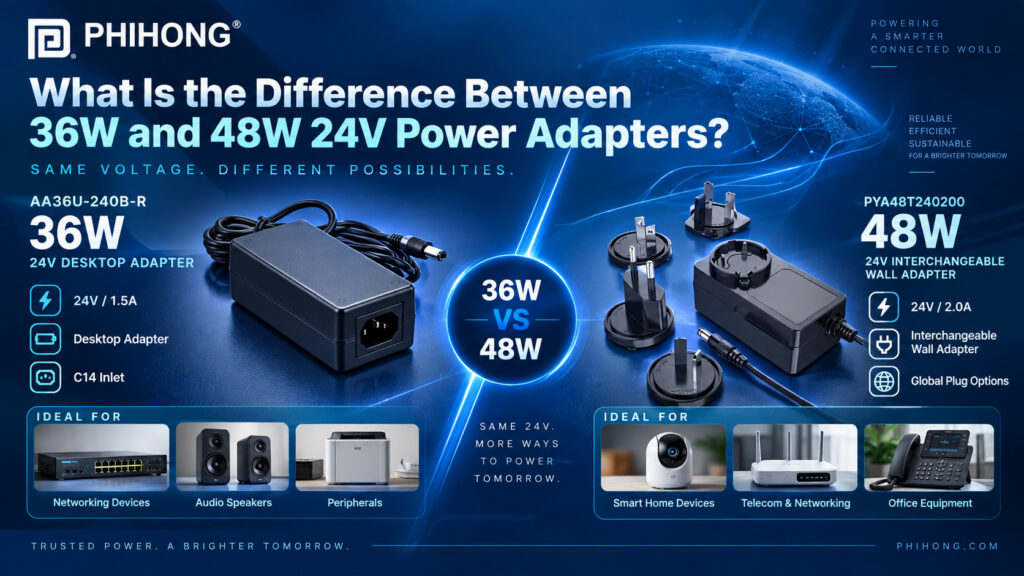
The main difference is available output current. Both adapters can supply 24VDC, but a 36W adapter rated at 1.5A can deliver less total power than a 48W adapter rated at 2.0A. That difference matters when an OEM device has higher continuous current demand, startup loads, connected peripherals, or less room for power margin.
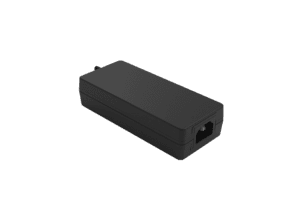
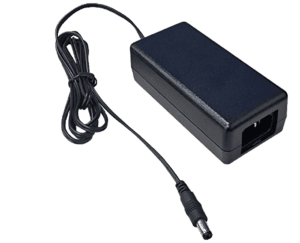
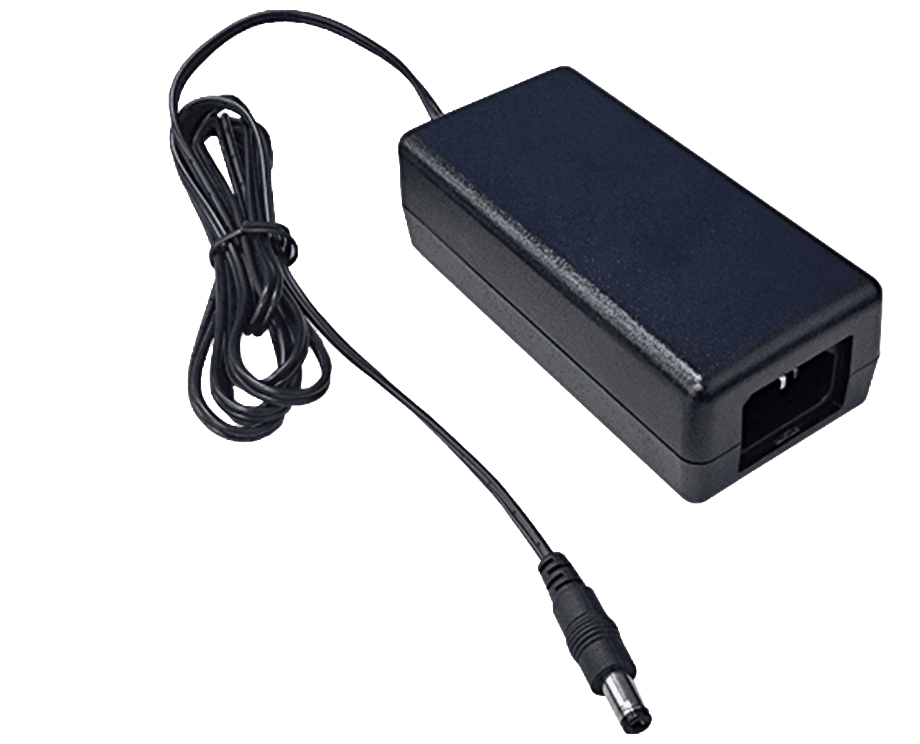
Phihong’s AA36U-240B-R provides 24V at 1.5A for 36W in a desktop C14 format. The PYA48T240200 provides 24V at 2.0A for 48W in an interchangeable wall-mount format. So the choice is not simply “36W versus 48W.” It also involves desktop versus wall-mount installation, detachable AC cord versus interchangeable plugs, device current requirements and regional deployment strategy.
| Comparison | AA36U-240B-R | PYA48T240200 |
|---|---|---|
| Output Voltage | 24VDC | 24VDC |
| Maximum Current | 1.5A | 2.0A |
| Rated Power | 36W | 48W |
| AC Format | Desktop with C14 inlet | Wall-mount with interchangeable AC plugs |
| DC Output | Barrel connector | Barrel connector |
| Primary Selection Question | Does the product fit within a 1.5A load and benefit from desktop placement? | Does the product need up to 2A and benefit from interchangeable wall power? |
Why This Matters
- Two adapters can both be labeled 24V while having significantly different current and power capabilities.
- The mechanical format may matter just as much as the additional 12W of available output.
What OEMs Should Do Now
- Measure the device’s maximum continuous current and startup behavior before selecting the adapter.
- Decide whether a desktop C14 architecture or direct wall-mount architecture better matches the finished product.
Useful Links
AA36U Series Datasheet: www.phihong.com/wp-content/uploads/AA36U.pdf
PYA48T240200 Product Page: www.phihong.com/products/adapters/pya48t240200/
PYA48T240200 Datasheet: www.phihong.com/wp-content/uploads/New-datasheet-PYA48T240200-_08262025.pdf
Power Adapter Product Line: www.phihong.com/products/adapters/
Related Links
The Power Supply Decisions OEMs Regret Most and Why They’re Hard to Fix Later: www.phihong.com/the-power-supply-decisions-oems-regret-most-and-why-theyre-hard-to-fix-later/
Custom Power Supplies: How to Reduce OEM Time-to-Market With Custom Power Supply Manufacturing: www.phihong.com/custom-power-supplies-how-to-reduce-oem-timetomarket-with-custom-power-supply-manufacturing/
FEATURED PRODUCTS
AM250U-540AP-R
AA240U-200A-R
AA240U-200B-R
AA280U-200B-R
AA240U-59FKEA-R
AA36U-240B-R

How Much More Power Does a 48W 24V Adapter Provide Than a 36W Adapter?
At the same 24V output, moving from 36W to 48W increases rated current from 1.5A to 2.0A. That is an additional 0.5A, or about 33% more rated output power and current capacity. For an OEM device, that additional capacity can matter when the normal load approaches the limit of a 36W supply or when the product needs additional operating margin.
More wattage should not automatically be interpreted as better. If a device is engineered to remain comfortably within the 36W adapter’s rated output, a larger 48W supply may not provide a meaningful advantage. Conversely, a system requiring close to or above 1.5A at 24V should not be forced onto a 36W platform simply because the voltage matches. Adapter sizing should follow the measured load profile, including normal operation, maximum system activity and startup behavior. Phihong specifies the AA36U-240B-R at 1.5A maximum and the PYA48T240200 at 2.0A maximum.
| 24V Load | Approximate Power | 36W / 1.5A Adapter | 48W / 2.0A Adapter |
|---|---|---|---|
| 0.75A | 18W | Within rated capacity | Within rated capacity |
| 1.0A | 24W | Within rated capacity | Within rated capacity |
| 1.25A | 30W | Within rated capacity | Within rated capacity |
| 1.5A | 36W | At rated maximum | Below rated maximum |
| 2.0A | 48W | Above rated capacity | At rated maximum |
The table is useful for understanding the basic electrical difference, but real adapter selection still requires more than dividing watts by volts. Startup demand, transient behavior, ambient temperature, cable voltage drop and the manufacturer’s operating specifications should also be reviewed.
Why This Matters
- The 48W adapter provides 0.5A more rated current at the same 24V output.
- OEM teams should size an adapter from actual current requirements rather than choosing a higher wattage simply because more power is available.
What OEMs Should Do Now
- Measure current during startup, normal operation and maximum system activity.
- Avoid designing the product around protection thresholds or assuming that the adapter can operate continuously above its rated output.
Useful Links
AA36U Series Datasheet: www.phihong.com/wp-content/uploads/AA36U.pdf
PYA48T240200 Datasheet: www.phihong.com/wp-content/uploads/New-datasheet-PYA48T240200-_08262025.pdf
Product Finder: www.phihong.com/product-finder/
Related Links
How to Validate Thermal Performance of Open-Frame Power Supplies in Real Enclosures: www.phihong.com/how-to-validate-thermal-performance-of-open-frame-power-supplies-in-real-enclosures/
What Compliance Engineers Look for in Internal PSUs: EMI, EMS, and Safety Basics: www.phihong.com/what-compliance-engineers-look-for-in-internal-psus-emi-ems-and-safety-basics/
C14 Desktop vs Interchangeable Wall-Mount: Which 24V Adapter Format Fits the Product?
The physical format may be the most important difference after current capacity. A C14 desktop adapter separates the AC wall connection from the power supply body by using a detachable AC cord. An interchangeable wall-mount adapter connects the power supply directly to the outlet and changes regional plug types through removable AC clips. Each approach solves a different integration problem.
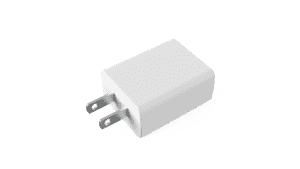
The AA36U-240B-R uses an IEC C14 inlet. Phihong’s AA36U documentation lists separate C13 cord options for North America, continental Europe and the United Kingdom. That can make the desktop architecture useful when OEMs want the power brick positioned away from the outlet while changing the detachable line cord for different regions. The PYA48T240200 instead uses interchangeable AC plug clips, allowing the adapter body itself to connect directly to regional outlets. Phihong describes the interchangeable design as suitable for global use, with the plug clips sold separately.
| Deployment Question | C14 Desktop: AA36U-240B-R | Interchangeable Wall-Mount: PYA48T240200 |
|---|---|---|
| Where does the adapter sit? | Desk, shelf, floor, cabinet, or near equipment | Directly at the AC outlet |
| How is regional AC handled? | Different C13 line cords | Different interchangeable AC clips |
| Extra AC cord required? | Yes | No separate line cord |
| Maximum rated output | 36W / 1.5A | 48W / 2.0A |
| Cable-management consideration | AC cord plus DC output cable | Primarily DC output cable |
| Good selection question | Does flexible adapter placement matter? | Does direct wall mounting and plug flexibility matter? |
Neither format is inherently better. A networking or audio device installed on a shelf may benefit from keeping the adapter body away from the wall socket. A smart home or office product may benefit from eliminating the separate AC line cord. Global deployment does not automatically favor only one format either. A C14 desktop supply can use regional line cords while an interchangeable wall adapter can use regional plug modules.
Why This Matters
- Desktop and wall-mount adapters solve different installation and regional deployment problems.
- OEM teams should evaluate the complete AC-to-device connection rather than comparing only 36W and 48W ratings.
What OEMs Should Do Now
- Map where the adapter, AC outlet and powered equipment will physically sit in the final installation.
- Compare regional cord sets versus interchangeable plug modules before establishing the product’s global SKU strategy.
Useful Links
AA36U Series Datasheet: www.phihong.com/wp-content/uploads/AA36U.pdf
PYA48T240200 Product Page: www.phihong.com/products/adapters/pya48t240200/
Power Adapter Product Line: www.phihong.com/products/adapters/
Contact Phihong: www.phihong.com/contact
Related Links
Fixed-Blade vs Interchangeable 65W USB-C Adapters: Which Format Works Better for Global Product Deployment?: www.phihong.com/fixed-blade-vs-interchangeable-65w-usb-c-adapters-which-format-works-better-for-global-product-deployment/
The Power Supply Decisions OEMs Regret Most and Why They’re Hard to Fix Later: www.phihong.com/the-power-supply-decisions-oems-regret-most-and-why-theyre-hard-to-fix-later/
CLIENT'S QUOTE
Phihong’s custom OEM power solutions have transformed our product development, boosting performance and reducing overhead. Their expert engineering support has simplified both the design and manufacturing phases.
Which 24V Power Adapter Is Better for Smart Home, Telecom, Networking, Audio, and Office Equipment?
The better 24V adapter depends on the equipment’s current demand, installation environment and AC connection strategy. A lower-power device that remains comfortably within 1.5A may fit a 36W platform such as the AA36U-240B-R, especially when a desktop adapter and detachable AC cord are useful. A device requiring more current, or one that benefits from direct wall mounting and interchangeable regional plugs, may be better matched to the PYA48T240200 at 24V, 2A and 48W.
Application category alone should not determine the choice. Two networking products can have very different current requirements. A smart home controller may need less power than an audio system. An office device may favor wall mounting while a telecom installation may benefit from putting the power brick away from the outlet. OEM teams should therefore start with the actual electrical and mechanical requirements rather than assuming that one format is universally better for a particular industry.
| Equipment Type | 36W Desktop Direction | 48W Interchangeable Direction | Key Question |
|---|---|---|---|
| Smart home equipment | Fits lower-power devices where remote adapter placement is useful | Useful when higher current or direct wall installation is preferred | How much current does the complete system actually draw? |
| Telecom equipment | Can fit equipment within the 1.5A power envelope | Provides up to 2A for higher-power requirements | What are continuous and startup loads? |
| Networking devices | Desktop C14 format can simplify placement near equipment | Wall-mount format can reduce AC cord requirements | Where will the adapter physically sit? |
| Audio equipment | 36W may be sufficient for lower-power audio electronics | 48W provides additional rated current capacity | What are maximum load and connector requirements? |
| Office equipment | Useful for corded desk or equipment installations | Useful for compact direct-outlet deployment | Does the installation favor a cord or wall plug? |
Why This Matters
- Equipment category does not determine wattage by itself. The actual load profile does.
- Mechanical placement can be just as important as the 12W difference between the two adapters.
What OEMs Should Do Now
- Measure the device at startup, normal operation and maximum expected load.
- Compare adapter placement, AC connection and regional deployment requirements before locking the power architecture.
Relevant Phihong Products
AA36U-240B-R
24V, 1.5A, 36W desktop adapter with C14 input.
PYA48T240200
24V, 2A, 48W wall-mount adapter with interchangeable AC plugs.
Useful Links
AA36U Series Datasheet: www.phihong.com/wp-content/uploads/AA36U.pdf
PYA48T240200 Product Page: www.phihong.com/products/adapters/pya48t240200/
PYA48T240200 Datasheet: www.phihong.com/wp-content/uploads/New-datasheet-PYA48T240200-_08262025.pdf
Contact Phihong: www.phihong.com/contact
Related Links
Best Guide to 24V Power Adapters for Smart Home, Telecom, Networking, Audio, and Office Equipment: Add parent-pillar URL when published
The Power Supply Decisions OEMs Regret Most and Why They’re Hard to Fix Later: www.phihong.com/the-power-supply-decisions-oems-regret-most-and-why-theyre-hard-to-fix-later/
How Does Phihong Support 36W and 48W 24V Power Adapter Selection?
Phihong’s 24V commercial adapter options show why OEM power selection should consider both electrical capacity and physical format. The AA36U-240B-R provides a 36W desktop solution at 24V and 1.5A with a C14 AC inlet. The PYA48T240200 increases available output to 48W at 24V and 2A while using an interchangeable wall-mount architecture.
Together, the two products give OEM teams distinct choices rather than simply two wattage levels. The AA36U direction can make sense when detachable regional AC cords, desktop placement and a 36W power envelope fit the equipment. The PYA48T direction can make sense when the product requires up to 2A and benefits from a direct wall-mount format with interchangeable AC plug options. The right choice should follow the device specification, installation environment and deployment strategy.
| Phihong Product | Electrical Direction | Mechanical Direction | What OEM Teams Should Evaluate |
|---|---|---|---|
| AA36U-240B-R | 24V, 1.5A, 36W | Desktop, C14 inlet | Device below 1.5A, cord strategy, placement and regional AC cords |
| PYA48T240200 | 24V, 2A, 48W | Wall-mount, interchangeable plugs | Higher current demand, outlet placement and multi-region plug strategy |
| Phihong adapter portfolio | Multiple external-power architectures | Application dependent | Future platform needs, related device variants and sourcing strategy |
| OEM engineering support | Application-specific discussion | Application dependent | Electrical, connector, thermal and mechanical requirements |
Why This Matters
- The 36W and 48W options address different power and integration requirements within the same 24V commercial-power authority group.
- OEMs can evaluate wattage, current capacity, AC input format and deployment strategy together rather than treating them as separate decisions.
What OEMs Should Do Now
- Establish the device’s electrical and mechanical requirements before choosing between the 36W and 48W platforms.
- Contact Phihong when the project requires help comparing standard adapters or defining application-specific power requirements.
Relevant Phihong Products
AA36U-240B-R
Best aligned with the 36W desktop/C14 side of this comparison.
PYA48T240200
Best aligned with the 48W interchangeable wall-mount side of this comparison.
Useful Links
Power Adapter Product Line: www.phihong.com/products/adapters/
PYA48T240200 Product Page: www.phihong.com/products/adapters/pya48t240200/
Product Finder: www.phihong.com/product-finder/
Contact Phihong: www.phihong.com/contact
Related Links
Custom Power Supplies: How to Reduce OEM Time-to-Market With Custom Power Supply Manufacturing: www.phihong.com/custom-power-supplies-how-to-reduce-oem-timetomarket-with-custom-power-supply-manufacturing/
What Compliance Engineers Look for in Internal PSUs: EMI, EMS, and Safety Basics: www.phihong.com/what-compliance-engineers-look-for-in-internal-psus-emi-ems-and-safety-basics/
A 36W and 48W 24V adapter are not simply smaller and larger versions of the same power supply. At 24V, the difference in rated current is 1.5A versus 2A, but the Phihong products also represent two different mechanical strategies: desktop C14 power versus interchangeable wall-mount power.
For OEM teams, the correct choice starts with the device. Determine the real load requirement, current margin, connector, adapter location, AC connection and target markets before deciding which format belongs in the product. If your team is comparing 24V power options for smart home, telecom, networking, audio or office equipment, contact Phihong to discuss your application.

CONTACT US TODAY
From concept to production, Phihong delivers custom OEM power solutions tailored to your specifications.
FAQ
What is the difference between a 36W and 48W 24V adapter?
At the same 24V output, a 36W adapter rated at 1.5A provides less available current than a 48W adapter rated at 2A. In the Phihong examples, there is also a physical-format difference. The AA36U-240B-R is a desktop adapter with C14 input while the PYA48T240200 is an interchangeable wall-mount adapter.
Can I use a 48W 24V adapter instead of a 36W 24V adapter?
Possibly, but matching voltage and having additional available wattage do not automatically establish compatibility. OEM engineers should confirm connector dimensions, polarity, voltage regulation, device current requirements and other electrical specifications. The mechanical format may also make one adapter more appropriate than the other.
Does a 48W power adapter force 48W into the device?
No. An adapter’s wattage rating indicates the amount of power it is designed to supply within its stated operating conditions. The connected device draws current according to its design. Compatibility still requires the correct voltage, connector, polarity and other electrical requirements.
How much current does a 36W 24V adapter provide?
A 36W supply at 24V corresponds to 1.5A. Phihong rates the AA36U-240B-R at 24V and 1.5A. Engineers should confirm that the device’s maximum current requirement fits within the adapter’s rated output rather than sizing from average consumption alone.
How much current does a 48W 24V adapter provide?
A 48W supply at 24V corresponds to 2A. Phihong rates the PYA48T240200 at 24V and 2A. That provides 0.5A more rated current than the 36W example, but OEM teams should still evaluate the complete load profile and integration requirements.
POE technology supports the centralization of power

AC Adapter Guide: Everything You Need to Know
Moreover, PoE technology supports the centralization of power management. By powering devices through a PoE-enabled network …
AC DC Power Chargers and How They Work: A Comprehensive Technical Breakdown
Moreover, PoE technology supports the centralization of power management. By powering devices through a PoE-enabled network …

USB-C Charger: Shaping the Future of the Tech World
Moreover, PoE technology supports the centralization of power management. By powering devices through a PoE-enabled network …

AC Adapter Guide: Everything You Need to Know
Moreover, PoE technology supports the centralization of power management. By powering devices through a PoE-enabled network …

AC DC Power Chargers and How They Work: A Comprehensive Technical Breakdown
Moreover, PoE technology supports the centralization of power management. By powering devices through a PoE-enabled network …

USB-C Charger: Shaping the Future of the Tech World
Moreover, PoE technology supports the centralization of power management. By powering devices through a PoE-enabled network …