










BLOG
How Redundant Front-End Power Supplies Share Load Across Multiple Units
QUICK LINKS
What does load sharing mean in redundant front-end power supplies?
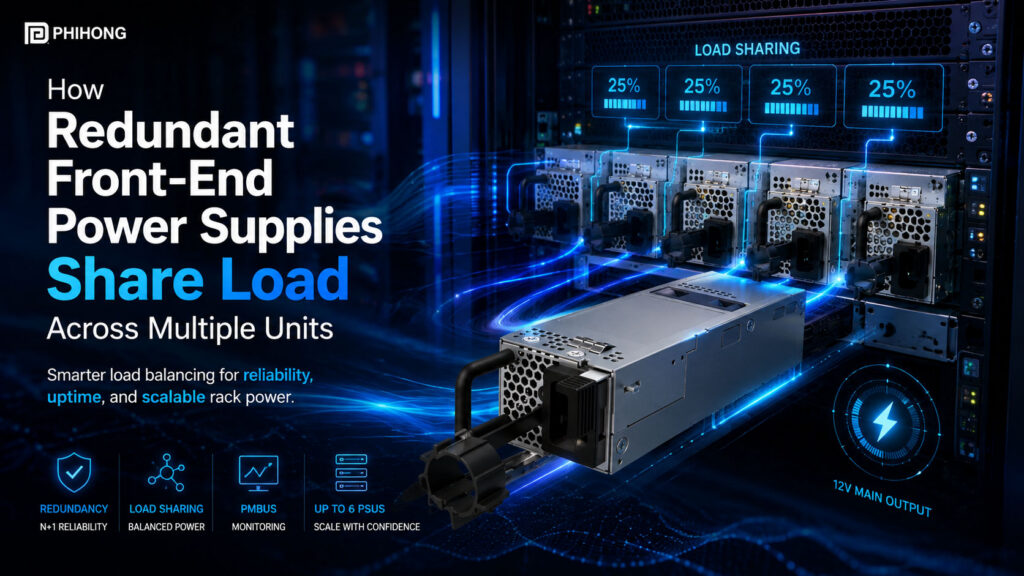
Load sharing means multiple power supplies work together to support the same output load instead of forcing one unit to carry most of the demand. In rack systems, this can matter because the power architecture may need serviceability, redundancy and predictable operation across more than one front-end PSU. If one power supply is doing too much of the work while another is lightly loaded, the system may lose thermal balance, reduce service margin or fail to deliver the redundancy behavior the OEM expected.
Phihong’s PA350R-212A-R datasheet gives a product-specific example of this concept. It lists redundant support for a maximum of 6 PSUs and current share accuracy of 4% at +12V full-load current. For OEMs building rack systems, telecom equipment, datacom platforms, enterprise hardware or industrial rack equipment, those details should be reviewed early because load sharing is not just a feature. It affects backplane design, monitoring strategy, PSU slot mapping, airflow, fault handling and service planning.
| Load Sharing Area | Why It Matters in Rack Systems | What OEM Teams Should Review |
|---|---|---|
| Multi-PSU operation | Helps several PSUs contribute to the same 12V load. | Maximum PSU count, load budget, redundancy target and backplane design. |
| Current share accuracy | Helps prevent one PSU from carrying too much of the system load. | Current share tolerance, full-load behavior and load-balance validation. |
| Thermal balance | More even load sharing can help distribute heat across modules. | PSU placement, airflow path, fan behavior and inlet temperature. |
| Service margin | Redundant systems should behave predictably when a unit is removed or faulted. | Removal behavior, fault response, replacement process and controller logic. |
Why This Matters
• Load sharing helps redundant front-end power supplies distribute system demand across multiple units.
• Current sharing must be validated in the final rack configuration, not assumed from wattage alone.
What OEMs Should Do Now
• Define the redundancy model and maximum PSU count before finalizing the rack power architecture.
• Validate current sharing under full-load, partial-load, fault and service conditions.
Useful Links
PA350R-212A-R Product Page: www.phihong.com/products/adapters/pa350r-212a-r/
PA350R-212A-R 350W Front-End Power Supply Datasheet: www.phihong.com/wp-content/uploads/New-datasheet-PA350R-212A-R-09082025.pdf
Open-Frame / Internal PSU Product Line: www.phihong.com/products/open-frame-internal-psu/
Related Links
Best Guide to Intelligent Rack Power Supplies: PMBus, Redundancy, and Digital Front-End Power: www.phihong.com/best-guide-to-intelligent-rack-power-supplies-pmbus-redundancy-and-digital-front-end-power/
What Is PMBus and Why Does It Matter in Front-End Power Supplies?: www.phihong.com/what-is-pmbus-and-why-does-it-matter-in-front-end-power-supplies/
FEATURED PRODUCTS
AM250U-540AP-R
AA240U-200A-R
AA240U-200B-R
AA280U-200B-R
AA240U-59FKEA-R
AA36U-240B-R

Why does current sharing matter more as rack systems add more PSU modules?
Current sharing becomes more important as rack systems add more PSU modules because the risk of imbalance increases. A two-supply design may already need careful validation, but a system that supports multiple supplies must also manage slot identity, load balance, controller logic, airflow and service behavior. If the rack allows up to six redundant PSUs, the system must be designed so every installed module contributes in a predictable way.
This matters because redundant power is not the same as extra power. OEM teams need to know whether the system is designed for N+1 redundancy, load sharing, capacity scaling, service replacement, or another architecture. Each approach changes how much current each PSU should provide and what happens when one unit is removed or fails. Current sharing helps the system avoid overstressing one module, but the backplane, I_Share connection, PMBus monitoring and firmware response must all be part of the design.
| Redundant Design Question | Why It Matters | What OEM Teams Should Review |
| How many PSUs are installed? | More modules increase the need for accurate slot mapping and current balance. | Maximum unit count, physical slots, address pins and controller mapping. |
| What is the redundancy model? | N+1, capacity sharing and service spare strategies behave differently. | Load budget, failure scenario, derating and operating margin. |
| How is current sharing measured? | The system needs a way to confirm whether units are sharing properly. | I_Share signal, PMBus readings, test points and firmware thresholds. |
| What happens during removal? | A redundant rack should manage service events without unexpected power behavior. | PRESENT signal, fault logic, LED behavior and service procedure. |
Why This Matters
• Multi-PSU rack systems need clear current-sharing behavior to support redundancy and serviceability.
• More PSU modules create more need for slot identity, monitoring and system-level validation.
What OEMs Should Do Now
• Decide whether the design goal is redundancy, capacity scaling, serviceability, or a combination of all three.
• Validate load sharing with the actual number of PSU modules expected in production configurations.
Useful Links
PA350R-212A-R Product Page: www.phihong.com/products/adapters/pa350r-212a-r/
PA350R-212A-R 350W Front-End Power Supply Datasheet: www.phihong.com/wp-content/uploads/New-datasheet-PA350R-212A-R-09082025.pdf
Product Finder: www.phihong.com/product-finder/
Related Links
Best Guide to Intelligent Rack Power Supplies: PMBus, Redundancy, and Digital Front-End Power: www.phihong.com/best-guide-to-intelligent-rack-power-supplies-pmbus-redundancy-and-digital-front-end-power/
What Is PMBus and Why Does It Matter in Front-End Power Supplies?: www.phihong.com/what-is-pmbus-and-why-does-it-matter-in-front-end-power-supplies/
How do I_Share signals help balance load between front-end power supplies?
I_Share signals help redundant power supplies coordinate how much current each unit contributes to the shared output load. In a multi-PSU system, the current-share signal gives the rack architecture a way to support better balance across installed modules. For PA350R-212A-R, the datasheet specifies I_Share voltage behavior at different 12V load levels, including 3.5V ±70mV at +12V 50% load and 7V ±2% at +12V 100% load.
For OEM teams, this signal should be treated as part of the rack power-control architecture. The I_Share connection, backplane routing, controller monitoring and validation plan all affect how confidently the team can rely on load sharing in production. If the current-share path is not designed correctly, redundancy may not behave as expected. Load sharing should also be tested during changing load conditions, startup, fault recovery, PSU insertion, PSU removal and full-load operation.
| I_Share Review Area | Why It Matters | What OEM Teams Should Review |
| Signal behavior | The I_Share voltage helps represent load-sharing conditions. | Voltage levels, load percentage, measurement points and tolerance. |
| Backplane routing | Current-share behavior depends on proper system interconnection. | Trace routing, connector pins, grounding and noise sensitivity. |
| Controller awareness | Monitoring can help detect uneven or abnormal sharing. | PMBus readings, firmware thresholds, alerts and event logging. |
| Dynamic operation | Load sharing must remain stable as operating conditions change. | Startup, load transients, PSU insertion, removal and fault recovery. |
Why This Matters
• I_Share helps multiple front-end PSUs balance load in redundant rack designs.
• The current-share signal must be designed, routed and validated as part of the full system.
What OEMs Should Do Now
• Map I_Share behavior into the backplane and validation plan before finalizing the PSU interface.
• Test current sharing across load levels, module counts and service scenarios.
Useful Links
PA350R-212A-R Product Page: www.phihong.com/products/adapters/pa350r-212a-r/
PA350R-212A-R 350W Front-End Power Supply Datasheet: www.phihong.com/wp-content/uploads/New-datasheet-PA350R-212A-R-09082025.pdf
Open-Frame / Internal PSU Product Line: www.phihong.com/products/open-frame-internal-psu/
Related Links
Best Guide to Intelligent Rack Power Supplies: PMBus, Redundancy, and Digital Front-End Power: www.phihong.com/best-guide-to-intelligent-rack-power-supplies-pmbus-redundancy-and-digital-front-end-power/
What Is PMBus and Why Does It Matter in Front-End Power Supplies?: www.phihong.com/what-is-pmbus-and-why-does-it-matter-in-front-end-power-supplies/
CLIENT'S QUOTE
Phihong’s custom OEM power solutions have transformed our product development, boosting performance and reducing overhead. Their expert engineering support has simplified both the design and manufacturing phases.
What happens when one power supply fails, is removed, or is replaced?
A redundant front-end power design needs to behave predictably when one PSU fails, is removed, or is replaced. This is where load sharing becomes more than a steady-state feature. If one supply stops contributing, the remaining supplies may need to carry more of the load while the system controller detects the event, logs the condition and alerts the service workflow. The system must avoid relying on one ideal lab condition that does not match real rack maintenance.
For OEM teams, this means validation should include live service scenarios, not only normal operation. The rack architecture should define what happens when a PSU is pulled, when a new PSU is inserted, when a fault appears, when load shifts across the remaining supplies and when PMBus or status signals report the change. The PA350R-212A-R datasheet includes PRESENT, SMB_ALERT, address pins and redundancy-related features, which should be mapped into the controller and service process.
| Service Scenario | Why It Matters | What OEM Teams Should Validate |
|---|---|---|
| PSU failure | Remaining supplies may need to absorb the load without unstable behavior. | Load transfer, fault signal, alert behavior and remaining PSU margin. |
| PSU removal | The system must detect that a module is no longer present. | PRESENT signal, PMBus address response, LED behavior and event logging. |
| PSU replacement | A new module should rejoin the system predictably. | Insertion behavior, current sharing recovery, address mapping and service instructions. |
| Uneven load shift | Remaining units may not share load exactly as expected. | Current balance, thermal behavior, fan response and controller thresholds. |
Why This Matters
• Redundant power only becomes useful when the system handles failure, removal and replacement predictably.
• Current sharing should be tested during service events, not only during normal full-load operation.
What OEMs Should Do Now
• Validate PSU removal, replacement, fault and recovery behavior under realistic rack load conditions.
• Confirm how the controller reports service events through PMBus, status signals, logs and user-facing diagnostics.
Useful Links
PA350R-212A-R Product Page: www.phihong.com/products/adapters/pa350r-212a-r/
PA350R-212A-R 350W Front-End Power Supply Datasheet: www.phihong.com/wp-content/uploads/New-datasheet-PA350R-212A-R-09082025.pdf
Open-Frame / Internal PSU Product Line: www.phihong.com/products/open-frame-internal-psu/
Related Links
Best Guide to Intelligent Rack Power Supplies: PMBus, Redundancy, and Digital Front-End Power: www.phihong.com/best-guide-to-intelligent-rack-power-supplies-pmbus-redundancy-and-digital-front-end-power/
What Is PMBus and Why Does It Matter in Front-End Power Supplies?: www.phihong.com/what-is-pmbus-and-why-does-it-matter-in-front-end-power-supplies/
How Phihong supports redundant front-end power supply load sharing
For OEMs developing rack systems that need redundant front-end power, Phihong’s PA350R-212A-R provides a focused product reference. It is a 350W front-end power supply with 12V main output, 5V standby output, PMBus Version 1.2 support, active current sharing, redundancy support and system status signals. The datasheet lists support for up to six redundant PSUs and specifies current-share behavior that helps engineers evaluate load sharing across multiple units.
The best fit is a rack or modular system where multiple supplies need to support the same load, communicate status and recover predictably during service events. OEM teams should review the PA350R-212A-R datasheet against the backplane design, current-share interface, PMBus address mapping, airflow path, system controller, redundancy target and service procedure. Load sharing works best when the PSU, backplane, firmware and mechanical service model are designed together from the beginning.
| Phihong Product Area | Why It Helps OEM Teams | What Teams Should Review |
|---|---|---|
| PA350R-212A-R | Provides a 350W front-end PSU reference with redundancy support. | Output ratings, PMBus support, active current sharing and signal behavior. |
| Multi-PSU support | Helps teams evaluate architectures with several redundant units. | Maximum PSU count, slot mapping, backplane design and load budget. |
| Current sharing | Supports load balancing across installed power modules. | I_Share behavior, current share accuracy, full-load validation and recovery. |
| Digital monitoring | Helps controller firmware detect status, alerts and service events. | PMBus, SMB_ALERT, PRESENT, address pins and event logs. |
Why This Matters
• Product-specific current-sharing data helps OEMs design redundancy around real PSU behavior.
• A redundant rack power design should be validated across normal operation, fault conditions and service events.
What OEMs Should Do Now
• Start with the PA350R-212A-R datasheet and map redundancy, I_Share, PMBus and status signals into the rack architecture.
• Validate current sharing with the final backplane, controller firmware, airflow path and intended service procedure.
Useful Links
PA350R-212A-R Product Page: www.phihong.com/products/adapters/pa350r-212a-r/
PA350R-212A-R 350W Front-End Power Supply Datasheet: www.phihong.com/wp-content/uploads/New-datasheet-PA350R-212A-R-09082025.pdf
Open-Frame / Internal PSU Product Line: www.phihong.com/products/open-frame-internal-psu/
Related Links
Best Guide to Intelligent Rack Power Supplies: PMBus, Redundancy, and Digital Front-End Power: www.phihong.com/best-guide-to-intelligent-rack-power-supplies-pmbus-redundancy-and-digital-front-end-power/
What Is PMBus and Why Does It Matter in Front-End Power Supplies?: www.phihong.com/what-is-pmbus-and-why-does-it-matter-in-front-end-power-supplies/
Redundant front-end power supplies do not share load automatically just because several modules are installed. The rack system needs the right current-share design, backplane routing, address mapping, PMBus monitoring, airflow, fault response and service workflow.
For OEMs building telecom, datacom, enterprise, industrial or infrastructure rack systems, load sharing should be validated as a complete system behavior. The strongest designs test normal operation, partial load, full load, unit removal, unit replacement, fault recovery and thermal balance before production release.

CONTACT US TODAY
From concept to production, Phihong delivers custom OEM power solutions tailored to your specifications.
FAQ
What does load sharing mean in redundant front-end power supplies?
Load sharing means multiple power supplies contribute to the same output load instead of one unit carrying most of the system demand. In rack systems, this helps distribute current, balance thermal stress and support redundancy goals. OEM teams should validate load sharing in the final system because behavior depends on the PSU, backplane, current-share connection, load profile and controller logic.
Why is current sharing important in redundant rack power systems?
Current sharing is important because redundant systems need predictable load distribution across installed PSU modules. If one supply carries too much current, it may run hotter or reduce system margin. Good current sharing helps support balanced operation, but it must be validated under real load, startup, removal, replacement and fault conditions.
What is I_Share in a front-end power supply?
I_Share is a current-sharing signal used to help multiple power supplies coordinate load contribution. In a redundant architecture, the I_Share connection can help the system support more balanced output sharing. OEMs should review I_Share voltage behavior, backplane routing, signal integrity, monitoring and test conditions before relying on it in production.
How many redundant power supplies can a rack system use?
That depends on the selected PSU and system architecture. The PA350R-212A-R datasheet lists redundant support for a maximum of six PSUs. OEM teams still need to define the redundancy model, load budget, backplane design, airflow path, address mapping and service behavior. Maximum PSU count does not replace system-level validation.
What should OEMs test before using redundant front-end power supplies?
OEMs should test current sharing, load balance, startup, full-load operation, partial load, PSU removal, PSU insertion, fault response, recovery behavior, thermal balance, PMBus monitoring and service diagnostics. Testing should use the final backplane, controller firmware, airflow path and expected load profile so redundancy behaves predictably in the field.
POE technology supports the centralization of power

AC Adapter Guide: Everything You Need to Know
Moreover, PoE technology supports the centralization of power management. By powering devices through a PoE-enabled network …
AC DC Power Chargers and How They Work: A Comprehensive Technical Breakdown
Moreover, PoE technology supports the centralization of power management. By powering devices through a PoE-enabled network …

USB-C Charger: Shaping the Future of the Tech World
Moreover, PoE technology supports the centralization of power management. By powering devices through a PoE-enabled network …

AC Adapter Guide: Everything You Need to Know
Moreover, PoE technology supports the centralization of power management. By powering devices through a PoE-enabled network …

AC DC Power Chargers and How They Work: A Comprehensive Technical Breakdown
Moreover, PoE technology supports the centralization of power management. By powering devices through a PoE-enabled network …

USB-C Charger: Shaping the Future of the Tech World
Moreover, PoE technology supports the centralization of power management. By powering devices through a PoE-enabled network …