









BLOG
What Does Class B EMI Mean for High-Power Open-Frame PSU Design?
QUICK LINKS
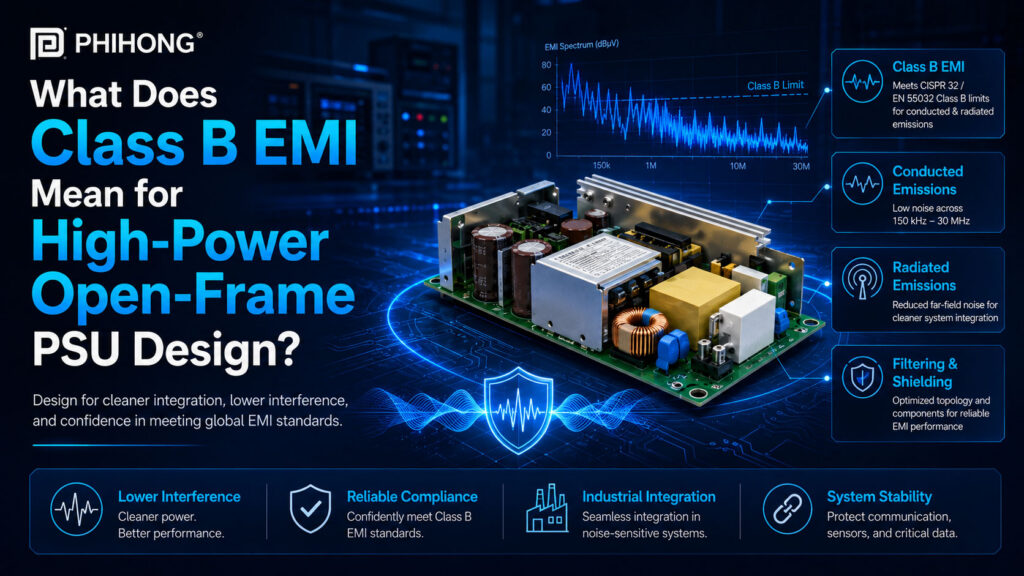
Why does Class B EMI matter in high-power open-frame power supplies?
Class B EMI matters because high-power open-frame power supplies often operate inside equipment that includes networking circuits, PoE power paths, IoT gateways, industrial controllers, communication boards, sensors, motors, displays, fans and other electronics that may be sensitive to electromagnetic noise. For OEMs, EMI is not only a compliance detail. It can affect product validation, enclosure design, cable routing, system stability and customer deployment.
In high-power open-frame PSU design, the power supply is installed inside the final equipment instead of being isolated in an external adapter enclosure. That means the OEM’s mechanical layout, grounding, shielding, wiring and airflow can affect the finished product’s EMI behavior. Phihong’s BF950-234A-R page lists Class B EMI as a feature for a 950W open-frame/internal PSU with 12Vdc and 54.5Vdc outputs, which makes EMI review especially relevant for high-power dual-output designs used in networking, PoE, IoT and industrial systems.
| EMI Review Area | Why It Matters for OEMs | What Teams Should Review |
|---|---|---|
| Conducted emissions | Noise can travel through input or output wiring and affect compliance testing. | AC input filtering, grounding, cable routing, load profile and final test setup. |
| Radiated emissions | High-power switching circuits and cables can contribute to system-level emissions. | Enclosure layout, shielding, wiring paths, heatsinks, nearby boards and test orientation. |
| Dual-output wiring | 12V and 54.5V / 55V rails may feed different parts of the system. | Output cable length, connector placement, load location and separation from signal lines. |
| Final system validation | Open-frame PSU EMI behavior depends on the finished product design. | Full enclosure, representative load, operating modes, grounding and production cable harness. |
Why This Matters
• Class B EMI can help OEMs plan high-power PSU integration for systems used near sensitive electronics or communications equipment.
• Open-frame PSU emissions should be validated inside the final product, not only as a standalone power supply.
What OEMs Should Do Now
• Treat EMI as part of the mechanical, electrical and cable-routing design from the beginning.
• Test the PSU with the actual enclosure, wiring harness, grounding scheme, load profile and operating modes planned for production.
Useful Links
BF950-234A-R Product Page: www.phihong.com/products/open-frame-internal-psu/bf950-234a-r-2/
BF550-234A-R Product Page: www.phihong.com/products/open-frame-internal-psu/bf550-234a-r/
Open-Frame / Internal PSU Product Line: www.phihong.com/products/open-frame-internal-psu/
Related Links
Best Guide to Dual-Output Power Supplies for Networking, Industrial Automation, and PoE Systems: www.phihong.com/best-guide-to-dual-output-power-supplies-for-networking-industrial-automation-and-poe-systems/
What Compliance Engineers Look for in Internal PSUs: EMI, EMS, and Safety Basics: www.phihong.com/what-compliance-engineers-look-for-in-internal-psus-emi-ems-and-safety-basics/
FEATURED PRODUCTS
AM250U-540AP-R
AA240U-200A-R
AA240U-200B-R
AA280U-200B-R
AA240U-59FKEA-R
AA36U-240B-R

How does Class B EMI affect networking, PoE and IoT equipment?
Class B EMI can matter in networking, PoE and IoT equipment because these products often operate near communication signals, data lines, sensors, wireless modules, Ethernet ports, control boards and connected devices. A power supply may provide the right voltage and wattage, but if emissions are not managed properly in the final equipment, the product can become harder to validate or less reliable in real deployment environments.
For PoE and IoT systems, the challenge is that power and communication often live close together. A higher-voltage output rail may support PoE-related power distribution while the 12V rail supports local electronics, fans, controllers, relays or monitoring circuits. Those power paths can run through the same enclosure as data connectors, network boards and control wiring. Class B EMI requirements push OEM teams to think carefully about layout, grounding, shielding and cable paths before the design reaches compliance testing.
| Device Area | Why EMI Matters | What OEM Teams Should Review |
| Networking ports | Ethernet and communication circuits can be sensitive to emissions and layout noise. | PSU placement, magnetics location, cable routing and board separation. |
| PoE power paths | Higher-voltage power distribution can run near data and control electronics. | 54.5V / 55V rail routing, output filtering, load behavior and grounding. |
| IoT gateways | IoT devices may include processors, sensors, wireless modules and communication interfaces. | RF sensitivity, board layout, enclosure shielding and operating modes. |
| Control electronics | 12V auxiliary loads may operate near signal-level circuits. | Relay switching, fans, sensors, controller logic and transient behavior. |
Why This Matters
• Networking, PoE and IoT systems combine power and communication paths, making EMI planning especially important.
• Class B EMI should be evaluated with the complete device architecture, including wiring, boards, connectors and enclosure design.
What OEMs Should Do Now
• Review power paths and communication paths together before board layout and cable harnesses are finalized.
• Validate EMI behavior in operating modes that represent real customer use, not only simplified lab conditions.
Useful Links
BF260-234A-R Product Page: www.phihong.com/products/open-frame-internal-psu/bf260-234a-r/
BF950-234A-R Product Page: www.phihong.com/products/open-frame-internal-psu/bf950-234a-r-2/
Power-Over-Ethernet Product Line: www.phihong.com/products/poe/
Related Links
Why 12V and 54.5V/55V Dual Outputs Matter in PoE and IoT Power Architectures: www.phihong.com/why-12v-and-54-5v-55v-dual-outputs-matter-in-poe-and-iot-power-architectures/
Introduction to PoE Injectors: What Are PoE Injectors?: www.phihong.com/introduction-to-poe-injectors-what-are-poe-injectors/
What design choices can make Class B EMI harder to pass?
Class B EMI can become harder to pass when OEM teams treat the power supply as separate from the system layout. With an open-frame PSU, the final product enclosure becomes part of the EMI environment. Grounding choices, mounting location, cable length, shield placement, output wiring, load behavior and nearby high-speed circuits can all change the finished product’s emissions profile. Even when the PSU is designed for Class B EMI performance, system-level validation is still necessary.
High-power dual-output systems add more complexity because the 12V rail and 54.5V / 55V rail may feed different loads with different switching behavior. The 12V rail might support fans, controllers and auxiliary circuits, while the higher-voltage rail supports PoE-related or distributed power loads. If the output wiring runs near sensitive communication circuits, or if return paths are poorly controlled, EMI issues may appear late in testing. That is why Class B EMI should be planned during mechanical and electrical layout, not left to the end.
| Design Choice | Why It Can Create EMI Risk | What OEM Teams Should Review |
| Long output wiring | Longer cables can radiate or pick up noise more easily. | Cable length, twist, shielding, routing and connector placement. |
| Poor grounding | Weak or inconsistent grounding can make emissions harder to control. | Chassis ground, PSU mounting, return paths and bonding strategy. |
| Crowded enclosure | Dense layouts can place power components near sensitive circuits. | PSU location, board spacing, heatsinks, airflow and shielding. |
| Late EMI testing | Problems found late are harder and more expensive to fix. | Pre-compliance testing, layout reviews and production-intent harnesses. |
Why This Matters
• Class B EMI performance depends on the PSU and the final equipment design working together.
• Many EMI problems are easier to prevent during layout than to fix after failed testing.
What OEMs Should Do Now
• Run early EMI layout reviews before enclosure, grounding and cable routing decisions are locked.
• Use pre-compliance testing with production-intent wiring, boards, loads and enclosure materials.
Useful Links
BF460-234A-R Product Page: www.phihong.com/products/open-frame-internal-psu/bf460-234a-r/
BF950-234A-R Product Page: www.phihong.com/products/open-frame-internal-psu/bf950-234a-r-2/
Open-Frame / Internal PSU Product Line: www.phihong.com/products/open-frame-internal-psu/
Related Links
What Compliance Engineers Look for in Internal PSUs: EMI, EMS, and Safety Basics: www.phihong.com/what-compliance-engineers-look-for-in-internal-psus-emi-ems-and-safety-basics/
How to Validate Thermal Performance of Open-Frame Power Supplies in Real Enclosures: www.phihong.com/how-to-validate-thermal-performance-of-open-frame-power-supplies-in-real-enclosures/
CLIENT'S QUOTE
Phihong’s custom OEM power solutions have transformed our product development, boosting performance and reducing overhead. Their expert engineering support has simplified both the design and manufacturing phases.
How should OEMs validate Class B EMI in the final enclosure?
OEMs should validate Class B EMI in the final enclosure because open-frame power supplies are affected by the system around them. A bench test can help engineering teams understand baseline behavior, but it does not fully represent the finished product. Once the PSU is installed into the final equipment, emissions can be affected by the enclosure material, grounding strategy, mounting hardware, output cable routing, nearby boards, ventilation openings, fans and the actual load profile.
For high-power networking, PoE, IoT and industrial systems, validation should include normal operating modes, peak load conditions, low-load behavior, startup behavior, fault scenarios and any load transitions that may occur in the field. OEM teams should also test with production-intent wiring and harnesses because temporary lab cables may hide or exaggerate EMI behavior. Class B EMI planning is strongest when pre-compliance testing begins early and continues through final system validation.
| Validation Area | Why It Matters | What OEM Teams Should Review |
|---|---|---|
| Final enclosure | The enclosure can affect grounding, shielding and radiated emissions. | Material, seams, vents, mounting points and chassis bonding. |
| Production wiring | Cable length and routing can change emissions behavior. | Harness design, cable separation, twisting, shielding and connector placement. |
| Real load conditions | EMI may change as loads turn on, switch or transition. | Full load, partial load, startup, peak demand and transient behavior. |
| Pre-compliance testing | Early testing can reveal problems before certification. | Test setup, operating modes, fixes, retest plan and documentation. |
Why This Matters
• Class B EMI validation should be performed with the PSU installed in the actual product configuration.
• Production-intent wiring, enclosure design and real operating modes can change the final emissions result.
What OEMs Should Do Now
• Schedule EMI pre-compliance testing before the product reaches final certification.
• Test with final or near-final wiring, grounding, enclosure materials, boards and load conditions.
Useful Links
BF550-234A-R Product Page: www.phihong.com/products/open-frame-internal-psu/bf550-234a-r/
BF950-234A-R Product Page: www.phihong.com/products/open-frame-internal-psu/bf950-234a-r-2/
Open-Frame / Internal PSU Product Line: www.phihong.com/products/open-frame-internal-psu/
Related Links
What Compliance Engineers Look for in Internal PSUs: EMI, EMS, and Safety Basics: www.phihong.com/what-compliance-engineers-look-for-in-internal-psus-emi-ems-and-safety-basics/
How to Validate Thermal Performance of Open-Frame Power Supplies in Real Enclosures: www.phihong.com/how-to-validate-thermal-performance-of-open-frame-power-supplies-in-real-enclosures/
How Phihong supports Class B EMI open-frame PSU selection for high-power systems
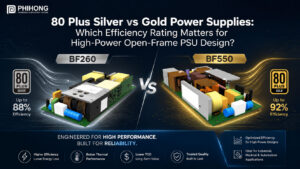
For OEM teams designing high-power open-frame PSU systems, Phihong’s BF260 / BF460 / BF550 / BF950 family provides a product-led path for Class B EMI review across multiple wattage levels. The BF950-234A-R is especially relevant for this article because the product page lists 950W output power, 12Vdc and 54.5Vdc outputs, Class B EMI, high-efficiency performance, protection features and 5,000-meter operating altitude. That makes it a useful high-power reference for dual-output PSU design.
The best fit depends on the complete product architecture. OEMs should compare Class B EMI needs against wattage class, enclosure design, rail loading, wiring, grounding, shielding, airflow, nearby communication circuits and final compliance targets. A Class B EMI feature can help product teams start from a stronger point, but the finished product still needs system-level validation. In open-frame PSU design, the enclosure, harness and load behavior are part of the emissions story.
| Phihong Product Area | Why It Helps OEM Teams | What Teams Should Review |
|---|---|---|
| BF260-234A-R | Provides a lower-power dual-output Class B EMI reference for PoE and IoT systems. | 12V and 55V loads, compact integration, airflow and EMI setup. |
| BF460-234A-R | Supports midrange industrial and networking dual-output power designs. | Wiring, grounding, load balance, EMI and thermal behavior. |
| BF550-234A-R | Supports higher-load 12V and 54.5V systems with efficiency and EMI needs. | Full-load operation, cable paths, enclosure effects and compliance setup. |
| BF950-234A-R | Provides a high-power 950W dual-output reference with Class B EMI. | Maximum load, shielding, airflow, output wiring, safety and service access. |
Why This Matters
• Product-specific Class B EMI review helps OEMs connect datasheet features to real system compliance planning.
• High-power open-frame PSU designs need EMI validation across the PSU, enclosure, wiring, grounding and load profile.
What OEMs Should Do Now
• Start with the BF product family and compare EMI requirements against the final equipment environment.
• Validate the selected PSU inside the finished product with production-intent wiring, enclosure, load profile and operating modes.
Useful Links
BF260-234A-R Product Page: www.phihong.com/products/open-frame-internal-psu/bf260-234a-r/
BF460-234A-R Product Page: www.phihong.com/products/open-frame-internal-psu/bf460-234a-r/
BF550-234A-R Product Page: www.phihong.com/products/open-frame-internal-psu/bf550-234a-r/
BF950-234A-R Product Page: www.phihong.com/products/open-frame-internal-psu/bf950-234a-r-2/
Related Links
Best Guide to Dual-Output Power Supplies for Networking, Industrial Automation, and PoE Systems: www.phihong.com/best-guide-to-dual-output-power-supplies-for-networking-industrial-automation-and-poe-systems/
Why 12V and 54.5V/55V Dual Outputs Matter in PoE and IoT Power Architectures: www.phihong.com/why-12v-and-54-5v-55v-dual-outputs-matter-in-poe-and-iot-power-architectures/
260W vs 460W vs 550W vs 950W Open-Frame Power Supplies: Which One Fits Your System?: www.phihong.com/260w-vs-460w-vs-550w-vs-950w-open-frame-power-supplies-which-one-fits-your-system/
Class B EMI matters because high-power open-frame power supplies do not operate in isolation. The PSU, enclosure, wiring, grounding, load profile and nearby electronics all affect the finished product’s emissions behavior. For networking, PoE, IoT and industrial systems, EMI planning should begin early because power and communication circuits often operate close together.
For OEMs selecting between BF260, BF460, BF550 and BF950 class dual-output power supplies, the strongest approach is to evaluate Class B EMI as part of the total design. Teams should review the power supply, enclosure layout, cable routing, shielding, grounding, airflow, safety requirements and final compliance plan before the product moves into production.

CONTACT US TODAY
From concept to production, Phihong delivers custom OEM power solutions tailored to your specifications.
FAQ
What does Class B EMI mean in an open-frame power supply?
Class B EMI means the power supply is designed for a stricter emissions class than Class A industrial-only environments. For OEMs, this can be important when the final product may operate near networking hardware, communication circuits, PoE systems, IoT devices, commercial equipment or other electronics. However, the finished product still needs system-level validation because the enclosure, wiring, grounding and load profile can affect final emissions.
Is Class B EMI enough to guarantee the finished product will pass testing?
No. Class B EMI on the power supply is helpful, but it does not guarantee that the finished equipment will pass compliance testing. Open-frame PSUs are integrated inside the product, so the OEM’s enclosure, cable harness, PCB layout, grounding strategy, shielding and operating modes all matter. Teams should run pre-compliance testing with production-intent hardware before final certification.
Why is EMI more challenging in high-power dual-output PSUs?
High-power dual-output PSUs may feed different system loads through separate output rails, such as 12V and 54.5V or 55V. These rails may connect to fans, control boards, PoE-related circuits, industrial loads or downstream converters. More wiring, higher power and mixed load behavior can make EMI planning more complex, especially when power and communication circuits share the same enclosure.
What design choices affect Class B EMI performance?
Cable length, output wiring, grounding, shielding, enclosure design, PSU placement, connector location, nearby communication boards and load behavior can all affect Class B EMI performance. OEMs should also review airflow openings, chassis bonding, cable harness routing and switching loads. EMI problems are usually easier to prevent during layout than to fix after a failed test.
How should OEMs validate Class B EMI for open-frame PSUs?
OEMs should validate EMI with the power supply installed in the final or near-final enclosure using production-intent wiring, grounding, boards and loads. Testing should include representative operating modes, startup behavior, full load, partial load and load transitions. Pre-compliance testing can help teams identify issues before formal certification and reduce late-stage redesign risk.
POE technology supports the centralization of power

AC Adapter Guide: Everything You Need to Know
Moreover, PoE technology supports the centralization of power management. By powering devices through a PoE-enabled network …
AC DC Power Chargers and How They Work: A Comprehensive Technical Breakdown
Moreover, PoE technology supports the centralization of power management. By powering devices through a PoE-enabled network …

USB-C Charger: Shaping the Future of the Tech World
Moreover, PoE technology supports the centralization of power management. By powering devices through a PoE-enabled network …

AC Adapter Guide: Everything You Need to Know
Moreover, PoE technology supports the centralization of power management. By powering devices through a PoE-enabled network …

AC DC Power Chargers and How They Work: A Comprehensive Technical Breakdown
Moreover, PoE technology supports the centralization of power management. By powering devices through a PoE-enabled network …

USB-C Charger: Shaping the Future of the Tech World
Moreover, PoE technology supports the centralization of power management. By powering devices through a PoE-enabled network …