












BLOG
What Is PMBus and Why Does It Matter in Front-End Power Supplies?
QUICK LINKS
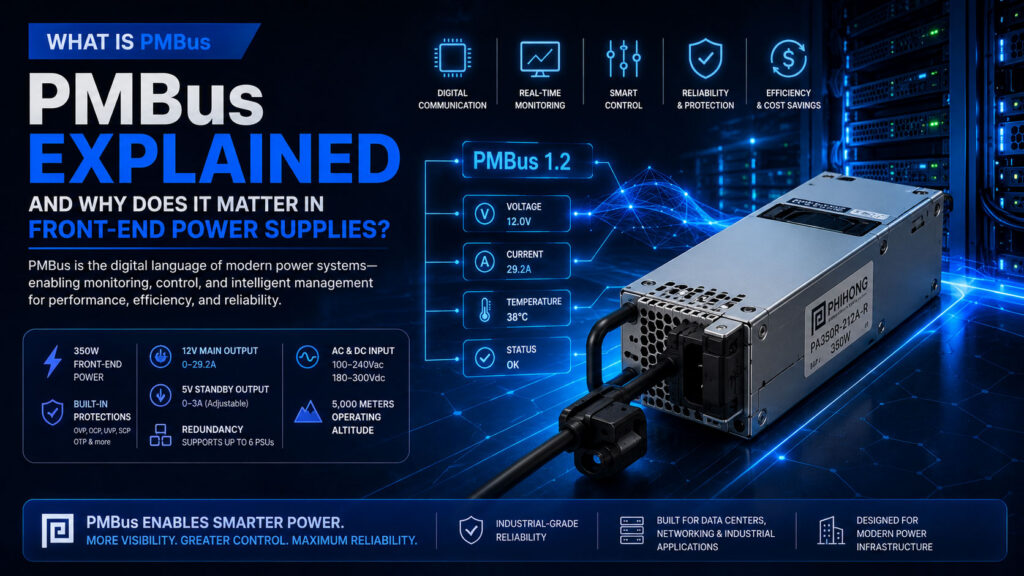
What is PMBus in a front-end power supply?
PMBus, short for Power Management Bus, is a digital communication protocol used to monitor and manage power supply behavior. In a front-end power supply, PMBus helps the system controller understand what the power supply is doing instead of treating it as a simple black-box power converter. This can include status reporting, warning signals, fault information, voltage and current readings, temperature data, fan behavior and other operating conditions.
For OEMs designing rack systems, telecom equipment, datacom platforms, enterprise hardware or industrial electronics, PMBus can make front-end power more visible and manageable. Phihong’s PA350R-212A-R is a useful product example because its datasheet identifies it as a 350W front-end power supply with PMBus Version 1.2 support. That matters because intelligent rack systems often need more than regulated 12V output. They may also need standby power, redundancy support, current sharing, fault reporting and digital power status that can be read by a system controller.
| PMBus Function | Why It Matters in Front-End Power Supplies | What OEM Teams Should Review |
|---|---|---|
| Digital monitoring | Gives the system visibility into PSU operating conditions. | Voltage, current, power, temperature, fan status and warning data. |
| Fault reporting | Helps the controller detect and respond to abnormal power events. | Fault flags, SMB_ALERT behavior, latching conditions and recovery logic. |
| Status visibility | Helps identify whether the PSU is present, enabled or operating correctly. | PRESENT, PW_OK, AC_OK, PS_ON and power-good timing. |
| System coordination | Allows the PSU to become part of the rack’s control architecture. | PMBus address mapping, command support, controller firmware and logging. |
Why This Matters
• PMBus helps front-end power supplies communicate operating status, warnings and telemetry to the system controller.
• Digital power visibility is useful in rack systems where uptime, serviceability and fault diagnostics matter.
What OEMs Should Do Now
• Define what PSU telemetry the rack controller needs before selecting a front-end power supply.
• Review PMBus command support, alert behavior, address mapping and firmware response early in system design.
Useful Links
PA350R-212A-R Product Page: www.phihong.com/products/adapters/pa350r-212a-r/
PA350R-212A-R 350W Front-End Power Supply Datasheet: www.phihong.com/wp-content/uploads/New-datasheet-PA350R-212A-R-09082025.pdf
Open-Frame / Internal PSU Product Line: www.phihong.com/products/open-frame-internal-psu/
Related Links
What Compliance Engineers Look for in Internal PSUs: EMI, EMS, and Safety Basics: www.phihong.com/what-compliance-engineers-look-for-in-internal-psus-emi-ems-and-safety-basics/
Best Guide to Open-Frame Internal Power Supplies: How to Choose the Right Internal PSU for Industrial Equipment: www.phihong.com/best-guide-to-open-frame-internal-power-supplies-how-to-choose-the-right-internal-psu-for-industrial-equipment/
FEATURED PRODUCTS
AM250U-540AP-R
AA240U-200A-R
AA240U-200B-R
AA280U-200B-R
AA240U-59FKEA-R
AA36U-240B-R

Why does PMBus matter in intelligent rack power systems?
PMBus matters in intelligent rack power systems because the power supply is no longer an isolated hardware component. In a rack architecture, multiple subsystems may depend on accurate power information: the system controller, backplane, fans, processors, communication modules, storage, service interface and remote monitoring software. PMBus can help connect the front-end PSU to that broader management layer.
This is especially important when the rack system includes redundancy or modular service. If a PSU is removed, faulted, overloaded, overheated, or sharing current unevenly, the controller needs a reliable way to detect and report that condition. Without digital visibility, technicians may rely more heavily on basic LEDs, manual checks, or late-stage failure symptoms. With PMBus, OEM teams can design systems that monitor power behavior more actively and respond before a small condition becomes a larger operational issue.
| Rack Power Need | How PMBus Helps | What OEM Teams Should Review |
| Redundancy monitoring | Helps identify individual PSU status in multi-supply systems. | Address pins, PMBus addresses, PSU presence and controller mapping. |
| Fault diagnostics | Provides warning or fault data that can support service workflows. | Fault registers, SMB_ALERT, LED behavior and event logs. |
| Current sharing review | Helps verify that supplies are contributing properly in redundant designs. | I_Share behavior, load balance and full-load conditions. |
| Remote management | Supports smarter monitoring in enterprise, telecom and infrastructure systems. | Telemetry accuracy, polling frequency, alert thresholds and firmware actions. |
Why This Matters
• Intelligent rack systems need power supplies that can report status, faults and operating data to the control layer.
• PMBus can improve diagnostics, serviceability and redundancy management when integrated properly.
What OEMs Should Do Now
• Map each PSU slot to the system controller so PMBus data can be tied to the correct physical module.
• Validate PMBus monitoring during startup, shutdown, PSU removal, fault conditions and redundant operation.
Useful Links
PA350R-212A-R Product Page: www.phihong.com/products/adapters/pa350r-212a-r/
PA350R-212A-R 350W Front-End Power Supply Datasheet: www.phihong.com/wp-content/uploads/New-datasheet-PA350R-212A-R-09082025.pdf
Product Finder: www.phihong.com/product-finder/
Related Links
The Power Supply Decisions OEMs Regret Most and Why They’re Hard to Fix Later: www.phihong.com/the-power-supply-decisions-oems-regret-most-and-why-theyre-hard-to-fix-later/
Custom Power Supplies: How to Reduce OEM Time to Market with Custom Power Supply Manufacturing: www.phihong.com/custom-power-supplies-how-to-reduce-oem-timetomarket-with-custom-power-supply-manufacturing/
What PMBus signals should OEMs review before choosing a front-end PSU?
OEMs should review PMBus-related signals before choosing a front-end PSU because those signals determine how the power supply communicates with the larger system. The datasheet may say PMBus is supported, but the practical value depends on what the rack controller can read, command and act on. In a front-end power supply, important signals may include power-good behavior, present detection, alert behavior, enable control, kill signals, address pins and current sharing.
The PA350R-212A-R datasheet references several system signals that matter in a managed rack environment, including AC_OK, PW_OK, PS_ON, PS_KILL, SMB_ALERT, PRESENT, address pins and I_Share. Each one has a different role. Some help confirm input or output status. Others support module detection, controller communication, current sharing, or safety-related control behavior. OEM teams should translate these signals into a clear firmware and backplane plan before the product reaches validation.
| Signal / Interface Area | Why It Matters | What OEM Teams Should Review |
| AC_OK and PW_OK | Help the system understand input and output power status. | Timing, thresholds, startup sequence and shutdown behavior. |
| PS_ON and PS_KILL | Support enable, disable and safety-related control behavior. | Logic levels, controller response, sequencing and service conditions. |
| SMB_ALERT | Allows the PSU to flag warning or fault conditions. | Alert triggers, interrupt handling, event logging and recovery. |
| A0, A1, A2 addressing | Helps the controller identify multiple PSUs in one system. | Address mapping, slot assignment, firmware table and redundancy logic. |
| I_Share | Supports current sharing between supplies. | Share accuracy, load balance, transient behavior and full-load testing. |
Why This Matters
• PMBus and signal behavior affect firmware, backplane design, service diagnostics and redundancy planning.
• A front-end PSU should be evaluated by how well its digital interface fits the rack system, not only by wattage.
What OEMs Should Do Now
• Create a signal map that connects every PSU pin or PMBus function to the controller’s firmware behavior.
• Validate signal timing, alert response, addressing and current sharing before moving into production design.
Useful Links
PA350R-212A-R Product Page: www.phihong.com/products/adapters/pa350r-212a-r/
PA350R-212A-R 350W Front-End Power Supply Datasheet: www.phihong.com/wp-content/uploads/New-datasheet-PA350R-212A-R-09082025.pdf
Open-Frame / Internal PSU Product Line: www.phihong.com/products/open-frame-internal-psu/
Related Links
What Compliance Engineers Look for in Internal PSUs: EMI, EMS, and Safety Basics: www.phihong.com/what-compliance-engineers-look-for-in-internal-psus-emi-ems-and-safety-basics/
The Power Supply Decisions OEMs Regret Most and Why They’re Hard to Fix Later: www.phihong.com/the-power-supply-decisions-oems-regret-most-and-why-theyre-hard-to-fix-later/
CLIENT'S QUOTE
Phihong’s custom OEM power solutions have transformed our product development, boosting performance and reducing overhead. Their expert engineering support has simplified both the design and manufacturing phases.
How does PMBus support redundancy, current sharing, and serviceability?
PMBus becomes especially useful when a front-end power supply is part of a redundant rack architecture. In a simple single-supply product, the system may only need basic power-good behavior. In a rack system with multiple power supplies, the controller may need to know which PSU is installed, which unit is sharing load, whether a warning condition has appeared and whether a supply has been removed or faulted.
This is where PMBus, address pins, presence detection and current sharing work together. A system controller can identify individual PSU slots, track power supply status and support service workflows more intelligently. The PA350R-212A-R datasheet identifies redundancy support for up to six PSUs and includes PMBus-related signals that can help rack systems manage multiple supplies. For OEM teams, the key is to validate the complete redundant behavior instead of assuming that adding more power modules automatically creates a reliable system.
| Redundancy Area | Why PMBus Matters | What OEM Teams Should Review |
|---|---|---|
| PSU identification | The controller needs to know which power supply is installed in each slot. | Address pins, PMBus address mapping, slot assignment and firmware logic. |
| Current sharing | Redundant PSUs need to share load predictably. | I_Share behavior, load balance, current share accuracy and full-load validation. |
| Fault response | The system should detect and report warning or fault conditions. | SMB_ALERT, fault registers, LED behavior, event logs and recovery process. |
| Service workflow | Technicians need clear information when replacing or troubleshooting PSUs. | PRESENT signal, removal behavior, replacement process and service documentation. |
Why This Matters
• PMBus can help rack systems monitor individual power supplies in redundant architectures.
• Redundancy requires current sharing, address mapping, fault reporting and service planning, not only multiple PSU slots.
What OEMs Should Do Now
• Validate PMBus behavior across startup, shutdown, PSU removal, PSU replacement and fault conditions.
• Confirm that current sharing and address mapping work correctly before moving into production rack design.
Useful Links
PA350R-212A-R Product Page: www.phihong.com/products/adapters/pa350r-212a-r/
PA350R-212A-R 350W Front-End Power Supply Datasheet: www.phihong.com/wp-content/uploads/New-datasheet-PA350R-212A-R-09082025.pdf
Open-Frame / Internal PSU Product Line: www.phihong.com/products/open-frame-internal-psu/
Related Links
Best Guide to Intelligent Rack Power Supplies: PMBus, Redundancy, and Digital Front-End Power: www.phihong.com/best-guide-to-intelligent-rack-power-supplies-pmbus-redundancy-and-digital-front-end-power/
The Power Supply Decisions OEMs Regret Most and Why They’re Hard to Fix Later: www.phihong.com/the-power-supply-decisions-oems-regret-most-and-why-theyre-hard-to-fix-later/
How Phihong supports PMBus-enabled front-end power supply design
For OEMs evaluating PMBus-enabled front-end power supplies, Phihong’s PA350R-212A-R provides a product-specific reference for intelligent rack power design. It is a 350W front-end power supply with 12V main output, 5V standby output, PMBus Version 1.2 support, AC/DC input capability, active current sharing, redundancy support and system status signals. These features make it relevant for rack systems that need digital monitoring, modular serviceability and more controlled power behavior.
The best fit is a rack or modular system that needs more than a basic internal PSU. OEM teams should review the datasheet against the actual system controller, backplane design, firmware logic, redundancy target, airflow path, service process and compliance requirements. PMBus can provide the digital pathway, but the value comes from how well the system uses the information. When the PSU, controller, firmware and mechanical design are planned together, PMBus can support smarter power monitoring and more serviceable rack architecture.
| Phihong Product Area | Why It Helps OEM Teams | What Teams Should Review |
|---|---|---|
| PA350R-212A-R | Provides a 350W front-end PSU reference with PMBus support. | 12V output, 5V standby, input range, PMBus, protections and signals. |
| PMBus Version 1.2 | Supports digital communication with the system controller. | Command support, address mapping, telemetry accuracy and alert behavior. |
| Redundancy support | Helps rack teams evaluate multi-PSU architectures. | Maximum PSU count, current sharing, PRESENT signal and service workflow. |
| Rack integration | Connects power conversion with monitoring and control design. | Backplane interface, controller firmware, airflow and validation plan. |
Why This Matters
• Product-specific PMBus evaluation helps OEM teams connect digital power monitoring to real rack-system requirements.
• A PMBus-enabled front-end PSU should be validated with the final controller, backplane, firmware and service model.
What OEMs Should Do Now
• Start with the PA350R-212A-R datasheet and map PMBus, signal, redundancy and standby power behavior into the rack architecture.
• Validate PMBus readings, alerts, address mapping, current sharing and service scenarios before production release.
Useful Links
PA350R-212A-R Product Page: www.phihong.com/products/adapters/pa350r-212a-r/
PA350R-212A-R 350W Front-End Power Supply Datasheet: www.phihong.com/wp-content/uploads/New-datasheet-PA350R-212A-R-09082025.pdf
Open-Frame / Internal PSU Product Line: www.phihong.com/products/open-frame-internal-psu/
Related Links
Best Guide to Intelligent Rack Power Supplies: PMBus, Redundancy, and Digital Front-End Power: www.phihong.com/best-guide-to-intelligent-rack-power-supplies-pmbus-redundancy-and-digital-front-end-power/
Best Guide to Open-Frame Internal Power Supplies: How to Choose the Right Internal PSU for Industrial Equipment: www.phihong.com/best-guide-to-open-frame-internal-power-supplies-how-to-choose-the-right-internal-psu-for-industrial-equipment/
PMBus matters because modern front-end power supplies are increasingly part of a larger digital power architecture. In rack systems, the PSU may need to report status, share current, support redundancy, power standby controllers and help service teams understand what is happening inside the system.
For OEMs building telecom, datacom, enterprise, industrial or infrastructure equipment, PMBus should be evaluated early. The strongest designs connect the power supply, backplane, firmware, controller, airflow and service workflow before the product moves into validation. That turns PMBus from a datasheet feature into a practical tool for intelligent rack power management.

CONTACT US TODAY
From concept to production, Phihong delivers custom OEM power solutions tailored to your specifications.
FAQ
What is PMBus in a front-end power supply?
PMBus is a digital power-management communication protocol that allows a front-end power supply to exchange information with a system controller. In rack systems, PMBus can help monitor power supply status, warnings, faults, voltage, current, temperature and other operating conditions. This gives OEM teams more visibility than a basic power supply that only provides output power and a limited number of control signals.
Why does PMBus matter in rack power systems?
PMBus matters because rack systems often need monitoring, diagnostics, redundancy management and service visibility. A rack controller may need to know whether each PSU is installed, operating correctly, sharing current, reporting warnings, or entering fault conditions. PMBus helps the system collect that information digitally, which can support uptime planning, maintenance and smarter power management.
Does every front-end power supply need PMBus?
No. Simpler systems may not need PMBus if they only require basic regulated DC output and limited control. PMBus becomes more valuable when the system needs telemetry, fault reporting, redundancy support, current sharing, remote monitoring, or service diagnostics. OEM teams should decide based on the product’s system architecture, uptime requirements, service model and monitoring needs.
What PMBus signals should OEMs review?
OEMs should review PMBus command support and related signals such as AC_OK, PW_OK, PS_ON, PS_KILL, SMB_ALERT, PRESENT, address pins and current sharing behavior when those functions apply to the selected PSU. These signals can affect startup sequencing, fault response, module detection, redundancy management and service diagnostics. The exact review should be tied to the rack controller and backplane design.
How does PMBus help with redundant power supplies?
PMBus can help a system controller identify and monitor multiple power supplies in a redundant architecture. It may support PSU slot identification, warning or fault reporting, telemetry and service diagnostics. However, redundancy also depends on current sharing, backplane design, thermal behavior, presence detection and service procedures. PMBus is one part of the complete redundant power strategy.
POE technology supports the centralization of power

AC Adapter Guide: Everything You Need to Know
Moreover, PoE technology supports the centralization of power management. By powering devices through a PoE-enabled network …
AC DC Power Chargers and How They Work: A Comprehensive Technical Breakdown
Moreover, PoE technology supports the centralization of power management. By powering devices through a PoE-enabled network …

USB-C Charger: Shaping the Future of the Tech World
Moreover, PoE technology supports the centralization of power management. By powering devices through a PoE-enabled network …

AC Adapter Guide: Everything You Need to Know
Moreover, PoE technology supports the centralization of power management. By powering devices through a PoE-enabled network …

AC DC Power Chargers and How They Work: A Comprehensive Technical Breakdown
Moreover, PoE technology supports the centralization of power management. By powering devices through a PoE-enabled network …

USB-C Charger: Shaping the Future of the Tech World
Moreover, PoE technology supports the centralization of power management. By powering devices through a PoE-enabled network …