










BLOG
Why OEM Rack Equipment Needs Flexible AC and High-Voltage DC Input Power
QUICK LINKS
Why does flexible AC and high-voltage DC input matter in OEM rack equipment?
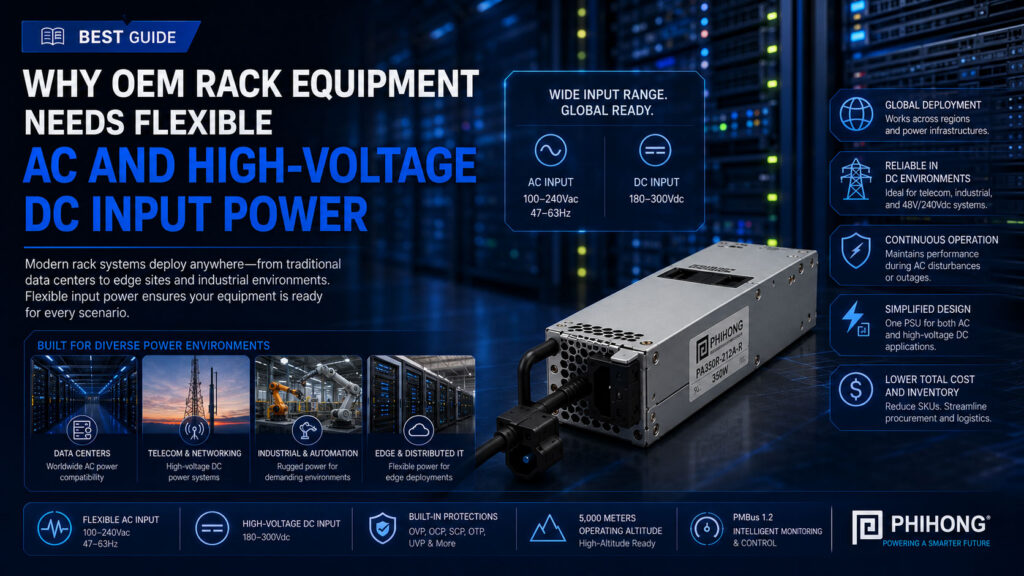
OEM rack equipment may be deployed into very different power environments. Some systems are installed in commercial buildings with standard AC mains. Others may be used in telecom, datacom, infrastructure, industrial, or backup-power environments where high-voltage DC input is part of the facility power architecture. For OEM teams, this means input flexibility can become a product-design advantage, not just a power-supply detail.
Phihong’s PA350R-212A-R is a useful product-specific example because the datasheet lists both 100Vac to 240Vac input and 180Vdc to 300Vdc input. That gives OEMs a front-end rack power reference for systems that may need to operate across multiple infrastructure types. Instead of designing one rack platform for AC-only environments and another for DC-powered installations, product teams can evaluate whether a flexible input front-end PSU can simplify deployment planning, documentation, service strategy and SKU control.
| Input Power Need | Why It Matters for OEM Rack Equipment | What Teams Should Review |
|---|---|---|
| AC mains operation | Many rack products are deployed into standard facility power environments. | 100Vac to 240Vac support, input current, inrush, leakage and regional deployment. |
| High-voltage DC input | Some telecom, datacom, industrial, or infrastructure sites may use DC power architecture. | 180Vdc to 300Vdc range, polarity, protection, cabling and installation guidance. |
| Global deployment | Rack equipment may be sold into regions with different facility power assumptions. | Target markets, input documentation, labels, certifications and customer requirements. |
| Platform flexibility | One power architecture may support more deployment scenarios. | SKU planning, system validation, service parts and lifecycle support. |
Why This Matters
• Flexible AC and high-voltage DC input can help OEM rack systems support more deployment environments.
• Input range should be reviewed early because it affects system architecture, documentation, compliance and service planning.
What OEMs Should Do Now
• Identify whether the rack platform will be deployed into AC-only, DC-powered, or mixed infrastructure environments.
• Review input voltage range, current, inrush, leakage, protection behavior and installation documentation before finalizing the PSU.
Useful Links
PA350R-212A-R Product Page: www.phihong.com/products/adapters/pa350r-212a-r/
PA350R-212A-R 350W Front-End Power Supply Datasheet: www.phihong.com/wp-content/uploads/New-datasheet-PA350R-212A-R-09082025.pdf
Open-Frame / Internal PSU Product Line: www.phihong.com/products/open-frame-internal-psu/
Related Links
Best Guide to Intelligent Rack Power Supplies: PMBus, Redundancy, and Digital Front-End Power: www.phihong.com/best-guide-to-intelligent-rack-power-supplies-pmbus-redundancy-and-digital-front-end-power/
What Is PMBus and Why Does It Matter in Front-End Power Supplies?: www.phihong.com/what-is-pmbus-and-why-does-it-matter-in-front-end-power-supplies/
FEATURED PRODUCTS
AM250U-540AP-R
AA240U-200A-R
AA240U-200B-R
AA280U-200B-R
AA240U-59FKEA-R
AA36U-240B-R

When does high-voltage DC input become important for telecom, datacom, and industrial racks?
High-voltage DC input becomes important when rack equipment may be installed in environments that do not rely only on conventional AC mains. Telecom and infrastructure systems may have different power distribution requirements than office equipment. Industrial and datacom environments may also include power architectures designed for backup, centralized conversion, battery-connected systems, or facility-level DC distribution. In those situations, a rack product that supports only AC input may limit where it can be deployed.
For OEMs, the important point is not that every rack product needs high-voltage DC input. The real issue is deployment uncertainty. A platform may begin as an AC-powered product but later be requested for infrastructure environments where DC input compatibility is valuable. If this possibility is not considered early, adding DC input later may require power architecture changes, documentation updates, qualification work and sourcing adjustments. A front-end PSU with both AC and DC input support can give product teams more room to serve these environments.
| Deployment Environment | Why DC Input May Matter | What OEM Teams Should Review |
| Telecom equipment | Telecom sites may use DC-oriented infrastructure or backup power strategies. | DC voltage range, wiring, protection, grounding and installation requirements. |
| Datacom systems | Rack systems may be deployed in facilities with specific power distribution models. | Input compatibility, uptime needs, redundancy and service process. |
| Industrial racks | Industrial environments may use dedicated power architecture for control systems. | DC source stability, cabling, environmental limits and safety documentation. |
| Infrastructure platforms | Remote or backup-supported systems may need more input flexibility. | Battery systems, power conversion chain, field service and customer documentation. |
Why This Matters
• High-voltage DC input can make rack equipment more adaptable to telecom, datacom, industrial and infrastructure deployments.
• OEMs should evaluate DC input needs before the product architecture becomes difficult to change.
What OEMs Should Do Now
• Ask target customers and channel teams whether DC input support is expected in any deployment scenario.
• Validate DC input behavior with the intended wiring, protection, grounding and operating conditions.
Useful Links
PA350R-212A-R Product Page: www.phihong.com/products/adapters/pa350r-212a-r/
PA350R-212A-R 350W Front-End Power Supply Datasheet: www.phihong.com/wp-content/uploads/New-datasheet-PA350R-212A-R-09082025.pdf
Product Finder: www.phihong.com/product-finder/
Related Links
Best Guide to Intelligent Rack Power Supplies: PMBus, Redundancy, and Digital Front-End Power: www.phihong.com/best-guide-to-intelligent-rack-power-supplies-pmbus-redundancy-and-digital-front-end-power/
The Power Supply Decisions OEMs Regret Most and Why They’re Hard to Fix Later: www.phihong.com/the-power-supply-decisions-oems-regret-most-and-why-theyre-hard-to-fix-later/
How does AC/DC input flexibility affect power status, startup, and system control?
Input flexibility affects more than the power source. It also affects how the rack system detects whether input power is valid, how the power supply enables outputs and how the controller responds to power-state changes. A rack system that may accept either AC or high-voltage DC input needs clear status behavior so the system controller can understand whether input is available and whether the output rails are ready.
The PA350R-212A-R datasheet includes AC_OK behavior that indicates input AC/DC OK, along with PW_OK, PS_ON, PS_KILL and PMBus-related signals. For OEM teams, these signals help connect input power behavior to the system controller and backplane design. Flexible input power is most valuable when the system can monitor it properly. If the rack controller cannot distinguish input status, output readiness and fault behavior, the design may lose some of the benefits of digital front-end power.
| System Control Area | Why Input Flexibility Affects It | What OEM Teams Should Review |
| Input status | The controller needs to know whether AC or DC input is valid. | AC_OK behavior, thresholds, timing and fault handling. |
| Output readiness | The system needs to know when output rails are stable. | PW_OK timing, 12V output status and standby power availability. |
| Enable logic | Rack systems may need controlled startup and shutdown behavior. | PS_ON, PS_KILL, sequencing and firmware response. |
| PMBus monitoring | Digital telemetry can help track input and operating conditions. | READ_VIN, READ_IIN, STATUS_INPUT, alert behavior and event logging. |
Why This Matters
• Flexible input power should be tied to clear status signals and controller behavior.
• AC_OK, PW_OK, PS_ON, PS_KILL and PMBus data help OEMs manage startup, shutdown and fault response.
What OEMs Should Do Now
• Map input status and output readiness signals into the rack controller before finalizing firmware.
• Validate AC input and DC input startup behavior separately under expected load and environmental conditions.
Useful Links
PA350R-212A-R Product Page: www.phihong.com/products/adapters/pa350r-212a-r/
PA350R-212A-R 350W Front-End Power Supply Datasheet: www.phihong.com/wp-content/uploads/New-datasheet-PA350R-212A-R-09082025.pdf
Open-Frame / Internal PSU Product Line: www.phihong.com/products/open-frame-internal-psu/
Related Links
What Is PMBus and Why Does It Matter in Front-End Power Supplies?: www.phihong.com/what-is-pmbus-and-why-does-it-matter-in-front-end-power-supplies/
Why 12V Main and 5V Standby Power Matter for Rack System Management: www.phihong.com/why-12v-main-and-5v-standby-power-matter-for-rack-system-management/
CLIENT'S QUOTE
Phihong’s custom OEM power solutions have transformed our product development, boosting performance and reducing overhead. Their expert engineering support has simplified both the design and manufacturing phases.
What should OEMs validate before relying on flexible AC and high-voltage DC input?
OEMs should validate AC and high-voltage DC input separately before relying on one rack power design across multiple deployment environments. AC input and DC input may share the same front-end PSU platform, but they can create different behavior in startup, protection, wiring, grounding, installation, documentation and service. A product that performs correctly on 120Vac or 240Vac should still be tested under the intended high-voltage DC conditions before it is released for infrastructure use.
This validation is especially important when rack equipment is sold into telecom, datacom, industrial or field environments where the OEM may not fully control the final installation. Teams should confirm input voltage range, startup timing, inrush behavior, protection response, leakage, conducted emissions, thermal behavior and system controller response. They should also confirm that service teams and installers understand whether the system is operating from AC or DC input and what that means for wiring, safety and replacement procedures.
| Validation Area | Why It Matters | What OEM Teams Should Review |
|---|---|---|
| AC input behavior | Confirms operation in standard commercial and global facility environments. | 100Vac to 240Vac range, inrush, leakage, startup timing and protection response. |
| High-voltage DC behavior | Confirms readiness for telecom, infrastructure and specialized power environments. | 180Vdc to 300Vdc range, polarity, wiring, grounding and input protection. |
| System status | The controller must respond correctly to input validity and output readiness. | AC_OK, PW_OK, PMBus input status, alerts and fault logging. |
| Installation documentation | AC and DC input use may require different field guidance. | Labels, safety notes, wiring diagrams, service procedures and customer instructions. |
Why This Matters
• Flexible AC/DC input only helps OEMs when both input paths are validated under real deployment conditions.
• Input behavior affects startup, protection, compliance, service documentation and rack controller logic.
What OEMs Should Do Now
• Test AC input and high-voltage DC input as separate production validation scenarios.
• Document input wiring, safety requirements, service procedure and controller behavior for each supported input mode.
Useful Links
PA350R-212A-R Product Page: www.phihong.com/products/adapters/pa350r-212a-r/
PA350R-212A-R 350W Front-End Power Supply Datasheet: www.phihong.com/wp-content/uploads/New-datasheet-PA350R-212A-R-09082025.pdf
Open-Frame / Internal PSU Product Line: www.phihong.com/products/open-frame-internal-psu/
Related Links
Best Guide to Intelligent Rack Power Supplies: PMBus, Redundancy, and Digital Front-End Power: www.phihong.com/best-guide-to-intelligent-rack-power-supplies-pmbus-redundancy-and-digital-front-end-power/
What Is PMBus and Why Does It Matter in Front-End Power Supplies?: www.phihong.com/what-is-pmbus-and-why-does-it-matter-in-front-end-power-supplies/
How Phihong supports OEM rack equipment with AC and high-voltage DC input power
For OEM teams designing rack equipment that may need both AC and high-voltage DC input, Phihong’s PA350R-212A-R provides a product-specific reference. It is a 350W front-end power supply with 12V main output, 5V standby output, PMBus support, active current sharing, redundancy support and flexible AC/DC input capability. The datasheet lists 100Vac to 240Vac and 180Vdc to 300Vdc input support, giving rack equipment teams a starting point for mixed infrastructure planning.
The best fit is not every rack system. The strongest use case is equipment that may be sold into enterprise, telecom, datacom, industrial, backup-supported or infrastructure environments where input flexibility can reduce platform fragmentation. OEM teams should compare the PA350R-212A-R datasheet against the rack architecture, input power plan, backplane design, controller firmware, PMBus requirements, airflow path, compliance targets and service documentation before moving into production.
| Phihong Product Area | Why It Helps OEM Teams | What Teams Should Review |
|---|---|---|
| PA350R-212A-R | Provides a 350W rack front-end PSU reference with AC/DC input support. | Input range, output ratings, PMBus, protections and redundancy features. |
| AC input capability | Supports standard facility power environments. | Global AC range, inrush, leakage, input status and compliance planning. |
| High-voltage DC input | Supports infrastructure-oriented power environments. | DC source range, wiring, grounding, protection and customer documentation. |
| Digital rack integration | Connects input behavior with status signals and PMBus monitoring. | AC_OK, PW_OK, PS_ON, alerts, controller logic and validation procedure. |
Why This Matters
• Product-specific AC/DC input support helps OEMs plan rack equipment for more deployment environments.
• Flexible input power should be evaluated with controller logic, documentation, safety, EMI, thermal behavior and service needs.
What OEMs Should Do Now
• Start with the PA350R-212A-R datasheet and map AC/DC input behavior to the actual rack platform.
• Validate input range, startup, fault response, PMBus status, thermal behavior and service documentation before production release.
Useful Links
PA350R-212A-R Product Page: www.phihong.com/products/adapters/pa350r-212a-r/
PA350R-212A-R 350W Front-End Power Supply Datasheet: www.phihong.com/wp-content/uploads/New-datasheet-PA350R-212A-R-09082025.pdf
Open-Frame / Internal PSU Product Line: www.phihong.com/products/open-frame-internal-psu/
Related Links
Best Guide to Intelligent Rack Power Supplies: PMBus, Redundancy, and Digital Front-End Power: www.phihong.com/best-guide-to-intelligent-rack-power-supplies-pmbus-redundancy-and-digital-front-end-power/
How Redundant Front-End Power Supplies Share Load Across Multiple Units: www.phihong.com/how-redundant-front-end-power-supplies-share-load-across-multiple-units/
Why 12V Main and 5V Standby Power Matter for Rack System Management: www.phihong.com/why-12v-main-and-5v-standby-power-matter-for-rack-system-management/
Flexible AC and high-voltage DC input power can help OEM rack equipment support more deployment environments without redesigning the full power architecture for every customer site. That flexibility matters most when products may be used in enterprise racks, telecom infrastructure, datacom systems, industrial control environments or backup-supported installations.
The strongest rack power designs treat input flexibility as a system decision. OEM teams should evaluate the front-end PSU, input wiring, status signals, PMBus behavior, controller firmware, thermal performance, compliance path and service documentation together before releasing a flexible AC/DC input product into the field.

CONTACT US TODAY
From concept to production, Phihong delivers custom OEM power solutions tailored to your specifications.
FAQ
Why would OEM rack equipment need both AC and high-voltage DC input?
OEM rack equipment may be deployed into different facility power environments. Some sites use standard AC mains, while telecom, datacom, industrial, or infrastructure environments may require high-voltage DC input. Supporting both input types can help reduce platform fragmentation and give product teams more deployment flexibility. OEMs should still validate each input path separately under the intended operating conditions.
What is high-voltage DC input in rack power systems?
High-voltage DC input refers to a DC input range used by some rack and infrastructure power architectures instead of standard AC mains. In the PA350R-212A-R datasheet, the listed DC input range is 180Vdc to 300Vdc. OEM teams should review DC source stability, wiring, polarity, grounding, protection behavior and installation documentation before supporting this input mode.
Does AC/DC input flexibility replace the need for system validation?
No. Flexible input capability gives OEMs more design options, but it does not eliminate validation. AC and DC input modes should be tested separately for startup, inrush, protection response, thermal behavior, EMI, safety, status reporting and controller response. The rack system should also include clear installation and service documentation for each input type.
How does PMBus help with flexible input power?
PMBus can help the system controller monitor input conditions, output status, alerts and operating behavior. In a rack system with flexible AC/DC input, PMBus and signals such as AC_OK and PW_OK can help controller firmware understand whether input power is valid and whether output rails are ready. OEMs should map these signals into the system firmware and validation plan.
What should OEMs check before selecting an AC/DC input front-end PSU?
OEMs should check AC input range, DC input range, input current, inrush, leakage, protection features, PMBus support, status signals, 12V output, 5V standby output, redundancy support, thermal behavior, EMI, safety documentation and installation requirements. The power supply should be validated with the final rack backplane, controller, airflow path and expected deployment environments.
POE technology supports the centralization of power

AC Adapter Guide: Everything You Need to Know
Moreover, PoE technology supports the centralization of power management. By powering devices through a PoE-enabled network …
AC DC Power Chargers and How They Work: A Comprehensive Technical Breakdown
Moreover, PoE technology supports the centralization of power management. By powering devices through a PoE-enabled network …

USB-C Charger: Shaping the Future of the Tech World
Moreover, PoE technology supports the centralization of power management. By powering devices through a PoE-enabled network …

AC Adapter Guide: Everything You Need to Know
Moreover, PoE technology supports the centralization of power management. By powering devices through a PoE-enabled network …

AC DC Power Chargers and How They Work: A Comprehensive Technical Breakdown
Moreover, PoE technology supports the centralization of power management. By powering devices through a PoE-enabled network …

USB-C Charger: Shaping the Future of the Tech World
Moreover, PoE technology supports the centralization of power management. By powering devices through a PoE-enabled network …