








BLOG
Can a 45W USB-C PD Charger Power a Laptop, Tablet or Phone?
QUICK LINKS
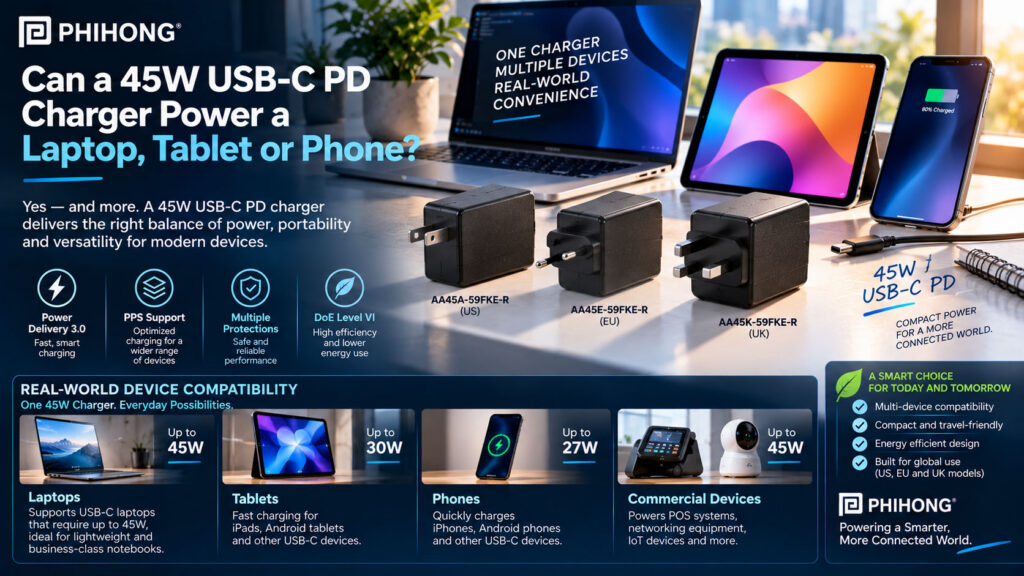
A 45W USB-C PD charger can power a laptop, tablet or phone when the device accepts a supported power contract and the available power meets its intended operating requirement. It may power the device without achieving the battery charging rate you expect. Some devices require more power, a different accepted profile or manufacturer-approved accessories.
For OEM qualification, replace the question “Does it have USB-C?” with “Does this exact device configuration accept and use the AA45 charger’s available power?” Phihong’s AA45A-59FKE-R, AA45E-59FKE-R and AA45K-59FKE-R provide a documented 45W PD 3.0 family for that assessment. The process below focuses on device acceptance and failure diagnosis rather than promising compatibility across whole product categories.
What must match between the 45W charger and the device?
Match three things: the device’s accepted voltage, the available current at that voltage and the power needed for the promised behavior. The AA45 fixed profiles are documented as 5V at up to 3A, 9V at up to 3A, 15V at up to 3A and 20V at up to 2.25A. That means the family’s 45W ceiling is available through the 15V and 20V profiles, not automatically through every contract.
A device requesting 20V at 3A asks for more than the AA45 family’s documented 20V continuous capability. A lower-power device accepting 9V might fit within the 27W fixed-profile ceiling, but the actual negotiated contract and operating demand still need verification. These examples are electrical comparisons, not evidence that a particular laptop or phone has been tested.
| Check | Acceptable evidence | Common mistaken inference |
|---|---|---|
| Voltage | Device specification and observed accepted profile | A USB-C plug means any voltage is usable |
| Current | Contract limit and measured input demand | 45W is available at every voltage |
| Function | Startup and representative workload tests | A charging icon proves full functionality |
| Battery target | Battery trend under defined conditions | Powering the device means charging it quickly |
Keep the manufacturer’s requirements alongside your measurements. An observed successful connection does not authorize an accessory configuration that the equipment manufacturer excludes.
Why This Matters
- The agreed contract determines available input power more precisely than the charger’s headline rating.
- Device acceptance includes functional behavior and permitted accessory use, not just electrical connection.
What OEMs Should Do Now
- Compare the device’s accepted profiles with the AA45 fixed output table.
- Capture the actual negotiated contract and test the required behavior on the exact configuration.
Useful Links
AA45 output profile and current specifications and USB-IF explanation of Power Delivery
FEATURED PRODUCTS


For the surrounding 45W family-selection decisions, review 45W USB-C wall charger selection, AA45 regional plugs and integration differences and 45W charger load and charging-time planning.
Why can a laptop connect successfully but charge slowly or lose battery?
A laptop may establish a PD contract and still have little power left for battery charging. Its processor, display and attached equipment consume part of the input. Internal conversion and charging circuitry also affect how much reaches the battery. The charging indicator alone does not show whether the complete power budget meets the intended use.
Evaluate battery behavior during the workload the product team intends to support. A lightly used laptop may charge while a more demanding configuration runs at a stable battery level or discharges. Firmware can also limit performance or decline a lower-power input. Those responses are device-specific. Do not claim a particular result without measuring it on the supported hardware, firmware and accessory set.
| Observed outcome | What it suggests | Next check |
|---|---|---|
| Battery rises during use | Some charging power is available in that test state | Confirm the required rate across the intended workload |
| Battery remains stable | Little or no net charging in that state | Review the promised charging behavior |
| Battery falls while connected | The system is using battery energy during the test | Check contract, demand and power-management policy |
| Device reports insufficient power | Its acceptance policy is not satisfied | Review manufacturer requirements and negotiation logs |
Include depleted-battery startup and the low-battery operating state in your matrix. Results from an already charged, idle laptop do not establish those conditions. Record input voltage and current as well as the battery trend so the failure can be investigated.
Why This Matters
- Successful PD negotiation does not establish the required battery charging rate during operation.
- A configuration that relies on battery assistance may fail the intended continuous-use requirement.
What OEMs Should Do Now
- Define acceptable battery behavior for startup, normal use and the demanding supported workload.
- Log negotiated power, actual input demand and device behavior together.
Related Links
Phihong’s guide to higher-power 65W USB-C adapter formats
What additional checks apply to tablets and phones using PPS?
A tablet or phone may accept fixed PD, PPS or another charging implementation. Verify the required mode for the target device. A 45W adapter does not force a smaller device to consume 45W, and the presence of PPS does not establish every branded charging feature or advertised recharge time.
The AA45 family technical document lists PPS support and a 5V to 21V range. Check the actual advertised programmable capabilities against the device’s requested operating points. The voltage range alone is insufficient to infer an available current at every point. Obtain clarification if the specific PPS combination needed by the device is not clear in the supplied documentation.
| Device requirement | Evidence to seek |
|---|---|
| Fixed PD charging | Accepted fixed profile and current contract |
| PPS-dependent charging | Advertised programmable capability and observed requests |
| Named fast-charging feature | Device manufacturer’s accessory conditions and actual test results |
| Target recharge time | Defined battery state, workload and temperature test |
Battery charge level and device temperature can change charging behavior. Establish the starting conditions when comparing results. Otherwise, a slower charge observed in one test could be attributed to the adapter when the device’s own charging policy caused it.
Why This Matters
- A protocol label cannot substitute for the exact programmable capability the sink requests.
- Different battery and thermal states can make unstructured charging comparisons misleading.
What OEMs Should Do Now
- Confirm the intended charging mode with the device documentation and a PD capture.
- Repeat the test at defined battery and temperature states before making a charging claim.
Useful Links
Related Links
Phihong’s background explanation of PD profiles and PPS
How do commercial devices change the compatibility test matrix?
Commercial devices should be tested in the sold configuration. A tablet terminal may add a display, scanner or communications accessory. A networking device may be expected to restart unattended after a power interruption. The equipment’s role determines which behaviors must be proven; a consumer charging demonstration is not a complete acceptance test.
Use the AA45 supplied output assembly in those tests. Its technical document identifies an attached cable with a USB-C plug. Confirm connector seating, route and strain relief at the actual device. Do not substitute an arbitrary cable or infer data capabilities from the plug. If a dock sits between the charger and device, evaluate that entire path, including the power available to the final sink.
| State | Behavior to evaluate | Configuration to retain |
|---|---|---|
| Cold start | Boot and initial contract establishment | Firmware, battery state and accessories |
| Continuous use | Functions and battery behavior during the workload | Display settings, communications and peripherals |
| Sleep and wake | Recovery and resumed operation | Device power-management settings |
| Power interruption | Expected restart or user recovery | Interruption procedure and observed response |
| Physical installation | Connector clearance and cable stability | Stand, enclosure and cable route |
Set the acceptance criteria before testing. “It remained connected” is inadequate when the product promise includes uninterrupted application operation, autonomous recovery or a minimum recharge rate. Evaluate the promised behavior explicitly and retain exceptions for engineering review.
Why This Matters
- Accessories and recovery requirements can change whether a charger fits the commercial application.
- Traceable configurations prevent a result from being applied to an untested device variant.
What OEMs Should Do Now
- Build the matrix around the shipped device, accessories and intended installation.
- Record acceptance criteria and observed exceptions for each operating state.
Useful Links
AA45 cable, environmental and electrical information
How should OEMs document AA45 acceptance with Phihong?
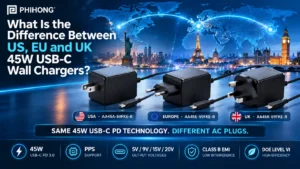
Link each approved device configuration to the full adapter part number. The AA45A US version, AA45E EU version and AA45K UK version share the family’s documented output architecture, but regional physical installation and supporting market documentation still require review.
Send Phihong a focused acceptance summary: device input requirements, observed contracts, operating demand, charging targets and unresolved behavior. If the device does not select the expected profile, include negotiation evidence. If battery performance falls short, include the workload and battery trend. That evidence distinguishes an unsupported requirement from a configuration issue or a question requiring supplier clarification.
Approve the tested configuration rather than an unlimited device category. Identify hardware and firmware revisions, accessories, destinations and the supplier document revision used. Reassess material changes that affect input behavior. A compatibility record is useful precisely because it states its boundaries. Product pages and datasheets support the assessment, but they do not prove that a particular third-party device has passed your tests.
Why This Matters
- A bounded acceptance record helps purchasing preserve the configuration engineering actually evaluated.
- Failure evidence gives the supplier a specific issue to assess without overstating what the charger should support.
What OEMs Should Do Now
- Associate each device acceptance result with the regional adapter, firmware and accessory configuration.
- Ask Phihong to clarify unresolved contract capabilities before approving the kit.
Useful Links
Discuss device acceptance and AA45 requirements with Phihong
A 45W charger should be accepted on evidence from the intended device, not its connector or product category. Confirm the contract, operating behavior and battery target, then preserve that qualified configuration. Contact Phihong with the requirements and test observations that remain unresolved.
Frequently Asked Questions
Will a 45W charger damage a phone that uses less power?
The 45W rating states available capability, not a command for every connected device to consume that amount. USB PD uses an agreed contract. That explanation is not a blanket safety guarantee for every device or accessory. Follow the device manufacturer’s requirements and verify the actual adapter, connection and charging configuration.
Can a 45W charger replace a laptop’s 65W charger?
It may fit some operating requirements, but substitution needs device-specific approval. Check accepted profiles, minimum startup power and battery charging during the intended workload. A laptop may limit performance, report insufficient power or use battery energy while connected. The original manufacturer’s adapter guidance remains relevant even when a bench test appears successful.
Does PPS support mean a phone will charge at 45W?
No. The phone must request a supported programmable operating point and permit that charging behavior under the test conditions. Battery state, temperature and device charging policy can affect the result. Verify the actual PPS capability and manufacturer requirements instead of deriving a charging rate from the adapter’s total rating.
Can an AA45 charger power a USB-C dock and laptop together?
Evaluate the complete power path. The dock may consume input power and limit what it offers the laptop. Check the dock’s input requirement, downstream contract and connected peripherals. The AA45 rating alone does not establish sufficient power for both devices or the laptop’s desired charging performance.
What proves compatibility for an OEM product?
A traceable acceptance record should identify the adapter, device revision, firmware, accessories and installation. It should show the negotiated contract and successful results against defined startup, operating and charging criteria. Include applicable manufacturer guidance and market documentation. A charger connection or a charging icon alone does not provide that evidence.