








BLOG
When Is a 45W USB-C Charger Enough Instead of a 65W Adapter?
QUICK LINKS
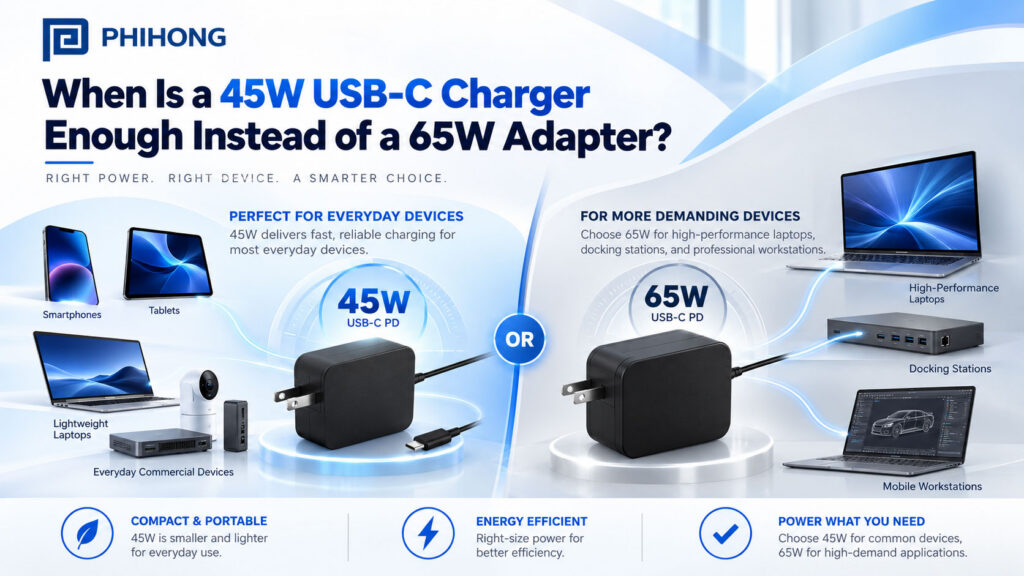
A 45W USB-C charger is enough when the device accepts an available power profile and that profile supports the intended workload and charging target under the qualified conditions. A 65W adapter becomes a candidate when the system needs more usable input power, but only if its exact output capabilities and the device’s accepted contracts support that requirement.
For OEM teams, the decision should come from a measured power budget. Neither “smaller is sufficient” nor “more watts is better” is a reliable selection rule. Phihong’s AA45 regional family provides a documented 45W baseline. Use that baseline to decide whether the product fits, needs a changed charging target or requires evaluation of a higher-power adapter.
Which output profile sets the actual 45W limit?
The relevant limit is the power available at the profile your device accepts. For the AA45 family, the fixed outputs are documented as up to 3A at 5V, 9V and 15V, and up to 2.25A at 20V. The resulting nominal power ceilings are 15W, 27W, 45W and 45W. They are separate operating contracts, not concurrent outputs.
Start the comparison with the sink requirement. If it needs more current at 9V than the selected source supports, a higher total wattage printed on another adapter does not automatically solve the problem. Check that alternative’s actual 9V capability. Similarly, a device accepting only a lower-power contract may never use the additional capacity of a nominally 65W source.
| Fixed profile | Documented continuous current | Calculated nominal power ceiling |
|---|---|---|
| 5V | 3A | 15W |
| 9V | 3A | 27W |
| 15V | 3A | 45W |
| 20V | 2.25A | 45W |
PPS is also a profile-specific decision. The AA45 document lists PPS support, but the voltage range alone does not establish current at every programmable operating point. Confirm advertised capabilities before using PPS in the power budget.
Why This Matters
- A wattage comparison is incomplete when it ignores the voltage and current contract the sink can use.
- A higher-rated source can leave a profile mismatch unresolved.
What OEMs Should Do Now
- Identify the intended fixed or programmable contract before comparing adapter wattages.
- Check the exact alternative adapter’s capability rather than transferring AA45 specifications to it.
Useful Links
AA45 electrical and PPS specifications and USB-IF overview of negotiated Power Delivery
FEATURED PRODUCTS


To relate the load budget to the selected charger and regional variant, review 45W USB-C wall charger selection, matching a 45W USB-C charger to device input requirements and AA45 regional plugs and integration differences.
How should operating load and battery charging be measured?
Measure at a clearly identified point and retain the operating conditions. A device input reading is different from wall-side AC power, processor power or battery charging power. Using values from those different locations without accounting for conversion losses can produce a misleading budget. Define the measurement boundary before deciding how much source capacity remains.
Exercise the intended workload with the actual accessories and charging policy. Include boot, sustained use, low-battery operation and the most demanding supported peripheral configuration. Observe battery behavior alongside input voltage and current. A stable charging icon cannot reveal whether the device is meeting the promised operating performance or replenishing its battery at the required rate.
| Test condition | Record | Decision it supports |
|---|---|---|
| Idle and normal use | Input demand and battery trend | Baseline operating fit |
| Demanding supported workload | Voltage, current, performance and charging behavior | Sustained capacity requirement |
| Low-battery startup | Boot result and negotiated contract | Minimum startup acceptance |
| Accessories connected | Complete configuration and power path | Shipped-system requirement |
Use appropriate instrumentation and test procedures selected by engineering. Retain device and firmware revisions so measurements are reproducible. A brief peak reading and an averaged sustained load answer different questions; keep both where relevant instead of treating one as a substitute for the other.
Why This Matters
- A shared measurement boundary prevents wall power and device power from being compared as if they were identical.
- Operating and battery behavior show whether the adapter meets the product promise, not merely whether it connects.
What OEMs Should Do Now
- Define the measurement point, workloads, accessories and battery starting conditions.
- Record sustained demand and relevant transitions alongside charging and functional results.
Related Links
PD and PPS background in Phihong’s 65W guide
How much headroom does a 45W selection actually leave?
Headroom is the difference between the usable source capability at the selected contract and the requirement evaluated at the same measurement boundary. It is not a universal percentage. The margin needed depends on workload variation, charging targets, environmental conditions, measurement uncertainty and the system’s response when power is constrained.
The table below illustrates simple subtraction from a 45W profile ceiling. The input figures are hypothetical budgets including operation and charging. They are not results from Phihong equipment or a customer device, and the arithmetic does not establish transient or thermal performance.
| Hypothetical required device input | Difference from 45W | Engineering interpretation |
|---|---|---|
| 31W | 14W remaining | Evaluate whether the remaining margin covers the qualified conditions |
| 40W | 5W remaining | Review variation and charging expectations carefully |
| 49W | 4W short | The stated continuous requirement exceeds this profile ceiling |
A nominally adequate budget still needs system testing. Battery-assisted operation can hide a shortfall, and device firmware may reduce demand by limiting functionality. Conversely, a product with a modest, well-characterized workload may not need the unused capacity of a larger source. Document the accepted behavior instead of selecting wattage by habit.
Why This Matters
- A visible margin clarifies what engineering has actually reserved for variation and charging.
- Arithmetic headroom is not proof that transitions, environmental limits or charging targets have passed.
What OEMs Should Do Now
- Calculate margin using the accepted contract and the complete defined input requirement.
- Justify the chosen margin with test evidence and document allowed power-management behavior.
Useful Links
AA45 continuous output and environmental conditions
When should the OEM evaluate a 65W adapter instead?
Evaluate a higher-power adapter when the qualified requirement exceeds the usable AA45 capability, when battery behavior misses the target during supported workloads or when startup and accessories require a contract the selected 45W configuration cannot provide. First diagnose the limiting factor. Additional source power cannot repair every firmware, connector or profile-selection issue.
A 65W label identifies an overall rating, not a guaranteed improvement for your device. Obtain the candidate’s fixed and programmable capabilities, output assembly details and operating conditions. Confirm that the sink accepts the relevant contract. Re-run the same system test matrix so the comparison evaluates actual behavior under matching conditions.
| Observed issue | Question before increasing wattage |
|---|---|
| Continuous budget exceeds the selected profile | Can the alternative deliver the required voltage and current? |
| Battery falls during required use | Is the limitation source capacity, charging policy or another constraint? |
| Startup is refused | What minimum contract does the device require? |
| Docked configuration misses the target | How much power reaches the final device after the dock? |
Do not borrow short-duration overload behavior to justify a larger continuous requirement. Similarly, do not promise faster charging, lower temperature or higher efficiency just because the candidate’s nameplate power is larger. Those outcomes require appropriate model and system evidence.
Why This Matters
- Identifying the actual constraint avoids treating every charging issue as a wattage shortage.
- A controlled comparison prevents untested performance claims about the higher-power alternative.
What OEMs Should Do Now
- State the unmet requirement and select a candidate whose documented contract addresses it.
- Repeat the same qualification conditions and compare measured outcomes.
Related Links
Phihong’s guide to 65W USB-C adapter formats
How can Phihong support the final 45W versus 65W decision?
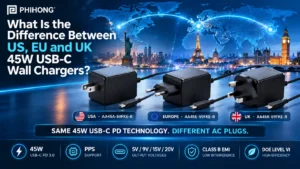
Use the AA45A US model, AA45E EU model and AA45K UK model as the documented 45W regional candidates. Match the electrical requirement first, then preserve the regional installation and documentation review. A common power budget does not make the plug assemblies interchangeable.
When asking Phihong to review a higher-power option, provide the accepted device profiles, measured input demand, charging target and the behavior that the 45W candidate did not satisfy. Include accessories and any intermediate dock. This gives the supplier a concrete requirement and prevents the selection from becoming a comparison of wattage labels alone.
Keep the final decision traceable. If 45W is accepted, record the supported workload, battery behavior and qualification conditions. If another adapter is chosen, record its full model and the new evidence. Check current release documentation and availability separately. Neither the article nor the product page establishes commercial supply status or completion of a destination-market assessment.
Why This Matters
- A documented budget makes the chosen wattage understandable to engineering, purchasing and product teams.
- The supplier can assess a specific unmet requirement more effectively than an undefined request for more power.
What OEMs Should Do Now
- Send Phihong the profile-specific budget and the relevant qualification observations.
- Release the adapter choice only after the defined operating, charging and regional criteria are resolved.
Useful Links
Review your adapter power requirement with Phihong
Choose 45W when the qualified system meets its required behavior within an accepted AA45 profile. Evaluate a higher-power option when a documented requirement remains unmet, then verify the exact candidate. Contact Phihong with your budget and test evidence to review the next step.
Frequently Asked Questions
Is a 65W charger always better than a 45W charger?
No. The device must accept and use the relevant power contract, and the larger adapter must fit the mechanical and regional requirements. If a 45W configuration meets the qualified workload and charging target, unused source capacity alone does not establish an improvement. Compare the actual candidates and measured system outcomes.
Can a laptop run from 45W while using its battery?
Some device configurations may supplement adapter power with battery energy, but that behavior is device-specific and requires testing. A falling battery level while connected may fail a continuous-use requirement even if the laptop remains on. Define whether battery-assisted operation is allowed and whether the product must recharge during the intended workload.
Should every design reserve a fixed percentage of spare power?
No universal percentage is established by the AA45 specification. Determine margin from the accepted contract, workload variation, charging target and qualified conditions. State the measurement boundary and test evidence supporting the decision. A percentage calculated from a headline rating can be misleading when the sink uses a lower-power profile.
Will a higher-power adapter charge the device faster?
Only if the device and adapter can establish a suitable contract and the device’s charging policy permits the additional input under those conditions. Battery state, temperature and system demand can constrain charging. A 65W rating alone is not evidence of a shorter recharge time for a particular device.
What information should an OEM send for a wattage review?
Send accepted voltage and current profiles, measured device input demand, battery charging targets, startup requirements and accessory details. Identify the test conditions and any behavior that failed acceptance. Include regional kit and installation constraints so the power decision leads to an adapter configuration the finished product can actually use.