








BLOG
Coreless DC Cord vs Ferrite Core: What Changes in High-Power Adapter Cable Design?
QUICK LINKS
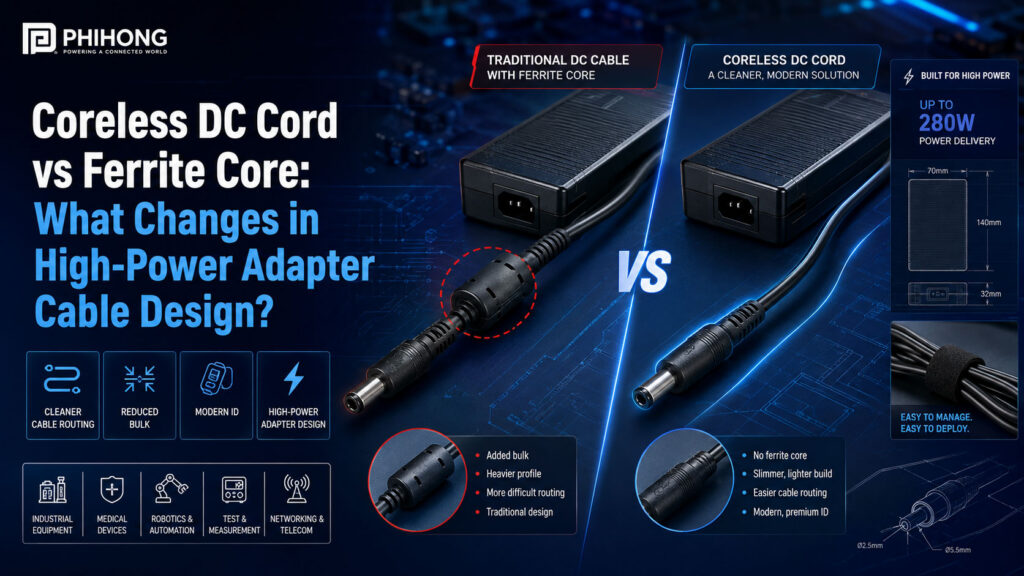
What does a ferrite core do on a power adapter cable?
A ferrite core on a power adapter cable is commonly used to help suppress certain high-frequency electromagnetic noise. In many traditional power adapter designs, the ferrite appears as a visible cylinder or block around the DC output cable. It is not decorative. It is part of the broader electromagnetic compatibility strategy that helps reduce unwanted noise traveling along the cable.
For OEM engineers, the important point is that the cable is part of the power system. The adapter, DC cord, connector, device load, PCB design, shielding and grounding all influence EMI behavior. A ferrite core can help control certain common-mode noise conditions, but it does not solve every EMC issue by itself. In high-power adapter design, engineers must review the cable and adapter together instead of treating the ferrite as a standalone fix.
| Ferrite Core Area | Why It Matters | What OEM Teams Should Review |
|---|---|---|
| EMI suppression | Ferrites can help reduce certain high-frequency noise on a cable. | Noise frequency range, cable path, load behavior and emissions test data. |
| Cable location | The ferrite is often placed externally on the DC cord. | Cord length, ferrite position, connector placement and product packaging. |
| System-level effect | Cable noise depends on the adapter and powered device together. | Adapter design, device load, grounding, shielding and final EMC testing. |
| Mechanical impact | A ferrite core adds bulk and weight to the cord. | Cable handling, wrapping, appearance, strain relief and user experience. |
Why This Matters
• Ferrite cores are commonly used to help manage high-frequency EMI behavior in power cables.
• Removing a visible ferrite core does not remove the need for system-level EMC engineering.
What OEMs Should Do Now
• Treat the DC cord as part of the complete adapter system, not just a cable accessory.
• Review ferrite use, cable routing, adapter architecture and final EMC testing together before approving a design.
Useful Links
Power Adapter Product Line: www.phihong.com/products/adapters/
What Compliance Engineers Look for in Internal PSUs: EMI, EMS, and Safety Basics: www.phihong.com/what-compliance-engineers-look-for-in-internal-psus-emi-ems-and-safety-basics/
Contact Phihong: www.phihong.com/contact
Related Links
Best Guide to GaN Power Adapters: What Modern Devices Need From Compact, High-Density Power: www.phihong.com/best-guide-to-gan-power-adapters-what-modern-devices-need-from-compact-high-density-power/
How Class B EMI and IEC 62368-1 Shape 250W Adapter Selection for Commercial Devices: www.phihong.com/how-class-b-emi-and-iec-62368-1-shape-250w-adapter-selection-for-commercial-devices/
FEATURED PRODUCTS
AM250U-540AP-R
AA240U-200A-R
AA240U-200B-R
AA280U-200B-R
AA240U-59FKEA-R
AA36U-240B-R

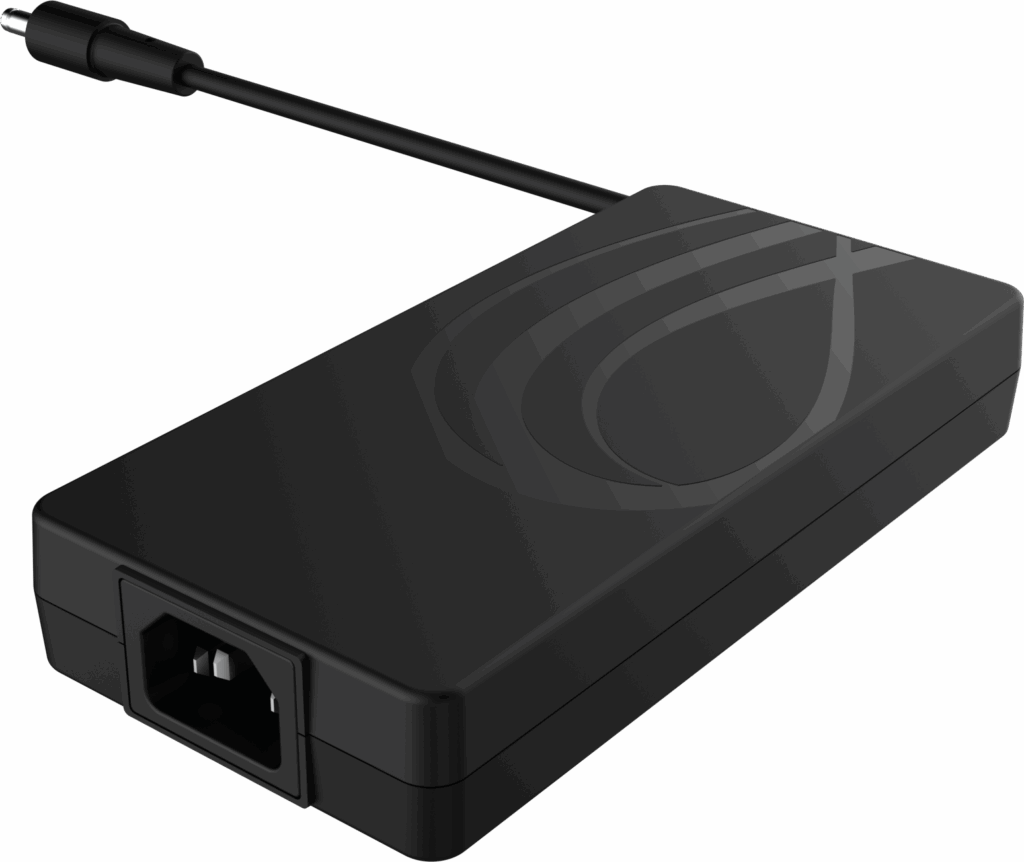
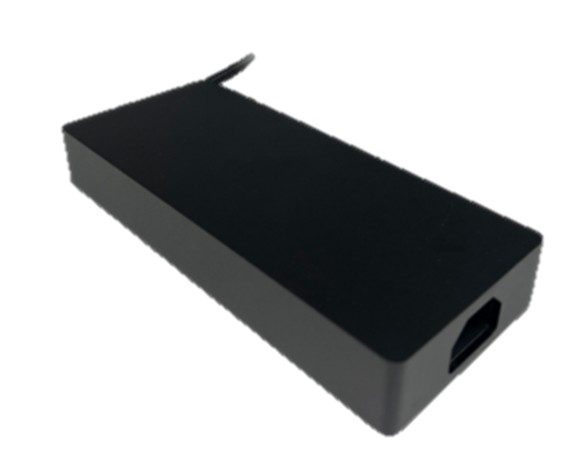
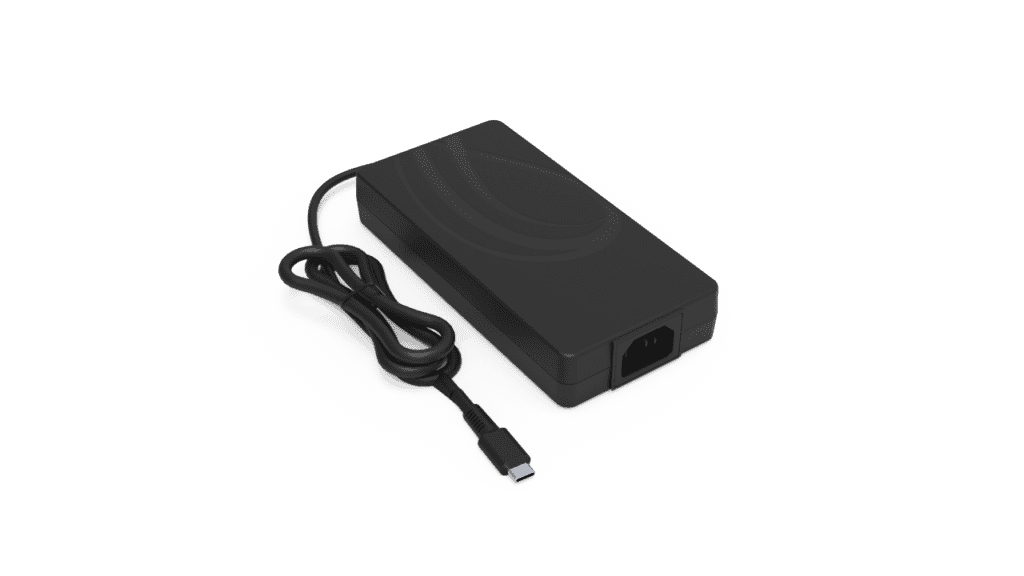
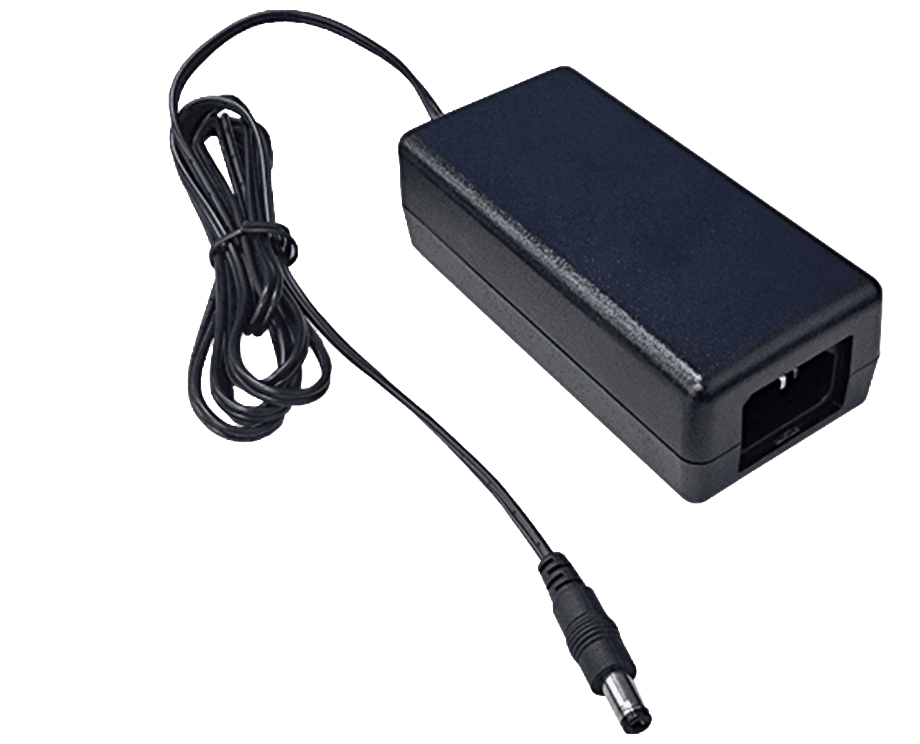
What is a coreless DC cord in a high-power adapter?
A coreless DC cord is a DC output cable design that removes the traditional external ferrite-core component from the cord. In Phihong’s supplied “Mechanical designs – DC Cord Design” comparison material, the traditional design is shown as a DC cord with ferrite core, while the Phihong design is shown as a coreless DC cord. That makes the cable design visually and mechanically different, but it also points to a deeper engineering question: how does the adapter and cord system manage EMC requirements without the visible ferrite component?
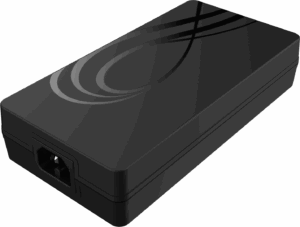
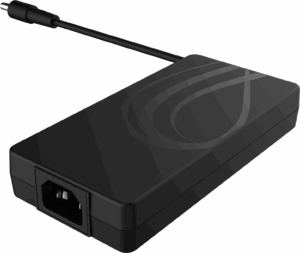
Phihong’s AA460U-205A-R ultra-slim 460W adapter illustrates one approach to coreless DC cord design. According to Phihong’s supplied engineering materials, the design removes the traditional external ferrite core while the overall adapter architecture incorporates EMC-focused engineering. This should not be interpreted as a claim that ferrites are obsolete or unnecessary. It means the coreless approach must be engineered and validated as part of the complete high-power adapter system.
| Coreless DC Cord Area | What Changes | What OEM Teams Should Review |
| External cable design | The visible ferrite-core component is removed from the DC cord. | Cable construction, shielding, filtering approach and EMC validation. |
| Appearance | The cord may look cleaner and more modern. | Industrial design goals, product presentation and customer handling. |
| Weight and handling | Removing the external core can reduce cable bulk and may improve wrapping. | Cord weight, flexibility, bend radius, strain relief and storage behavior. |
| Manufacturing flow | A simplified cable design may reduce assembly complexity. | Process control, quality checks, supplier consistency and production validation. |
Why This Matters
• A coreless DC cord can change the adapter’s mechanical feel, appearance, handling and manufacturing process.
• The design still requires appropriate EMC engineering because EMI requirements do not disappear when the ferrite core is removed.
What OEMs Should Do Now
• Evaluate coreless DC cord design as both a mechanical and EMC engineering decision.
• Validate cable behavior, EMI performance, durability, wrapping and strain relief with the final device and adapter configuration.
Useful Links
Power Adapter Product Line: www.phihong.com/products/adapters/
Power Adapter Design Decisions: www.phihong.com/the-power-supply-decisions-oems-regret-most-and-why-theyre-hard-to-fix-later/
Contact Phihong: www.phihong.com/contact
Related Links
How 330W GaN Power Adapters Support Gaming Laptops and Mobile Workstations: www.phihong.com/how-330w-gan-power-adapters-support-gaming-laptops-and-mobile-workstations/
Best Guide to GaN Power Adapters: What Modern Devices Need From Compact, High-Density Power: www.phihong.com/best-guide-to-gan-power-adapters-what-modern-devices-need-from-compact-high-density-power/
Can a high-power adapter work without an external ferrite core?
A high-power adapter can be designed without a visible external ferrite core only when the broader adapter, cable and system architecture still meets applicable EMC requirements. The absence of the ferrite component does not automatically mean the cable is less engineered. In some designs, EMI control may be handled through internal filtering, cable construction, layout decisions, shielding strategy, switching architecture or other EMC-focused design choices.
This is especially important at higher wattage levels. A high-power adapter such as the AA460U-205A-R operates in a more demanding category than a low-wattage accessory charger. Phihong’s supplied materials connect the coreless DC cord to the product’s broader EMI / EMC engineering approach, while also describing the adapter as an ultra-slim 460W external power adapter with high power density and high-power design features. OEM teams should review this as a system-level design approach, not as permission to remove ferrites from any adapter cable without validation.
| EMC Design Question | Why It Matters | What OEM Teams Should Review |
| Noise source | EMI can originate from switching power conversion, cable behavior or the load. | Switching frequency, load profile, cable length and device-side electronics. |
| Noise path | The DC cord can conduct or radiate unwanted noise. | Output cable routing, connector design, shielding and return path. |
| Mitigation method | Ferrite is one method, but not the only possible EMC tool. | Filtering, layout, cable construction, shielding and system grounding. |
| Final validation | EMC performance must be proven in the finished configuration. | Pre-compliance testing, full-load testing, cable positioning and device modes. |
Why This Matters
• A coreless cable approach requires deliberate EMC design elsewhere in the adapter and cable system.
• OEM teams should not assume a high-power adapter can remove the ferrite core without engineering and validation.
What OEMs Should Do Now
• Ask how EMI is controlled across the adapter, cable and powered device when a visible ferrite core is not used.
• Validate EMC behavior with the final cable, load profile, equipment configuration and operating modes before production.
Useful Links
Power Adapter Product Line: www.phihong.com/products/adapters/
EMI and Safety Basics: www.phihong.com/what-compliance-engineers-look-for-in-internal-psus-emi-ems-and-safety-basics/
Contact Phihong: www.phihong.com/contact
Related Links
How Class B EMI and IEC 62368-1 Shape 250W Adapter Selection for Commercial Devices: www.phihong.com/how-class-b-emi-and-iec-62368-1-shape-250w-adapter-selection-for-commercial-devices/
What Does Class B EMI Mean for High-Power Open-Frame PSU Design?: www.phihong.com/what-does-class-b-emi-mean-for-high-power-open-frame-psu-design/
CLIENT'S QUOTE
Phihong’s custom OEM power solutions have transformed our product development, boosting performance and reducing overhead. Their expert engineering support has simplified both the design and manufacturing phases.
How does coreless DC cord design affect weight, appearance, and handling?
Coreless DC cord design can affect the physical experience of a high-power adapter because the cable no longer includes the traditional external ferrite-core component. For users, installers, service teams, or OEM product reviewers, this can make the cord look cleaner, feel less bulky, and wrap more naturally. In a high-wattage external adapter, those details matter because the cable is part of the product experience, not just a hidden electrical component.
Phihong’s supplied materials identify several potential advantages of the coreless DC cord used with the AA460U-205A-R, including sleeker and more modern appearance, reduced cable weight, simplified design that can help reduce manufacturing cost, and cleaner cable wrapping and user handling. These benefits should be described carefully. They are design advantages identified by Phihong, not universal guarantees for every cable or adapter design. OEM teams should still evaluate how the cord behaves during repeated bending, wrapping, storage, routing, strain relief and installation.
| Mechanical Design Area | What Coreless Design May Improve | What OEM Teams Should Review |
|---|---|---|
| Cable appearance | Removing the visible ferrite can create a cleaner, more modern cable profile. | Industrial design goals, product presentation, cable length and packaging. |
| Cable weight | Eliminating the external ferrite component can reduce cable bulk and weight. | Total adapter weight, cable handling, strain relief and user comfort. |
| Cable wrapping | A smoother cable can be easier to wrap and store. | Bend radius, cable memory, repeated wrapping and durability. |
| Manufacturing simplicity | Fewer external cable components may simplify some assembly steps. | Supplier process, quality control, inspection points and production consistency. |
Why This Matters
• Cable design affects how a high-power adapter is handled, stored, packaged and perceived by users.
• Coreless DC cord benefits should be validated mechanically and electrically before being treated as production-ready advantages.
What OEMs Should Do Now
• Test the cord for wrapping, bending, pulling, strain relief and repeated handling in realistic user conditions.
• Review the coreless cable as part of product design, manufacturing, EMI validation and field-service planning.
Useful Links
Power Adapter Product Line: www.phihong.com/products/adapters/
Power Supply Decisions OEMs Regret: www.phihong.com/the-power-supply-decisions-oems-regret-most-and-why-theyre-hard-to-fix-later/
Contact Phihong: www.phihong.com/contact
Related Links
How 330W GaN Power Adapters Support Gaming Laptops and Mobile Workstations: www.phihong.com/how-330w-gan-power-adapters-support-gaming-laptops-and-mobile-workstations/
Best Guide to GaN Power Adapters: What Modern Devices Need From Compact, High-Density Power: www.phihong.com/best-guide-to-gan-power-adapters-what-modern-devices-need-from-compact-high-density-power/
How Phihong uses coreless DC cord design in the AA460U-205A-R adapter
Phihong’s AA460U-205A-R ultra-slim 460W adapter provides a real product example of coreless DC cord design in a high-power external adapter category. According to Phihong’s supplied engineering materials, the adapter uses a coreless DC cord that removes the traditional external ferrite-core component. The same product development materials connect the design to broader themes including ultra-slim construction, high power density, EMI / EMC engineering, thermal design, peak-load capability, and cable handling.
The strongest way to understand this product example is as a system-level design approach. The AA460U-205A-R is not simply a high-power adapter with a different cable appearance. Phihong’s supplied materials position the coreless DC cord alongside engineering features such as 460W output class, 17.85W/in³ stated power density, approximate 422cc case volume, product weight below 750g, interleaved PFC topology, thermal distribution planning and mature EMC / EMI solutions. OEM teams should evaluate these features together because high-power adapter cable design affects electrical, mechanical and user-experience requirements at the same time.
| Phihong Design Area | Why It Matters | What OEM Teams Should Review |
|---|---|---|
| AA460U-205A-R | Provides a 460W ultra-slim adapter example with a coreless DC cord. | Power demand, adapter size, device fit and integration conditions. |
| Coreless DC cord | Removes the traditional external ferrite-core component from the cable. | EMI validation, cable construction, wrapping, handling and durability. |
| High-density adapter design | Connects cable design with slim mechanical architecture. | Power density, case volume, surface temperature and product use environment. |
| EMC-focused engineering | Reinforces that coreless design still needs EMC control. | EMI / EMC testing, surge expectations, cable routing and final equipment validation. |
Why This Matters
• The AA460U-205A-R shows how coreless DC cord design can be part of a broader high-power adapter engineering strategy.
• Coreless cable design should be evaluated with EMI, thermal, mechanical, manufacturing and user-handling requirements together.
What OEMs Should Do Now
• Use Phihong’s supplied AA460U-205A-R materials as a starting point for evaluating coreless DC cord design in high-power adapters.
• Contact Phihong to discuss cable, thermal, EMI or mechanical requirements for the intended high-power external adapter application.
Useful Links
Power Adapter Product Line: www.phihong.com/products/adapters/
Contact Phihong: www.phihong.com/contact
GaN Power Adapter Guide: www.phihong.com/best-guide-to-gan-power-adapters-what-modern-devices-need-from-compact-high-density-power/
Related Links
What Does Class B EMI Mean for High-Power Open-Frame PSU Design?: www.phihong.com/what-does-class-b-emi-mean-for-high-power-open-frame-psu-design/
How Class B EMI and IEC 62368-1 Shape 250W Adapter Selection for Commercial Devices: www.phihong.com/how-class-b-emi-and-iec-62368-1-shape-250w-adapter-selection-for-commercial-devices/
Coreless DC cord design is not just a cosmetic change. It changes the way engineers think about the adapter cable, EMI strategy, mechanical handling, manufacturing process and user experience. A visible ferrite core may be useful in many traditional designs, and removing it requires careful system-level EMC engineering.
For OEM teams evaluating high-wattage external adapters, the best approach is to treat the adapter, DC cord, connector, device load, cable routing and compliance requirements as one system. If your team is evaluating cable, thermal, EMI or mechanical requirements for a high-power external adapter, contact Phihong to discuss your application.

CONTACT US TODAY
From concept to production, Phihong delivers custom OEM power solutions tailored to your specifications.
FAQ
What does a ferrite core do on a power adapter cable?
A ferrite core is commonly used to help suppress certain high-frequency electromagnetic noise traveling along a power cable. It is often visible as a cylindrical or block-like component on the DC cord. Ferrites can be useful in EMC design, but they are only one part of the system. The adapter, cable, connector, device load, grounding and final product configuration all affect EMI behavior.
What is a coreless DC cord?
A coreless DC cord is a DC output cable design that removes the traditional external ferrite-core component. In Phihong’s supplied comparison material, the traditional design is shown with a DC cord ferrite core, while the Phihong design is shown as a coreless DC cord. The design may support a cleaner appearance, lower cable weight, easier wrapping and simplified manufacturing, but it still requires EMC validation.
Can a high-power adapter work without an external ferrite core?
Yes, but only when the full adapter and cable system is engineered to meet applicable EMC requirements without relying on the visible external ferrite. Removing a ferrite core is not something that can be done casually. Engineers must review internal filtering, cable construction, layout, shielding, switching behavior, grounding and final emissions testing before using a coreless approach in production.
Does a coreless DC cord mean EMI is no longer a concern?
No. EMI remains important. A coreless DC cord removes the visible ferrite component, but the adapter still needs appropriate EMI / EMC engineering. In high-power adapter systems, the DC cord can affect conducted and radiated behavior. OEM teams should validate the adapter, cable and powered device together under representative load, cable position and operating conditions.
Why would an OEM care about coreless cable design?
OEMs may care because cable design affects product appearance, weight, wrapping, packaging, user handling and manufacturing. A large external ferrite can make a cable feel bulkier or harder to wrap. Phihong’s supplied materials identify possible benefits of coreless DC cord design, including sleeker appearance, reduced cable weight, simplified design and cleaner cable handling. These benefits should be validated in the final product context.
What should engineers test before using a coreless DC cord?
Engineers should test EMI / EMC behavior, cable routing, cable bending, strain relief, connector stress, wrapping behavior, durability, thermal conditions and full-load operation. Testing should use the final or production-intent adapter, DC cord, powered device and operating modes. A coreless design should be approved only after both electrical and mechanical requirements are satisfied.
POE technology supports the centralization of power

AC Adapter Guide: Everything You Need to Know
Moreover, PoE technology supports the centralization of power management. By powering devices through a PoE-enabled network …
AC DC Power Chargers and How They Work: A Comprehensive Technical Breakdown
Moreover, PoE technology supports the centralization of power management. By powering devices through a PoE-enabled network …

USB-C Charger: Shaping the Future of the Tech World
Moreover, PoE technology supports the centralization of power management. By powering devices through a PoE-enabled network …
AC Adapter Guide: Everything You Need to Know
Moreover, PoE technology supports the centralization of power management. By powering devices through a PoE-enabled network …

AC DC Power Chargers and How They Work: A Comprehensive Technical Breakdown
Moreover, PoE technology supports the centralization of power management. By powering devices through a PoE-enabled network …

USB-C Charger: Shaping the Future of the Tech World
Moreover, PoE technology supports the centralization of power management. By powering devices through a PoE-enabled network …