









BLOG
How Does Low-Profile Adapter Height Affect High-Wattage Desktop Power Supply Integration?
QUICK LINKS
Why Does Adapter Height Matter in High-Wattage Desktop Power Supply Design?
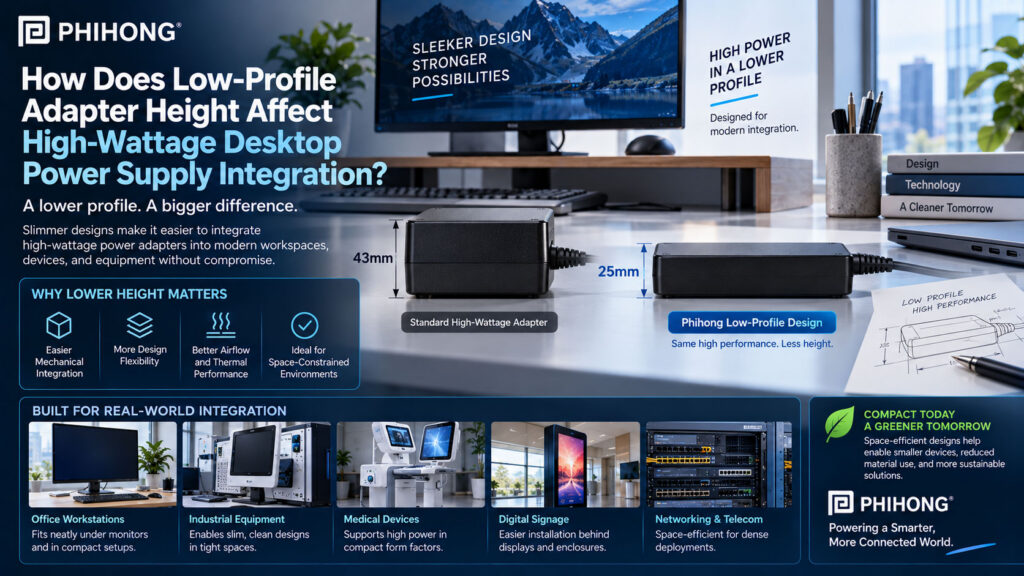
Adapter height matters because high-wattage external power supplies still have to fit into real products, workspaces, packaging and installation environments. A desktop adapter can meet every electrical requirement and still create integration problems if its enclosure is too tall for the intended space behind a display, beneath a desk, near equipment, inside a workstation accessory area, or within the product’s shipping configuration.
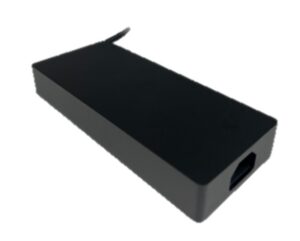
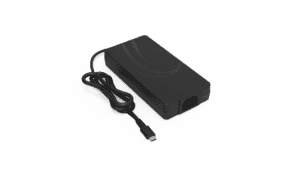
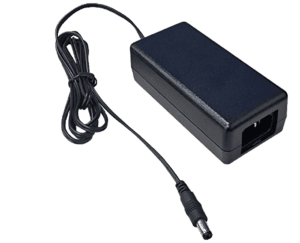
Phihong’s AA240U-200B-R and AA280U-200B-R provide a useful example of this issue. Both are high-wattage GaN desktop adapters with a listed height of 25.4mm, or about 1 inch. The AA240U-200B-R is rated at 240W while the AA280U-200B-R is rated at 280W, showing how a low-profile enclosure can be relevant even as power levels increase. Phihong
| Mechanical Factor | Why It Matters | What OEM Teams Should Review |
|---|---|---|
| Adapter height | Determines whether the unit fits into constrained spaces | Clearance above and below the adapter |
| Footprint | A thinner design may still require more length or width | Total volume and placement area |
| Cable exit | Low-profile packaging changes where cables route | Bend radius and connector clearance |
| Surface exposure | Thin adapters may spread heat across a larger face | Placement and contact with nearby surfaces |
| Packaging | Adapter geometry affects tray and carton design | Accessory layout and shipping efficiency |
Why This Matters
- Adapter integration is a three-dimensional mechanical problem, not just a wattage decision.
- Height can become a limiting dimension even when length and width are acceptable.
What OEMs Should Do Now
- Define the maximum adapter height early in the mechanical design process.
- Evaluate adapter clearance, cable routing and heat exposure with production-intent hardware.
Relevant Phihong Products
AA240U-200B-R
240W GaN desktop adapter with a listed height of 25.4mm.
AA280U-200B-R
280W GaN desktop adapter with a listed height of 25.4mm.
Related Phihong Product
AA240U-200A-R
Related 240W / 20V GaN desktop platform within the same high-wattage product group.
Useful Links
AA240U-200B-R Datasheet: www.phihong.com/wp-content/uploads/New-datasheet-AA240U-200B-R-08252025.pdf
AA280U-200B-R Datasheet: www.phihong.com/wp-content/uploads/New-datasheet-AA280U-200B-R-06262025.pdf
Power Adapter Product Line: www.phihong.com/products/adapters/
Related Links
How Do You Choose a 240W, 250W, or 280W Desktop Power Adapter?: Add pillar URL once live
When Should You Choose a 280W GaN Desktop Adapter Instead of a 240W Model?: Add cluster URL once live
FEATURED PRODUCTS
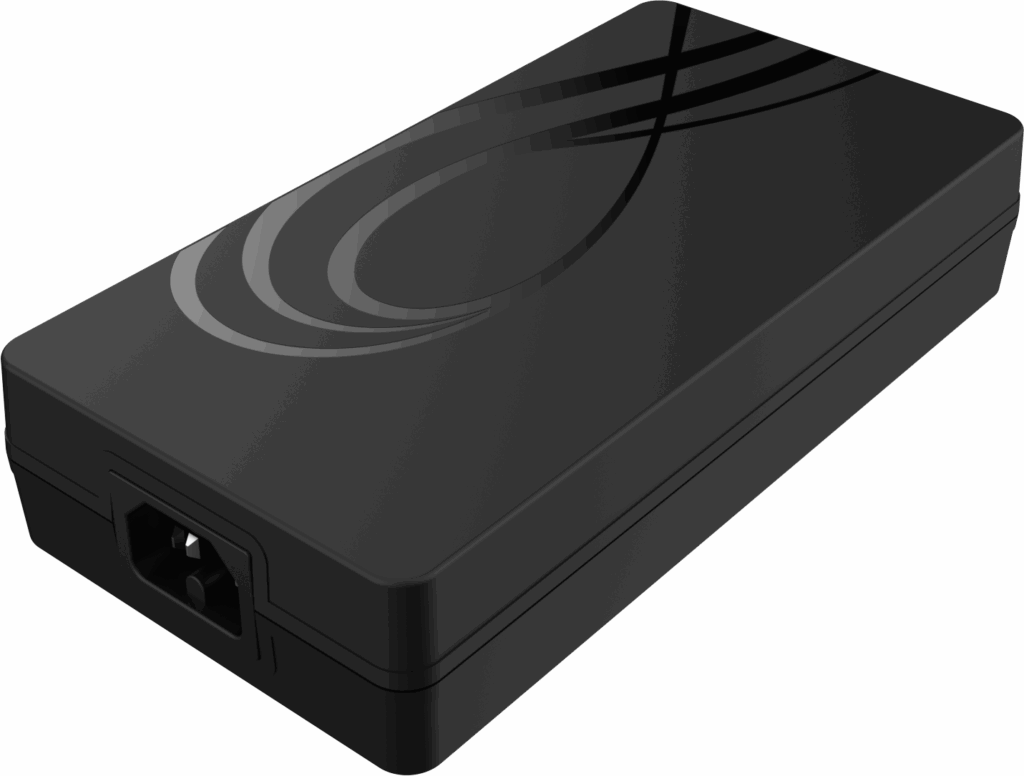
AM250U-540AP-R
- Output Power - 250W
- Output Volt - 54V
- Output Current - 4.63A
- Features - Class B EMI , US DoE Level VI Efficiency compliance, EU CoC Ver 5 Tier 2 Compliance, Over-Voltage, Over-Current, Short Circuit, & Over-Temperature Protection, 5,000 Meters Operating Altitude
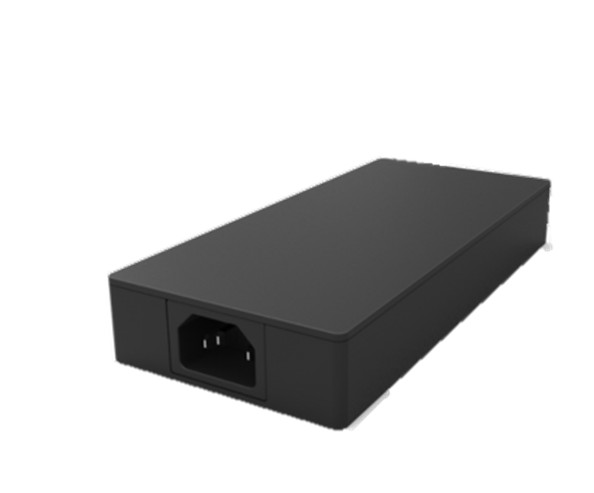
AA240U-200A-R
- Output Power - 240W
- Output Volt - 20V
- Output Current - 12A
- Features - high-efficiency desktop power supply designed for multiple applications, delivering a reliable 240W single output with advanced GaN technology for compact performance. Ideal for powering high-demand gaming systems etc with reduced heat and improved energy conversion.
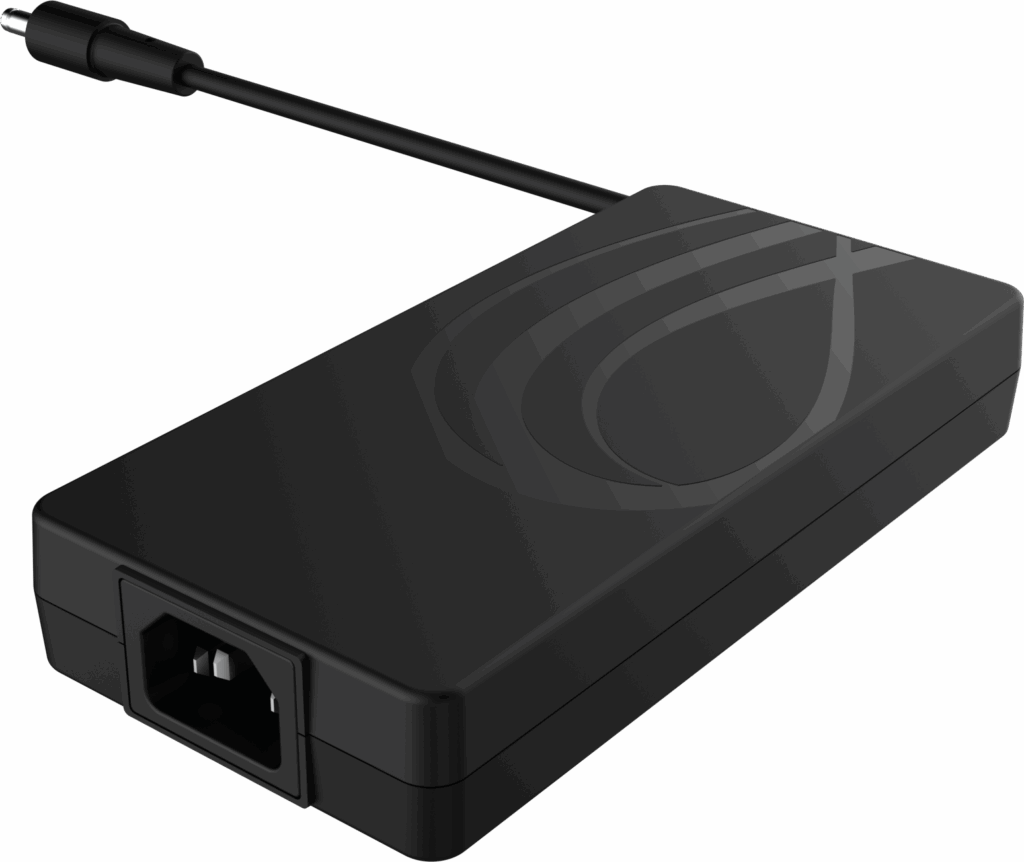
AA240U-200B-R
- Output Power - 240W
- Output Volt - 20V
- Output Current - 12A
- Features - This 240-watt GaN Series Desktop C14 Adapter delivers high power in a compact, efficient design, ideal for demanding professional and industrial applications. Its GaN technology ensures cooler operation, reliability, and space-saving performance.
AA280U-200B-R
- Output Power - 280W
- Output Volt - 20V
- Output Current - 14A
- Features - high-efficiency desktop power supply designed for multiple applications, delivering a reliable 240W single output with advanced GaN technology for compact performance. Ideal for powering high-demand gaming systems etc with reduced heat and improved energy conversion.
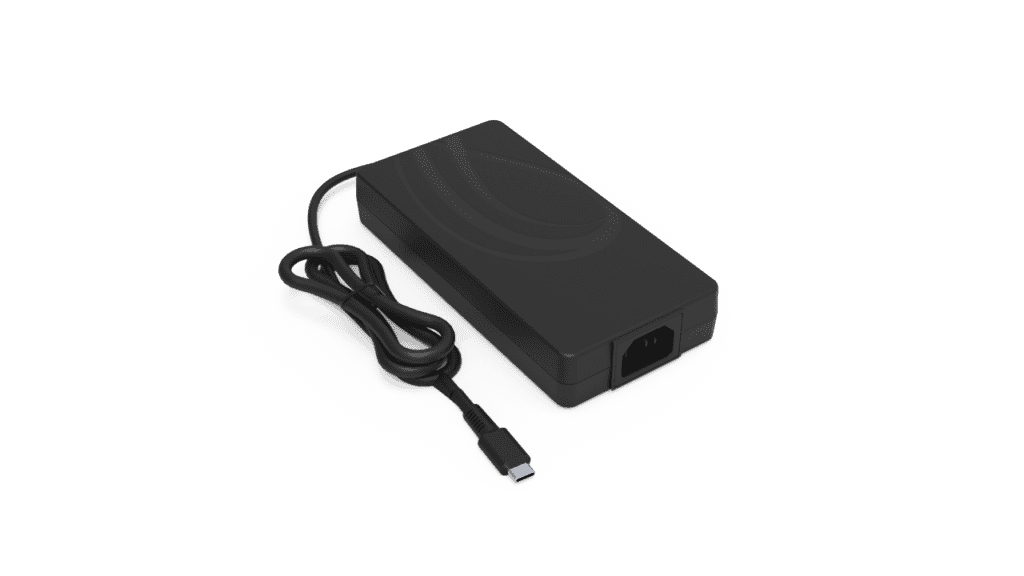
AA240U-59FKEA-R
- Output Power - 240 Watt
- Output Volt - 5Vdc/ 9Vdc/ 15Vdc/ 20Vdc/ 28V/ 36V/ 48V
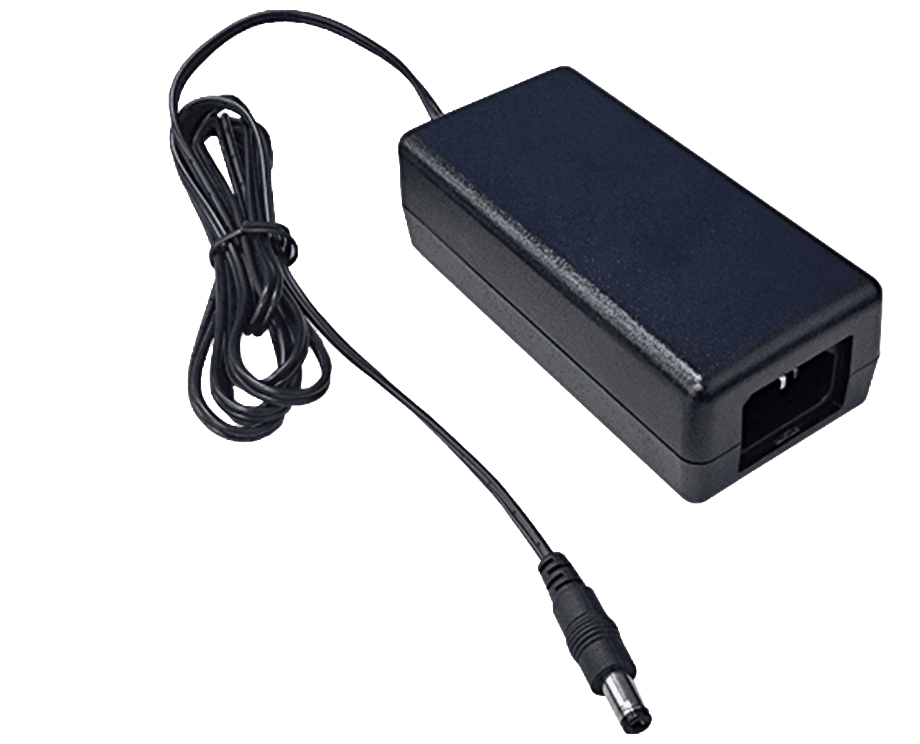
AA36U-240B-R
- Output Power - 36W
- Output Volt - 24V
- Output Current - 1.5A
- Features - C14 Inlet Receptacle, US DoE Level VI & NRCan Compliance, EU Ecodesign 2019/1782 Compliance, CoC V5 Tier 2 Compliance, Operating Altitude to 5,000 Meters, and Protections from Short Circuit, Over-Current and Over-Voltage

What Are the Benefits of a 25.4mm Low-Profile Adapter in Space-Constrained Equipment?
A 25.4mm adapter height can help when the product environment has limited vertical clearance. For example, the adapter may need to fit behind a commercial display, beneath a workstation surface, next to a docking system, inside furniture, or within an equipment installation where vertical space is more restricted than horizontal space.
The benefit is not simply that the adapter looks thinner. A lower profile can give mechanical engineers more flexibility in how the power supply is positioned relative to the product, cable path and surrounding hardware. At the same time, a low-profile enclosure does not remove the need to consider total footprint, ventilation, connector clearance and service access.
| Integration Scenario | Why Lower Height Can Help | What OEM Teams Should Review |
|---|---|---|
| Behind a display | Reduces required depth from the mounting surface | Display clearance and cable exit |
| Under a desk or shelf | Fits within shallower gaps | Ventilation and user access |
| Workstation accessories | Can sit near docks or peripherals | Cable routing and heat sources |
| Equipment furniture | Easier to integrate into thin compartments | Airflow and surrounding materials |
| Product packaging | Can fit into flatter accessory trays | Carton height and protective spacing |
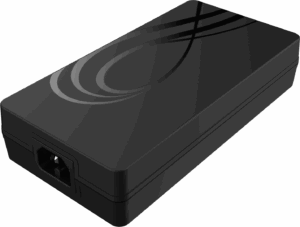
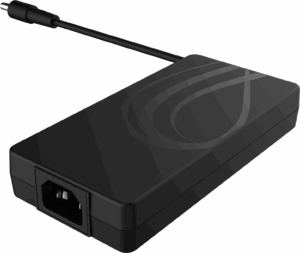
Phihong lists the AA240U-200B-R at 151.3 x 75.6 x 25.4mm, while the AA280U-200B-R is 180 x 82 x 25.4mm. That comparison shows an important mechanical point: the 280W model keeps the same 25.4mm height while using a larger length and width footprint. Phihong
Why This Matters
- Low-profile design can preserve vertical clearance even when total adapter power increases.
- Engineers should compare all three dimensions rather than assuming “low-profile” means smaller in every direction.
What OEMs Should Do Now
- Compare adapter height, length and width against the real installation envelope.
- Check whether the thinner profile changes cable routing, service access or thermal exposure.
Relevant Phihong Products
AA240U-200B-R
151.3 x 75.6 x 25.4mm, providing a compact low-profile 240W reference.
AA280U-200B-R
180 x 82 x 25.4mm, maintaining the same listed 25.4mm height at a higher 280W output level.
Useful Links
AA240U-200B-R Datasheet: www.phihong.com/wp-content/uploads/New-datasheet-AA240U-200B-R-08252025.pdf
AA280U-200B-R Datasheet: www.phihong.com/wp-content/uploads/New-datasheet-AA280U-200B-R-06262025.pdf
Contact Phihong: www.phihong.com/contact
Related Links
Why Does High Current Matter in 240W and 280W 20V Desktop Power Adapters?: Add cluster URL once live
Best Guide to GaN Power Adapters: What Modern Devices Need From Compact, High-Density Power: www.phihong.com/best-guide-to-gan-power-adapters-what-modern-devices-need-from-compact-high-density-power/
How Does a Low-Profile Adapter Change Thermal and Mechanical Integration?
A thinner enclosure changes how engineers think about component placement, surface area and heat distribution. High-wattage adapters convert hundreds of watts in a compact external package, so mechanical design and thermal design are closely connected. Reducing enclosure height places more pressure on internal layout because magnetics, switching components, capacitors and thermal structures still need adequate spacing and heat paths.
This does not mean that a low-profile adapter automatically runs hotter. Thermal performance depends on the complete design, including efficiency, GaN implementation, PCB layout, component selection, enclosure construction and operating environment. What changes is the integration challenge. OEM teams need to understand how the adapter releases heat and whether the surrounding equipment allows that heat to dissipate.
| Integration Area | Low-Profile Design Effect | What OEM Teams Should Review |
|---|---|---|
| Internal component layout | Less vertical space for tall components | Component placement and thermal paths |
| Surface temperature | Heat may be distributed across broad enclosure surfaces | Contact surfaces and nearby materials |
| Air circulation | Thin gaps can restrict natural airflow | Clearance around the adapter |
| Mechanical stacking | Easier to place in shallow spaces | Avoid sandwiching between heat sources |
| Cable routing | Cable exits may sit close to adjacent surfaces | Bend radius and strain relief |
For OEM engineers, this is why adapter height should be evaluated together with operating load and placement. A low-profile adapter located in open air may behave differently from the same unit placed in a narrow compartment or directly adjacent to another heat-generating device.
Why This Matters
- Low-profile mechanical design affects thermal integration as well as physical fit.
- A thinner enclosure does not eliminate the need for adequate clearance and realistic thermal validation.
What OEMs Should Do Now
- Test the adapter in the actual orientation and clearance expected in the final installation.
- Monitor adapter surface temperature and nearby component temperatures under sustained full-load conditions.
Relevant Phihong Products
AA240U-200B-R
Low-profile 240W GaN desktop platform.
AA280U-200B-R
Low-profile 280W GaN desktop platform with the same listed 25.4mm height.
Related Phihong Product
AA240U-200A-R
Related 240W GaN platform in the same product family.
Useful Links
AA240U-200B-R Datasheet: www.phihong.com/wp-content/uploads/New-datasheet-AA240U-200B-R-08252025.pdf
AA280U-200B-R Datasheet: www.phihong.com/wp-content/uploads/New-datasheet-AA280U-200B-R-06262025.pdf
Contact Phihong: www.phihong.com/contact
Related Links
How to Validate Thermal Performance of Open-Frame Power Supplies in Real Enclosures: www.phihong.com/how-to-validate-thermal-performance-of-open-frame-power-supplies-in-real-enclosures/
Why Does High Current Matter in 240W and 280W 20V Desktop Power Adapters?: Add cluster URL once live
CLIENT'S QUOTE
Phihong’s custom OEM power solutions have transformed our product development, boosting performance and reducing overhead. Their expert engineering support has simplified both the design and manufacturing phases.
What Should OEM Engineers Measure When Adapter Height Is a Design Constraint?
When adapter height is a hard mechanical constraint, OEM engineers should evaluate more than the enclosure dimension printed on the datasheet. The complete installation includes the adapter body, AC cord, DC cable, connector bend radius, surrounding clearance and any nearby equipment. A nominally 25.4mm-high adapter may still require additional space above, below or beside it for safe routing and thermal management.
This is especially important for equipment mounted behind monitors, beneath work surfaces, inside equipment furniture or near docking and networking hardware. Mechanical CAD should include the adapter as a real assembly rather than a simple rectangular placeholder.
| Integration Measurement | Why It Matters | What OEM Teams Should Check |
|---|---|---|
| Adapter height | Defines the basic vertical envelope | 25.4mm body height plus required clearance |
| Cable exit clearance | Cables need room to bend without excessive stress | Bend radius and connector orientation |
| AC connector space | C14 input requires room for the mating cord | Cord depth and removal access |
| Thermal clearance | Nearby surfaces can restrict heat transfer | Air gap and surrounding materials |
| Service access | Adapter may need to be removed or replaced | Reach, unplugging clearance and maintenance path |
Engineers should also consider tolerance. Mechanical drawings, molded enclosures, cable assemblies and mounting structures all have manufacturing variation. Designing an installation with almost no clearance can create assembly or field-service problems even when the nominal dimensions appear to fit.
Why This Matters
- A low-profile adapter can reduce vertical space requirements, but the complete installation envelope is larger than the adapter body alone.
- Cable access, heat clearance and manufacturing tolerance should be included before mechanical design freeze.
What OEMs Should Do Now
- Place the actual adapter and cable geometry into the product CAD model.
- Validate installation, removal and cable routing using production-intent hardware.
Relevant Phihong Products
AA240U-200B-R
240W low-profile GaN desktop adapter with a listed 25.4mm enclosure height.
AA280U-200B-R
280W GaN desktop adapter that maintains the same listed 25.4mm height while increasing length and width.
Related Phihong Product
AA240U-200A-R
Related 240W high-wattage GaN desktop option within the same product authority group.
Useful Links
AA240U-200B-R Datasheet: www.phihong.com/wp-content/uploads/New-datasheet-AA240U-200B-R-08252025.pdf
AA280U-200B-R Datasheet: www.phihong.com/wp-content/uploads/New-datasheet-AA280U-200B-R-06262025.pdf
Power Adapter Product Line: www.phihong.com/products/adapters/
Contact Phihong: www.phihong.com/contact
Related Links
The Power Supply Decisions OEMs Regret Most and Why They’re Hard to Fix Later: www.phihong.com/the-power-supply-decisions-oems-regret-most-and-why-theyre-hard-to-fix-later/
How to Validate Thermal Performance of Open-Frame Power Supplies in Real Enclosures: www.phihong.com/how-to-validate-thermal-performance-of-open-frame-power-supplies-in-real-enclosures/
How Does Phihong Support Low-Profile High-Wattage Desktop Adapter Integration?
Phihong’s AA240U-200B-R and AA280U-200B-R provide OEM teams with two examples of high-wattage desktop power delivered in a low-profile enclosure. Both models maintain a listed height of 25.4mm, while their electrical capabilities differ. The AA240U-200B-R provides 240W at 20V / 12A, while the AA280U-200B-R increases output to 280W at 20V / 14A.
That combination gives system architects an important design option. A project can increase available continuous power without necessarily increasing the adapter’s vertical dimension. The tradeoff is that the higher-power model uses a larger overall footprint, which reinforces why OEM engineers should evaluate height, width, length, power density, cable routing and thermal performance together.
| Phihong Product | Power | Output | Listed Height | Integration Direction |
|---|---|---|---|---|
| AA240U-200B-R | 240W | 20V / 12A | 25.4mm | Low-profile high-wattage 20V systems |
| AA280U-200B-R | 280W | 20V / 14A | 25.4mm | Higher-current systems needing the same low-profile height |
| AA240U-200A-R | 240W | 20V / 12A | Related platform | Alternative within the 240W GaN family |
Why This Matters
- Phihong’s 240W and 280W designs demonstrate that increased power does not automatically require increased adapter height.
- Mechanical integration should still consider the complete footprint, thermal environment and cable arrangement.
What OEMs Should Do Now
- Compare the actual equipment envelope against both the 240W and 280W mechanical drawings.
- Contact Phihong to review power, mechanical, thermal and connector requirements before final integration.
Relevant Phihong Products
AA240U-200B-R
Primary 240W low-profile product for this cluster.
AA280U-200B-R
Primary 280W comparison product with the same listed 25.4mm height.
AA240U-200A-R
Related 240W GaN desktop platform.
Useful Links
AA240U-200B-R Product Page: www.phihong.com/products/adapters/aa240u-200b-r/
AA240U-200B-R Datasheet: www.phihong.com/wp-content/uploads/New-datasheet-AA240U-200B-R-08252025.pdf
AA280U-200B-R Datasheet: www.phihong.com/wp-content/uploads/New-datasheet-AA280U-200B-R-06262025.pdf
Contact Phihong: www.phihong.com/contact
Related Links
How Do You Choose a 240W, 250W, or 280W Desktop Power Adapter?: Add pillar URL once live
When Should You Choose a 280W GaN Desktop Adapter Instead of a 240W Model?: Add cluster URL once live
Why Does High Current Matter in 240W and 280W 20V Desktop Power Adapters?: Add cluster URL once live
Low-profile adapter height matters because OEM equipment often has mechanical constraints that are completely separate from its electrical requirements. A system may need 240W or 280W of external power but still have only a shallow area available behind a monitor, beneath a workstation or within a commercial equipment installation.
For OEM teams, the advantage of a low-profile adapter is therefore not simply cosmetic. It can create more freedom in product layout, cable routing and equipment placement. The correct design process should evaluate height, total footprint, thermal clearance, cable geometry and service access together.
If your team is integrating a high-wattage desktop power adapter into space-constrained equipment, contact Phihong to discuss electrical, mechanical and thermal requirements.

CONTACT US TODAY
From concept to production, Phihong delivers custom OEM power solutions tailored to your specifications.
FAQ
What is considered a low-profile desktop power adapter?
A low-profile adapter generally refers to a design with reduced enclosure height compared with larger traditional power bricks. There is no single universal height that defines the category. For this Phihong product comparison, the AA240U-200B-R and AA280U-200B-R both have a listed height of 25.4mm, or approximately one inch.
Why does adapter height matter for OEM equipment?
Adapter height can determine whether a power supply fits behind a display, beneath a desk, inside equipment furniture or near other hardware. Mechanical engineers need to consider the adapter body, cable bends, connector access and thermal clearance rather than evaluating the enclosure height alone.
Can a 280W power adapter have the same height as a 240W adapter?
Yes. In this Phihong comparison, both the AA240U-200B-R and AA280U-200B-R have a listed height of 25.4mm. The 280W model uses a larger length and width footprint, illustrating how enclosure dimensions can change in different directions as power increases.
Does a thinner power adapter run hotter?
Not necessarily. Adapter temperature depends on efficiency, internal component layout, thermal design, enclosure construction, operating load and surrounding environment. A thinner enclosure changes the mechanical and thermal integration challenge but does not automatically mean higher operating temperature.
What should engineers check before installing a low-profile adapter in a tight space?
Engineers should review adapter dimensions, cable bend radius, C14 cord clearance, DC connector routing, thermal clearance, surrounding materials, ventilation and service access. The production-intent adapter should also be tested under sustained load in the actual orientation and space expected in the finished installation.
POE technology supports the centralization of power

AC Adapter Guide: Everything You Need to Know
Moreover, PoE technology supports the centralization of power management. By powering devices through a PoE-enabled network …
AC DC Power Chargers and How They Work: A Comprehensive Technical Breakdown
Moreover, PoE technology supports the centralization of power management. By powering devices through a PoE-enabled network …

USB-C Charger: Shaping the Future of the Tech World
Moreover, PoE technology supports the centralization of power management. By powering devices through a PoE-enabled network …

AC Adapter Guide: Everything You Need to Know
Moreover, PoE technology supports the centralization of power management. By powering devices through a PoE-enabled network …

AC DC Power Chargers and How They Work: A Comprehensive Technical Breakdown
Moreover, PoE technology supports the centralization of power management. By powering devices through a PoE-enabled network …

USB-C Charger: Shaping the Future of the Tech World
Moreover, PoE technology supports the centralization of power management. By powering devices through a PoE-enabled network …