









BLOG
What Should OEMs Include in a Power Supply Manufacturer RFQ?
QUICK LINKS
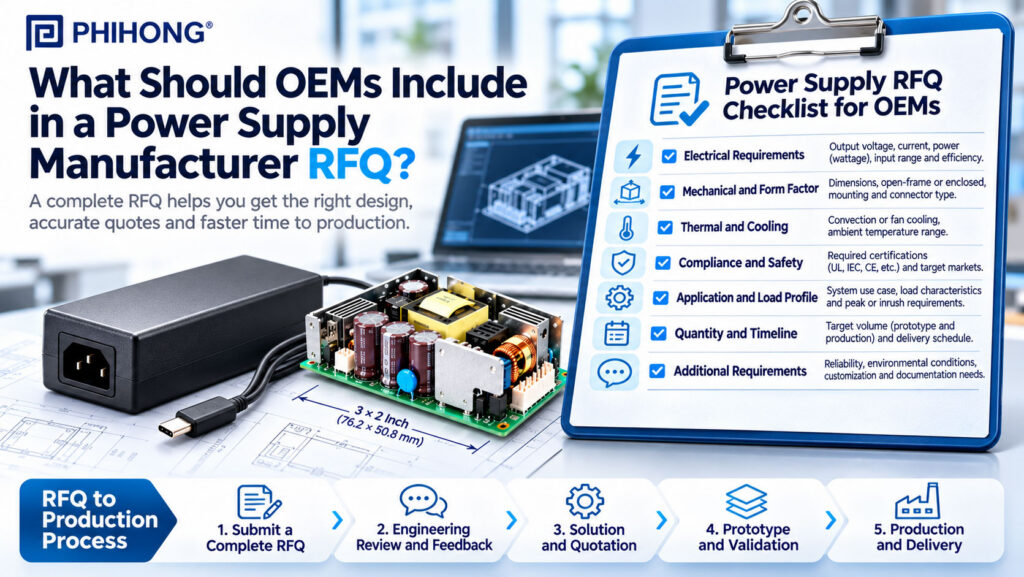
Quick Answer: An OEM power supply RFQ should define the actual equipment load, interfaces, operating conditions and evidence required for release. Ask each manufacturer to identify the exact proposed configuration, answer the same requirements matrix and list deviations explicitly. Compare the quotation together with drawings, applicable reports, sample results and change-control commitments before selecting a production source.
A quotation can look complete while leaving the engineering decision unfinished. A wattage, price and delivery estimate do not explain whether the quoted cable matches the enclosure, whether the sample represents production or whether an approval document covers the configuration being purchased. These gaps become harder to resolve when procurement and engineering work from different assumptions.
This guide concerns the information exchanged between an OEM and a power supply manufacturer during an RFQ and the release decisions that follow. It is a practical document framework, not a model-specific qualification procedure or a substitute for an equipment safety assessment. Use it to make proposals comparable and route unanswered questions to named owners.
Define the equipment requirement before requesting a price
Begin with the device rather than a catalog wattage. Describe normal operation, startup, simultaneous peripheral use and any battery-charging behavior. Distinguish measured values from estimates and identify the hardware and firmware versions behind the measurements. A manufacturer can respond more precisely when the expected workload is reproducible rather than described only as a maximum power figure.
Specify where voltage matters. A measurement at an adapter output can differ from the voltage reaching a device after its cable, connector and distribution path. Define the minimum acceptable device input during relevant events, the measurement location and the operating combinations that must be evaluated. Do not copy a generic limit from another project without checking the receiving circuit.
Give each requirement an identifier, an owner and an evidence request. For example, a connector requirement may need a controlled drawing and a sample fit check, while a startup requirement may need a waveform recorded with the real system. Mark unresolved design inputs as open questions so that the manufacturer can price the investigation rather than silently assume an answer.
| RFQ item | Information to provide | Requested response |
|---|---|---|
| Device workload | Sustained and transient operating cases | Proposed configuration and explicit limitations |
| Electrical interface | Device limits and measurement points | Voltage and current evidence under stated conditions |
| Mechanical interface | Enclosure, inlet and mating drawings | Controlled drawing and sample confirmation |
| Release evidence | Reports, tests and responsible reviewers | Document list with open actions |
Why This Matters
- An incomplete load description makes technically different offers appear equivalent.
- Recorded assumptions let the team identify which design changes require another review.
What OEMs Should Do Now
- Attach the load profile and the proposed measurement points to the RFQ.
- Assign engineering owners to unresolved limits before comparing final offers.
Ask for a configuration baseline rather than a family description
A product family is a starting point for discussion. The purchasing baseline should identify a full model number, option suffixes, cable assembly, connector drawing, labeling and any agreed customization. Record the document revision or issue date for each item. If the supplier proposes a variant, ask which documents change and which existing reports still apply.
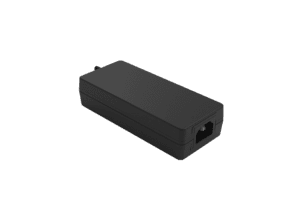
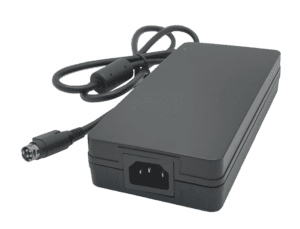
For a concrete reference, Phihong publishes the AA240U-200A-R product record and its official technical datasheet. The document identifies a 240W desktop adapter with a nominal 20V output and an IEC C14 inlet. These details can anchor an RFQ example, but they do not determine the correct connector, approval scope or configuration for every OEM application.
Separate the catalog record from the quoted production definition. Ask the manufacturer to confirm the released drawing, current commercial availability and the exact variant supplied for evaluation. Keep the response alongside the quotation. A product page establishes a useful reference; it does not replace the agreement about what will arrive at receiving inspection.
Why This Matters
- Similar model names can conceal interface or regional differences.
- Traceable drawings connect a purchasing line item to the hardware engineers actually evaluated.
What OEMs Should Do Now
- List every required option and document revision in the quotation comparison.
- Obtain written confirmation when a catalog example differs from the offered build.
Turn performance claims into evidence requests
Require each important performance statement to include its conditions. Ask for input conditions, load waveform, ambient conditions, cable arrangement, instrumentation and the location where the result was measured. Keep typical behavior separate from a stated limit. If the datasheet does not supply a condition that matters to the equipment, request clarification or plan a system test.
Treat transient demand independently from continuous operation. A peak figure without duration, repetition and recovery information cannot establish support for a particular device workload. Similarly, a successful startup on a bench supply does not demonstrate startup with the proposed adapter and production cable. The RFQ should identify the events to evaluate and who will approve the results.
Texas Instruments provides AN-1733 on load transient testing as technical background for understanding measurement setup and regulator response. Use this type of primary engineering reference to improve the test discussion. It does not validate a Phihong model or create an acceptance criterion for your equipment.
When reviewing evidence, retain the raw capture and test description together. A cropped waveform without time scale, probe point or sample identity is difficult to reuse. Ask the supplier to distinguish tests already completed from tests proposed after an order. This prevents a planned activity from being treated as a delivered result.
| Response | Follow-up question | Release record |
|---|---|---|
| Typical waveform | Which sample, setup and operating point? | Capture plus test configuration |
| Peak capability | What duration and repetition apply? | Qualified statement or open clarification |
| Thermal result | What enclosure and airflow were used? | Conditions and system verification plan |
| Protection behavior | What recovery sequence was observed? | Device-level recovery assessment |
Why This Matters
- A measurement has limited decision value when its setup cannot be reconstructed.
- Separating completed and proposed evidence exposes technical work still required before release.
What OEMs Should Do Now
- Create a claim-to-evidence register for the requirements that control selection.
- Agree on additional testing when supplier conditions do not represent the equipment.
Review safety and EMC documentation by scope
Ask for the evidence relevant to the exact proposed model and intended markets. A list of standards or a logo on a sales sheet does not explain the document scope, covered variants or conditions of use. Route the actual reports and certificates to the person responsible for equipment compliance and record their assessment.
The IEC 62368-1 official abstract describes the safety standard for relevant audio/video and information and communication technology equipment. Referencing that standard does not establish certification of an adapter or compliance of the final equipment. The applicable edition, market requirements and assessment route belong in the project review.
Keep component evidence and final-system work distinct. An adapter report may supply useful inputs to the equipment assessment, but the surrounding enclosure, interfaces, cabling and intended use still matter. Ask which conditions must be maintained and what additional evaluation the equipment needs. Avoid using a supplier response as permission to claim universal approval.
Create an exception process for missing documents. A quotation may proceed commercially while technical review remains open, provided the status is explicit. Record the missing item, responsible party and decision affected. Do not convert an unanswered question into a presumed pass simply because the delivery schedule is short.
Why This Matters
- A family-level statement may not cover the purchased configuration.
- Document scope helps compliance reviewers determine what evidence is usable.
What OEMs Should Do Now
- Request model-specific documentation and route it to the equipment compliance owner.
- Keep market and certification questions open until the relevant evidence is reviewed.
Compare commercial offers with engineering deviations visible
Use a common response sheet rather than comparing prose quotations line by line. Include price basis, quantities, tooling or development charges, sample definition, estimated lead time and evidence deliverables. Ask each manufacturer to identify assumptions and deviations against the same requirement IDs. An unanswered requirement should remain visible even if the total price is attractive.
Distinguish a supplier commitment from a planning estimate. A quoted lead time can depend on configuration approval, material availability or other milestones. Ask when the timing begins, what event changes it and how updates will be communicated. Do not describe an estimate as guaranteed availability in the internal project plan.
Plan the cost of qualification and integration alongside the unit price. Cable changes, additional samples, laboratory work and fixture development can affect the project decision. These costs are project-specific. Document the assumptions used in the comparison instead of promising a universal saving from one sourcing strategy.
For adjacent planning questions, see Phihong’s published alternate-component sourcing guide. Keep this RFQ focused on evidence and offer comparison while using the sourcing discussion for broader continuity planning.
| Decision area | Record for every supplier | Owner |
|---|---|---|
| Technical fit | Requirement response and deviations | Engineering |
| Documentation | Delivered evidence and missing reports | Compliance / quality |
| Commercial basis | Quantity, configuration and included work | Procurement |
| Release timing | Milestones and outstanding approvals | Project lead |
Why This Matters
- A lower unit price can arrive with unpriced integration work or unresolved exceptions.
- Consistent response fields reduce ambiguity when engineering and procurement compare proposals.
What OEMs Should Do Now
- Review deviations before selecting the preferred commercial offer.
- Identify the trigger and assumptions behind sample and production delivery estimates.
Connect sample approval to production change control
Define what sample approval authorizes. It may approve fit, electrical behavior or a limited evaluation build without approving full production. Record the scope in plain language and link it to sample identities, test results and outstanding actions. A signed sample is useful only when the team knows which configuration it represents.
Request an agreed notification process for changes affecting the approved baseline. The parties should define which changes require notice, supporting documentation or requalification. Examples to discuss include cable construction, connectors, critical components, manufacturing location and labeling. These are negotiation topics rather than claims about a supplier’s existing contractual obligations.
At production release, connect the OEM part number to the supplier model and controlled configuration. Ensure receiving inspection can access the relevant drawings and approved criteria. Retain any approved deviations with their expiry or review conditions. Otherwise, later lots can be accepted using information that belonged only to an early sample.
When a change arrives, assess its effect on requirements and evidence. Do not automatically repeat every test, and do not automatically accept a change because the model name remains the same. Have the responsible engineers and quality reviewers determine the scope, record the rationale and update the baseline when approved.
Why This Matters
- Sample approval and production authorization are different project decisions.
- A controlled baseline makes later change assessments more specific and auditable.
What OEMs Should Do Now
- Write the approval scope and outstanding actions on the sample review record.
- Agree notification and requalification expectations before production release.
How Phihong can support a clearer OEM RFQ
Bring Phihong the equipment requirements, target markets, mechanical interfaces and expected qualification evidence. Use the published model and datasheet references to start a configuration discussion, then ask which options and documents apply to the proposed supply. This approach gives the technical team concrete questions to answer without assuming that a catalog model is already approved for the system.
For the AA240U-200A-R example, request confirmation of the current drawing, output connection and model-specific documentation before sample release. Keep any unresolved interface or test condition in the RFQ exception register. The model is an illustration of the documentation method, not a recommendation for equipment with unverified electrical or mechanical needs.
Use the existing high-wattage desktop adapter guide for the separate product-selection decision. The RFQ then captures the exact evidence needed to qualify the chosen configuration. Keeping these decisions connected helps teams avoid treating a selection guide as a completed design review.
Why This Matters
- A specific question is easier to resolve than a broad request for a suitable adapter.
- Model selection becomes actionable when paired with configuration and evidence requirements.
What OEMs Should Do Now
- Send the requirement matrix and interface drawings with the initial inquiry.
- Ask Phihong to identify missing evidence and configuration questions before sample approval.
CTA: Contact Phihong to discuss the proposed configuration and documentation needs for your OEM RFQ. Final suitability requires review against your equipment and intended markets.
Frequently Asked Questions
Is a datasheet enough to select a power supply manufacturer?
A datasheet is a starting reference. The sourcing decision also needs the exact offered configuration, interface drawings, relevant documentation, sample evidence and commercial assumptions. Use the datasheet to identify questions, then obtain responses tied to your requirement IDs. A complete document set depends on the equipment and intended market rather than a universal list.
Should the RFQ specify every test method?
Specify the conditions and acceptance limits that control the equipment decision. Where the method is still being developed, ask the manufacturer to propose a method and identify assumptions. Engineering should review it before results are accepted. Avoid imposing unrelated limits copied from another device, particularly when the measurement location or workload differs.
Can two adapters with the same wattage be treated as alternatives?
Equal rated power does not establish equivalent interfaces, transient behavior, thermal conditions or documentation coverage. Compare the complete configuration and device requirements. If an alternative is proposed, identify the evidence that can be reused and the checks that must be repeated. Record the review before releasing it against the OEM part number.
What should happen when a manufacturer cannot supply a requested report?
Record the missing report and ask what alternative evidence is available. The responsible reviewer should decide whether that evidence is adequate or additional assessment is needed. Keep the affected release decision open until resolved. A missing report is neither proof of failure nor a basis for assuming compliance.
Does approving an evaluation sample authorize production?
Only if the approval explicitly says so and the required release work is complete. Sample approval can be limited to fit checks or engineering evaluation. State the approved scope, configuration and outstanding actions. Procurement should use the production baseline once the responsible team authorizes it rather than infer permission from a sample signoff.