









BLOG
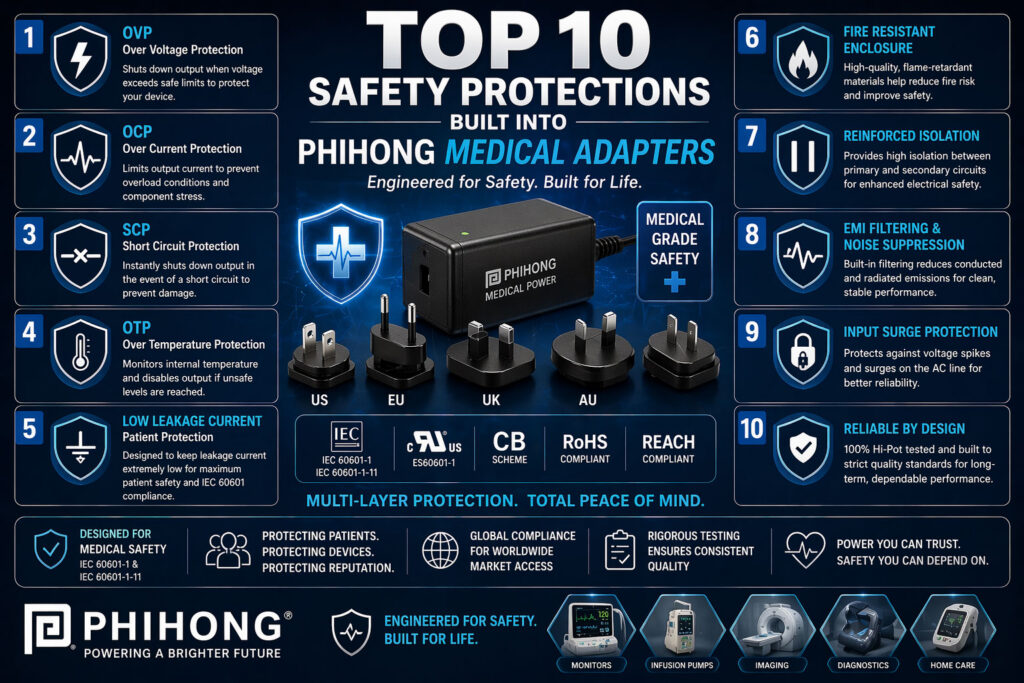
Top 10 Safety Protections Built into Phihong Medical Adapters
QUICK LINKS
Why Do Built-In Safety Protections Matter So Much in Medical Adapter Design?
In medical power design, the most important safety features are often the ones the end user never sees. A charger may look simple from the outside, but internally it has to manage insulation, leakage current, thermal behavior, over-current events, EMI resilience, and fault conditions without ever turning a power issue into a patient risk. Your uploaded draft frames this correctly: for medical OEMs, the protection architecture inside the adapter is one of the most heavily scrutinized parts of the compliance story.
Phihong’s current medical content supports that positioning directly. Its medical manufacturing and safety articles consistently emphasize IEC 60601-1 compliance, 2 x MOPP isolation, low leakage current, reinforced insulation, EMC control, and fault-tolerant protection design as core requirements for medical power supplies, not optional enhancements. That matters because medical adapters are expected to remain safe not only in normal operation, but also under abnormal and single-fault conditions.
Useful Links
- How to manufacture IEC 60601-1 medical power supplies
- What IEC 60601 means for medical power supply design
- Medical vs. industrial power adapters and why safety approvals matter
Related Articles
- Best guide to medical power supplies for modern medical devices
- Medical power solution: how low leakage current affects medical power supply selection
- Medical power supply: how to choose the best solution for safe, reliable medical devices
Which Safety Layers Give Medical Adapters the Most Real-World Protection?
The most important protections are the ones that work together. A safe medical adapter is not defined by a single spec. It is defined by layers: isolation, leakage control, input protection, output protection, thermal shutdown, enclosure behavior, and EMC immunity. If one part of the system is strong but another is weak, the total safety profile suffers. Your source document focuses on this layered design approach, and that is exactly the right framework for a Top 10 article like this.
Phihong’s medical articles reinforce that same system view. Its current pages describe medical adapters as requiring reinforced insulation, low leakage current, fail-safe overload and short-circuit behavior, and EMI or EMC performance that protects device operation in clinical and home environments. In other words, medical safety is not just about avoiding shock. It is also about maintaining reliable performance when the surrounding environment or load condition becomes less than ideal.
Useful Links
- How low leakage current affects medical power supply selection
- How to choose the best OEM power supply manufacturer for medical devices
- Top power supply manufacturers for medical devices
Related Articles
- How to design internal medical power systems: isolation, EMC, and compliance explained
- How thermal design affects open-frame medical power supply performance
- Medical power supply vs. medical power adapter: what’s the difference and which one do you need
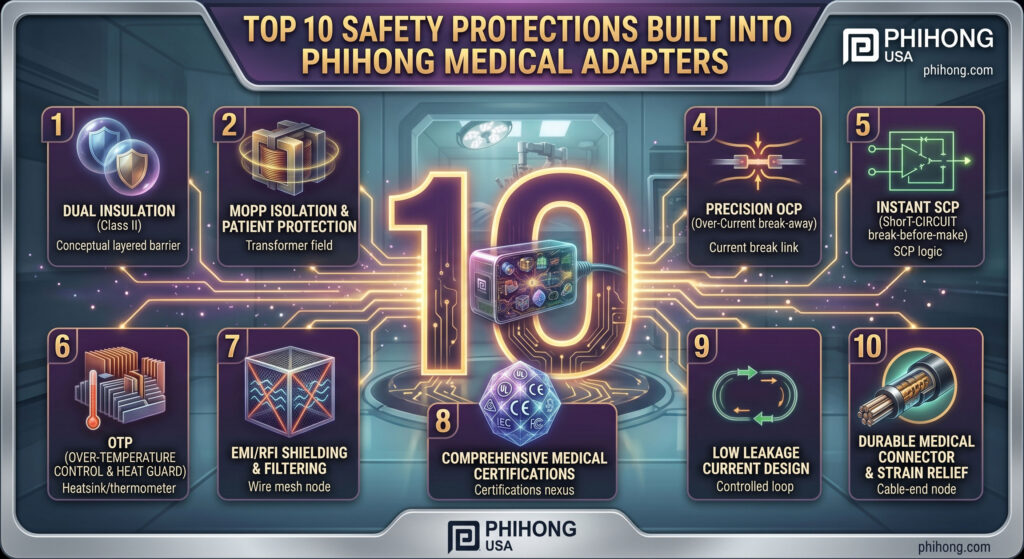
Top 10 Safety Protections Built into Phihong Medical Adapters
Before getting into the list, the key idea is simple: in medical electronics, the adapter cannot be the weak link. It has to protect the device, the operator, and the patient at the same time, even when something goes wrong.
1. 2 x MOPP Isolation Is the Foundation of Patient Protection
One of the most important safety protections in a medical adapter is 2 x MOPP, or two means of patient protection. Phihong’s current medical manufacturing content describes 2 x MOPP as the strictest classification and positions it as central to medical power safety design. That matters because it gives the product two independent insulation barriers between hazardous voltage and the patient side of the system.
Your draft correctly treats this as the cornerstone of medical safety. In practical terms, 2 x MOPP is what helps ensure that a single insulation failure does not immediately create a dangerous condition. For OEMs, it is also one of the clearest signals that an adapter was designed for medical use rather than repurposed from a general electronics platform.
2. Reinforced Insulation Helps Prevent Hazardous Voltage Transfer
Reinforced insulation works with the isolation system to prevent dangerous voltage from crossing from the primary side to the secondary side of the adapter. Phihong’s medical pages repeatedly highlight reinforced insulation as part of its medical safety approach and connect it directly to IEC 60601-1 compliance.
This matters because safety in medical adapters is not only about active circuitry. Passive protections matter just as much. A strong insulation system gives the product a constant physical safety barrier, even before active protection circuits come into play. For medical OEMs, reinforced insulation is one of the most valuable hidden protections built into a qualified adapter.
3. Low Leakage Current Protects Both Patients and Sensitive Systems
Leakage current is one of the most critical safety metrics in medical power design. Phihong’s current medical content emphasizes low leakage current repeatedly and notes that for patient-connected equipment, even very small amounts of unintended current can be unacceptable. Its manufacturing article also specifically mentions low leakage current under 100 µA for CF-rated supplies as an example of strict medical safety expectations.
Your uploaded draft is right to call this one of the most important protections in the entire adapter. Low leakage is not just about passing a test. It helps protect vulnerable patients and supports cleaner operation for sensitive monitoring and diagnostic equipment.
4. Over-Voltage Protection Helps Prevent Damage from Output Spikes
Over-voltage protection is one of the most practical active safety circuits in a medical adapter. If the output rises above safe limits, the protection system is there to stop that abnormal condition from reaching the device. Your source document presents this as a key built-in safeguard, and that is a strong inclusion because output spikes can damage expensive medical electronics very quickly.
While Phihong’s public medical articles speak more broadly about fail-safe overload and short-circuit protection than about every exact OVP implementation detail, the overall principle is supported: medical adapters are expected to include protective behavior that helps contain electrical faults before they propagate to the connected system.
5. Over-Current and Short-Circuit Protection Add a Critical Fault Layer
Phihong’s medical manufacturing content explicitly mentions fail-safe design with overload and short-circuit protection as part of the medical safety picture. This makes over-current protection one of the clearest confirmed protection categories to highlight. If a connected load draws too much current or a cable fault occurs, the adapter needs to limit damage and protect both itself and the device.
Your draft describes this as an auto-recovery style safeguard, which fits the kind of operational protection OEMs want in real-world use. In practical terms, over-current and short-circuit protection help stop small wiring or device-side problems from turning into larger failures.
FEATURED PRODUCTS
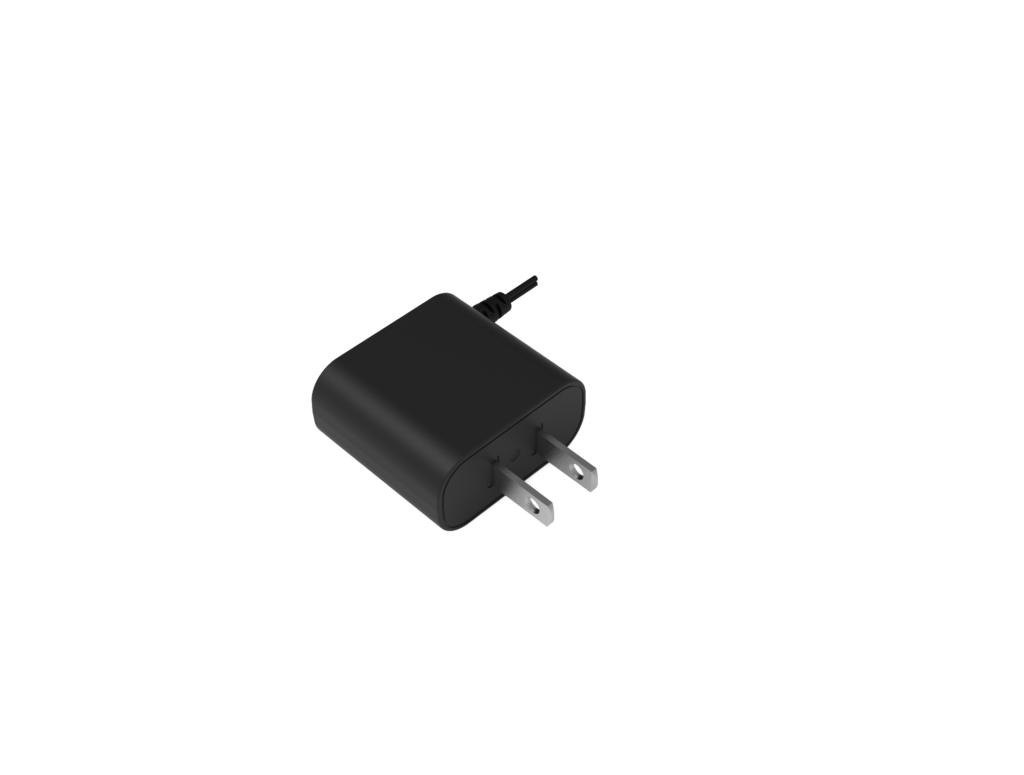
AA03A-075A-R
- Output Power - 2.75W
- Output Volt - 7.5V
- Output Current - 0.366A
- Features - Fixed Blade AC Input, Limited Power Source, Class B EMI, Level VI Efficiency, Standard Barrel Connector
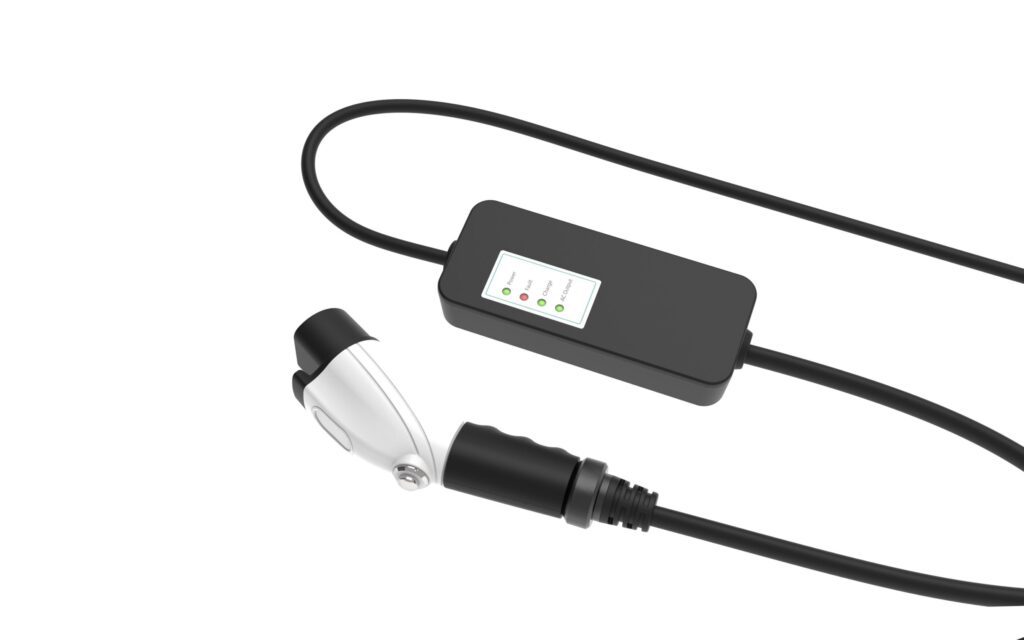
AC Series
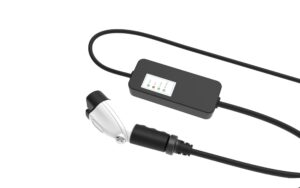
- Output Current - 16A
- Features - Mode 2-chargers can use a circuit ranging from 8Amp to 16Amp with a local standard AC input plug installed for operation, Provides overcurrent, over voltage and short circuit protection, Protected against strong jets of water from all directions, Continuously monitors/supervises the ground connection between the AC supply and EV to ensure safe and reliable charging
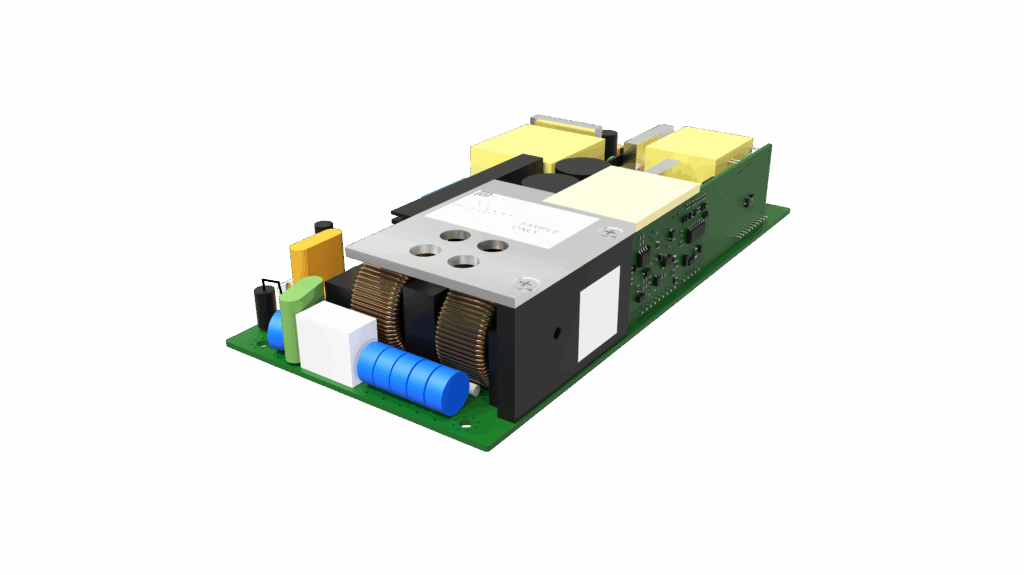
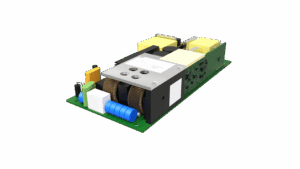
BF550-234B-R
- Output Power - 550W
- Output Volt - 12Vdc / 54.5Vdc
- Features - Universal AC Input range, Class I Design , Class B EMI , High Efficiency Performance , OVP, OCP, SCP, OTP Protections , Operating Altitude: 5,000M
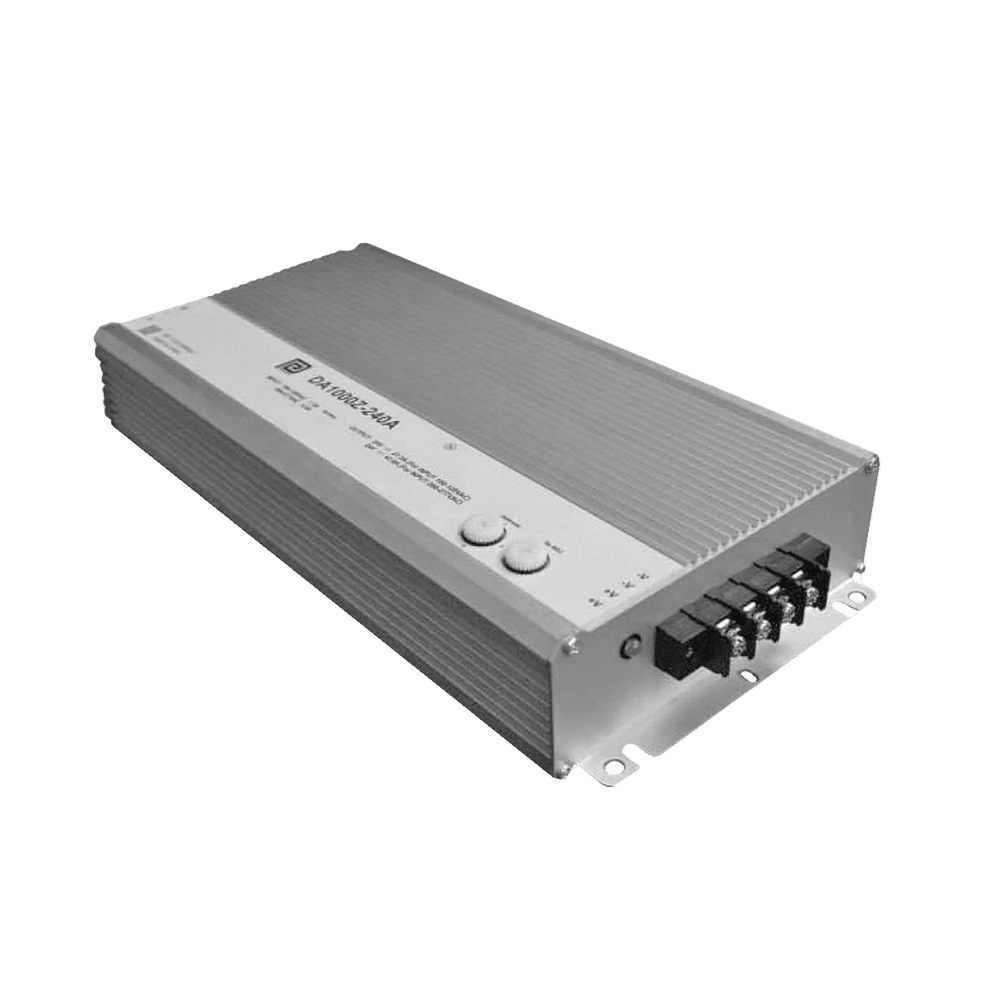
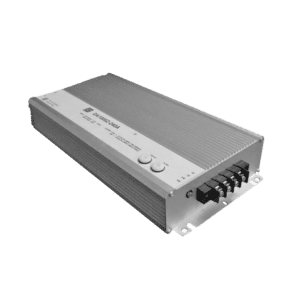
DA1000Z-240AEV-R
- Output Power - 1000W
- Output Volt - 24V
- Output Current - 42A
- Features - Extended operating temperature range of -40℃ to 70℃, Fan-less aluminum case filled with heat conductive glue, Able to withstand 10G vibration, Power on LED indicator, Short Circuit, Over Current, Over Voltage, and Over Temperature Protections, & Adjustable output through potentiomete
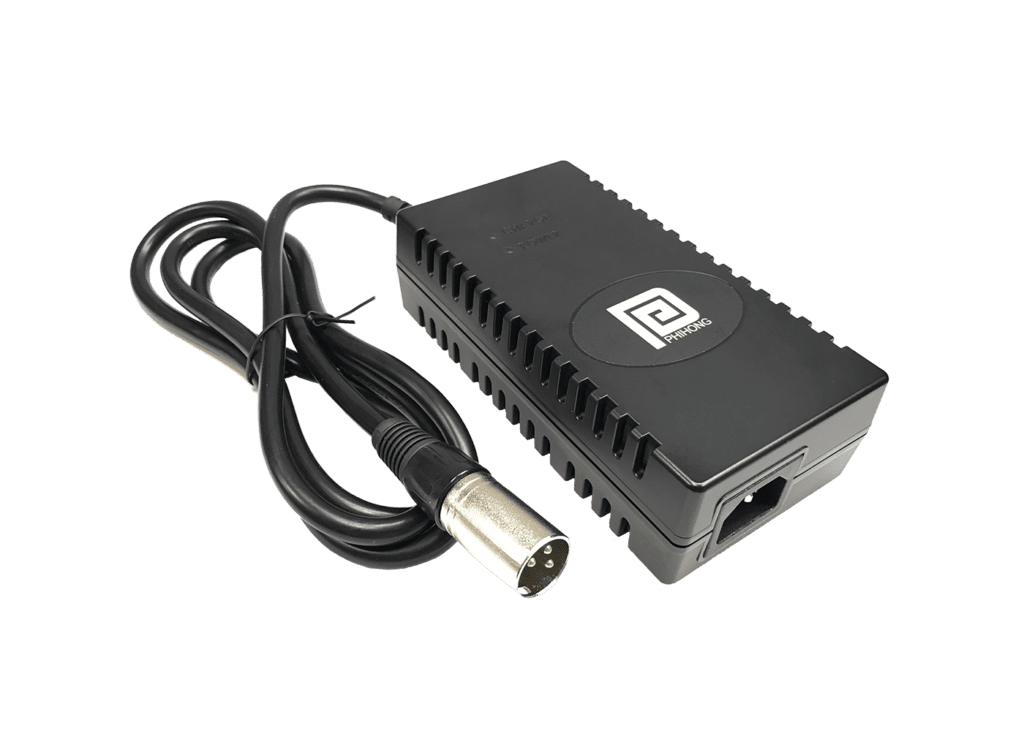
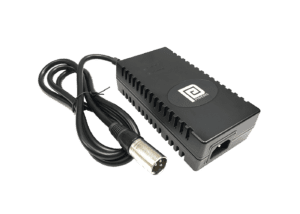
DA60U-240A-R
- Output Power - 60W
- Output Volt - 24V
- Output Current - 2.5A
- # of ports - 1
- Features - RESNA Compliant, CEC Compliant, LED Indicators Charge State, OVP, OTP, SCP, Charges AGM Batteries, Max 12hrs Charging Time
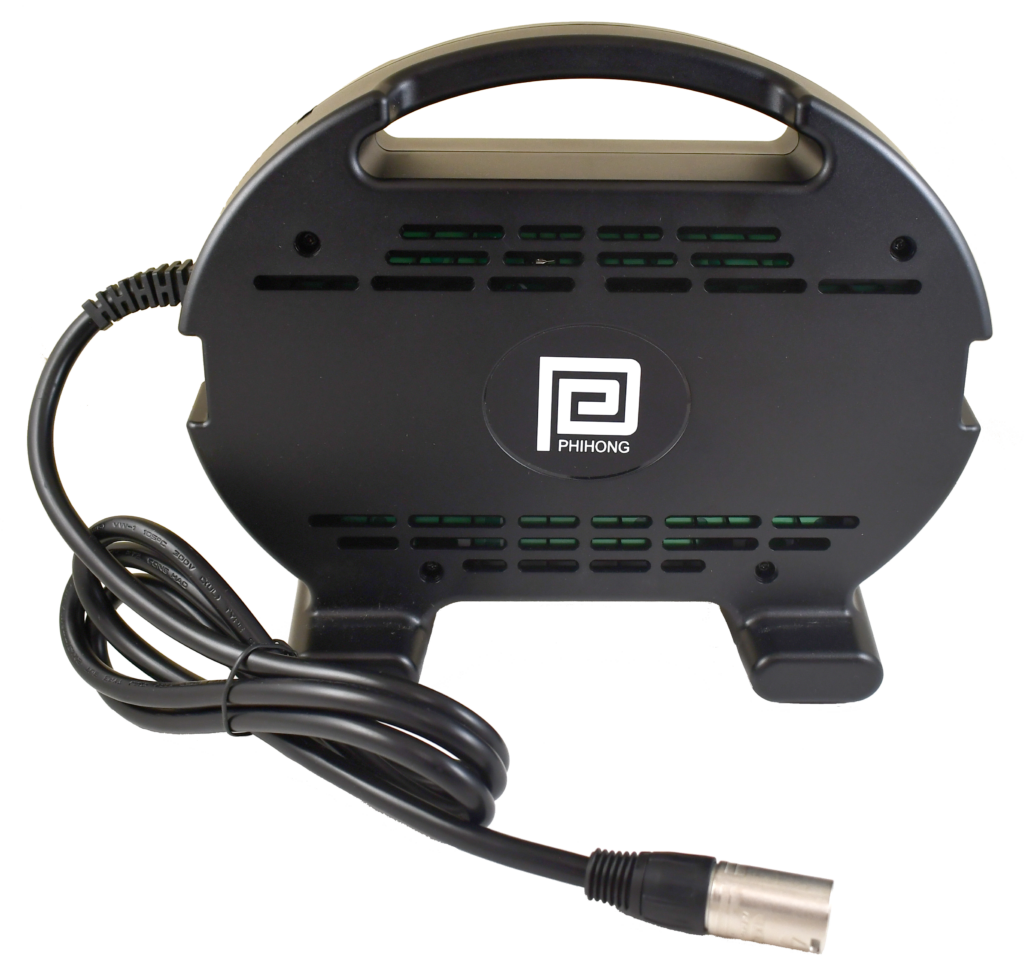
DA200U-250A-R
- Output Power - 200W
- Output Volt - 24V
- Output Current - 8A
- # of ports - 1
- Features - RESNA Compliant, CEC Compliant, LED Indicators Charge State, OVP, OTP, SCP, Dual-Mode Charger, Charges GEL or AGM batteries, Max 12hrs Charging Time
CLIENT'S QUOTE
Phihong’s custom OEM power solutions have transformed our product development, boosting performance and reducing overhead. Their expert engineering support has simplified both the design and manufacturing phases.
6. Thermal Protection Helps Stop Heat from Becoming a Safety Hazard
Thermal protection is another vital built-in layer because medical adapters often operate in enclosed, warm, or poorly ventilated environments. If internal temperatures rise too far, shutdown or protective throttling behavior can help prevent deformation, overstress, or more serious hazards. Your uploaded article includes over-temperature protection as one of the Top 10, and that is absolutely justified.
Phihong’s recent medical and thermal content also reinforces the broader point that temperature behavior is inseparable from safe power design. Even when the public pages do not list every OTP threshold, the company clearly treats thermal stability as part of reliability and safety engineering for medical systems.
7. Double-Fused Input Design Supports Better Primary-Side Protection
Your draft highlights dual input fusing as a meaningful medical safety layer, especially in the context of building wiring faults and polarity issues. That fits well with Phihong’s broader emphasis on reinforced input-side protection and fault-tolerant medical design, even though the public articles summarize this at a higher level rather than listing every fuse architecture by model.
From a systems perspective, strong primary-side protection matters because it is the first line of defense between the AC source and the rest of the adapter. For medical OEMs, that means better control over abnormal input events and a stronger overall fault-containment story.
8. Flame-Retardant Enclosure Materials Add Passive Fire Protection
Your source document calls out UL 94V-0 enclosure behavior as a distinct safety protection, and that is a smart addition because enclosure material choice is a real protective layer, not just a mechanical detail. A flame-retardant housing helps contain ignition risk and supports safer failure behavior if internal stress ever escalates.
This is a good example of why medical adapter safety depends on both visible and invisible design choices. The power electronics, insulation, and control circuits matter, but so does the material that physically surrounds them. Passive fire resistance remains a crucial part of medical product confidence.
9. IP22-Level Protection Improves Safety in Real Clinical and Home Environments
IP22 is especially relevant for home-healthcare and light clinical environments where dripping water, handling, and incidental exposure are realistic. Your uploaded article includes IP22 as one of the built-in protections, and that matches how Phihong has positioned some of its medical adapters in public materials, particularly for home-use or compact medical applications.
This is important because medical safety is not defined only by lab conditions. Adapters also have to survive the kinds of small real-world environmental challenges that happen during cleaning, bedside use, and everyday handling. IP-rated protection helps extend safety into those conditions.
10. EMC Immunity Helps Protect Essential Performance in Noisy Environments
Phihong’s current medical content explicitly ties medical power design to EMI and EMC requirements under IEC 60601-1-2 and emphasizes that electromagnetic control is mandatory in medical environments where multiple devices operate side by side. That makes EMC immunity one of the strongest externally supported protections to include here.
This matters because a medically safe adapter is not only one that avoids shock. It is one that continues supporting essential device performance in the presence of wireless signals, nearby electronics, and electrically noisy spaces. In modern healthcare, EMC protection is a core safety feature because performance instability can become a safety risk of its own.
By combining isolation, reinforced insulation, low leakage current, output fault protection, thermal safeguards, primary-side protection, flame-retardant housing, environmental resistance, and EMC resilience, Phihong’s medical safety story becomes much stronger than any one line item on a datasheet. Your draft captures that layered philosophy well.
For medical OEMs, that is the real takeaway. The best medical adapters are not built around one hero feature. They are built around multiple overlapping protections that help the product stay safe, stable, and compliant under normal use and fault conditions alike.
Useful Links
- How to manufacture IEC 60601-1 medical power supplies
- Medical vs. industrial power adapters and why safety approvals matter
- Top power supply manufacturers for medical devices
Related Articles
- What is IEC 60601 and why it matters for medical power supply design
- Medical power solution: how low leakage current affects medical power supply selection
- Best guide to medical power supplies for modern medical devices
How Phihong Can Help OEMs Choose Medical Adapters with Stronger Built-In Protection
Phihong’s recent medical content makes it easier for OEMs to evaluate medical power beyond simple wattage and form factor. The company’s official articles consistently emphasize 2 x MOPP, low leakage current, reinforced insulation, EMC readiness, documentation support, and IEC 60601-aligned design. Together, those give OEM teams a clearer framework for choosing adapters that support both safety and smoother certification work.
That matters because medical adapter selection is often really about risk reduction. A product with stronger built-in protection layers can reduce surprises during validation, help support a more credible regulatory file, and lower the chance that power becomes the weak point in the final device. For OEMs building clinical or home-use systems, that is exactly the kind of value a medical power partner should provide.
As medical devices become smaller, more connected, and more widely deployed across clinical and home settings, the importance of layered protection inside the adapter will only grow. Safety is not getting simpler. It is becoming more integrated into every part of power design.

CONTACT US TODAY
From concept to production, Phihong delivers custom OEM power solutions tailored to your specifications.
POE technology supports the centralization of power

AC Adapter Guide: Everything You Need to Know
Moreover, PoE technology supports the centralization of power management. By powering devices through a PoE-enabled network …
AC DC Power Chargers and How They Work: A Comprehensive Technical Breakdown
Moreover, PoE technology supports the centralization of power management. By powering devices through a PoE-enabled network …

USB-C Charger: Shaping the Future of the Tech World
Moreover, PoE technology supports the centralization of power management. By powering devices through a PoE-enabled network …

AC Adapter Guide: Everything You Need to Know
Moreover, PoE technology supports the centralization of power management. By powering devices through a PoE-enabled network …

AC DC Power Chargers and How They Work: A Comprehensive Technical Breakdown
Moreover, PoE technology supports the centralization of power management. By powering devices through a PoE-enabled network …

USB-C Charger: Shaping the Future of the Tech World
Moreover, PoE technology supports the centralization of power management. By powering devices through a PoE-enabled network …