









BLOG
How Does Fan Cooling Change the Available Output of a 200W Open-Frame PSU?
QUICK LINKS
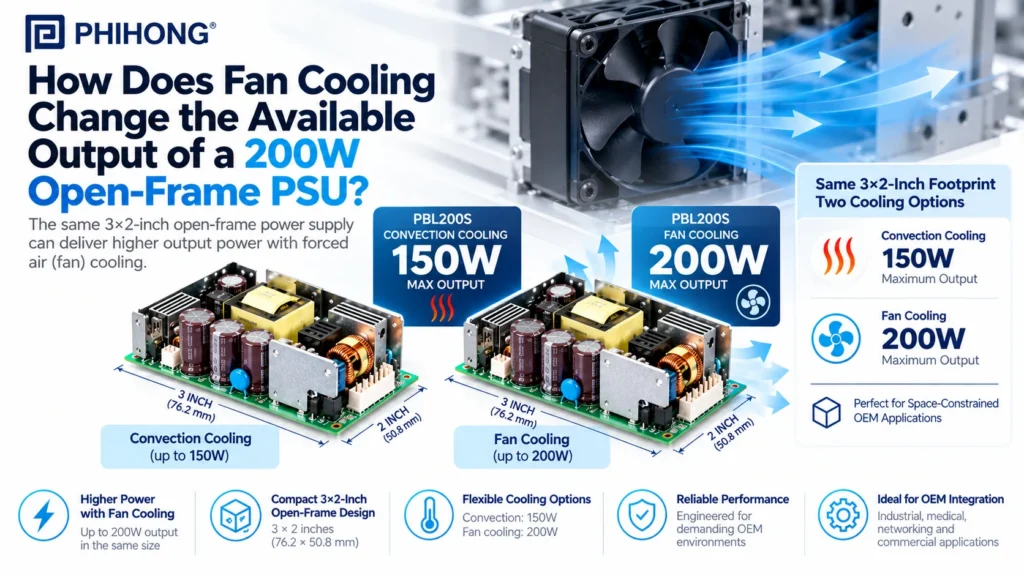
Fan cooling changes the output reference available for a Phihong PBL200S integration. The official family datasheet lists 150W with convection cooling and 200W with fan cooling. The higher figure therefore belongs to a cooling configuration, not to every installation carrying the PBL200S name.
For an OEM, the next question is whether the enclosure actually provides the conditions needed for that fan-cooled rating. The concise document does not define a complete airflow rate, direction or derating curve. Use the listed distinction to plan the design, then obtain the supplier conditions and qualify the installed supply, load and cooling arrangement together.
What does the PBL200S 150W versus 200W statement establish?
The source identifies two cooling-dependent family references: 150W convection and 200W fan cooling. That supports an electrical shortlist, but it does not say that a fanless assembly provides 200W continuously or that any fan unlocks the higher figure. The voltage variant, installed airflow and applicable operating conditions remain part of the configuration.
The datasheet covers PBL200S-120, PBL200S-240 and PBL200S-480, with nominal 12V, 24V and 48V outputs. Its exact fan-cooled summary includes slightly different power figures by variant. Keep the nominal 200W family comparison separate from exact released model limits, rather than deriving a guaranteed current from a rounded name.
| Mode in the source | Listed family output | What still needs verification |
|---|---|---|
| Convection cooling | 150W | Model-specific installed conditions and any derating |
| Fan cooling | 200W family class | Airflow basis, model limit and enclosure qualification |
The entries describe alternative design conditions. They are not a time-based overload allowance or a claim that equipment can switch between them without changing its operating requirement.
Why This Matters
- A fanless budget based on the higher family rating can overlook the documented convection limit.
- A cooling-mode entry does not fully define the tested assembly or exact model current.
What OEMs Should Do Now
- Record the selected voltage variant and intended cooling mode with the electrical requirement.
- Obtain the exact fan-cooled rating conditions before approving a load above the convection reference.
Useful Links
PBL200S cooling and output summary
FEATURED PRODUCTS
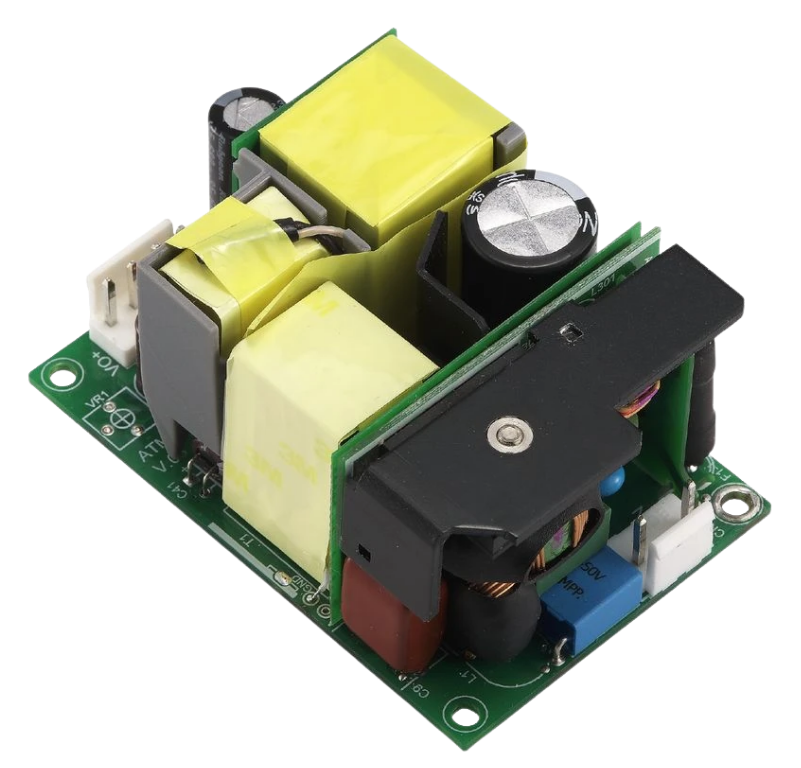
PBL200S-120
- Output Power - 200W(with Fan)
- Output Volt - 12Vdc
- Features - Class B EMI , High Efficiency Performance , OVP, OCP, SCP, OTP Protections , Operating Altitude: 5,000M
PBL200S-240
- Output Power - 200W(with Fan)
- Output Volt - 24Vdc
- Features - Class B EMI , High Efficiency Performance , OVP, OCP, SCP, OTP Protections , Operating Altitude: 5,000M
PBL200S-480
- Output Power - 200W(with Fan)
- Output Volt - 48Vdc
- Features - Class B EMI , High Efficiency Performance , OVP, OCP, SCP, OTP Protections , Operating Altitude: 5,000M
Why is a fan specification alone insufficient?
A fan’s catalog performance does not establish airflow reaching the supply. The installed path can include inlet restrictions, outlet restrictions, filters and obstructions from neighboring components. Air can also circulate around a board instead of reaching the areas relevant to cooling. Qualify the installation rather than treating the enclosure’s fan presence as the evidence.
The PBL200S source does not provide a required CFM value, prescribed direction or detailed pressure condition. Do not invent those numbers to complete a drawing. Ask Phihong for the rating test arrangement and applicable thermal guidance. Its listed −20°C to +50°C operating range is a boundary to review, not a complete statement of full-output capability at every temperature.
| Detail | Why it affects qualification |
|---|---|
| Required airflow arrangement | Defines the basis for the fan-cooled rating |
| Airflow direction and restrictions | Connects the rating arrangement to the actual enclosure |
| Temperature measurement locations | Distinguishes local supply conditions from room ambient |
| Derating information | Relates allowable output to operating conditions |
Retain the final mounting and neighboring hardware in the thermal record. A layout change can alter the cooling path even if the fan and supply part numbers remain unchanged.
Why This Matters
- Installed airflow can differ from the fan’s isolated catalog performance.
- Missing cooling conditions should remain explicit rather than becoming assumed design inputs.
What OEMs Should Do Now
- Request the supplier airflow and derating basis for the intended variant and output.
- Measure the completed enclosure under defined loading and local temperature conditions.
Related Links
Phihong’s broader enclosure thermal validation methods and Phihong’s open-frame power supply selection guide
How does the fan affect the electrical and control budget?
Include fan demand in the appropriate electrical budget. If the fan draws from the same DC output as the equipment, its operating and startup demand belongs on that rail. If another supply powers it, retain that separate power path. The PBL200S datasheet does not establish a dedicated fan connector or auxiliary fan output, so neither should be assumed.
For illustration only, a hypothetical 170W equipment load plus a 4W fan supplied from the same output totals 174W. Subtracting that from a nominal 200W screening reference leaves 26W. This is arithmetic, not a Phihong test result or proof of thermal acceptance. The exact model limit, fan startup and qualified operating conditions still govern the design.
| Item | Requirement to define |
|---|---|
| Fan power source | Voltage, current and startup demand on the actual rail |
| Control behavior | How cooling is established before demanding operation |
| Monitoring | What information the system uses to detect degraded cooling |
| Failure response | Permitted load reduction, shutdown or other qualified behavior |
Do not treat a stopped fan as an automatic transition to a qualified 150W system. The equipment load may remain above the convection reference, and the previous thermal state matters. Supplier protection functions do not establish the OEM’s complete cooling-loss response.
Why This Matters
- A fan may consume part of the same output capacity that supports the equipment.
- Cooling-loss behavior requires a system decision rather than an assumed rating change.
What OEMs Should Do Now
- Identify the fan’s actual power and control path without assuming an undocumented auxiliary output.
- Specify and qualify the response to loss or degradation of the required cooling.
Useful Links
PBL200S documented output and protection information
What should the installed cooling test demonstrate?
Test the enclosure and workload intended for sale. Record the supply model, input conditions, load, mounting, fan arrangement and local temperatures. Keep the measurement boundary clear: room ambient, inlet air and component temperatures answer different questions. Ask the supplier which points matter for the released rating and use an appropriate engineering test procedure.
The useful result is not simply that the fan spins or the output remains present. Demonstrate the defined equipment behavior and the applicable electrical and thermal acceptance criteria. Include the operating states that affect heat or airflow, and evaluate degraded cooling where the product requirement calls for it. These are proposed qualification cases, not reported results for a particular unit.
| Case | Evidence to retain |
|---|---|
| Required sustained load | Output, equipment function and relevant temperatures |
| Restricted installation | Actual inlet/outlet arrangement and approved conditions |
| Cooling startup | Fan establishment and equipment loading sequence |
| Defined degradation case | System detection and response against the acceptance criteria |
| Configuration change | Review of altered airflow, mounting or neighboring heat sources |
Record exceptions and corrective actions with the configuration. A passing result from an unobstructed laboratory arrangement should not be silently applied to a different enclosure or mounting orientation.
Why This Matters
- Functional and thermal evidence is stronger than a fan-presence check.
- A traceable installation keeps test results from being generalized to untested layouts.
What OEMs Should Do Now
- Agree on thermal and functional acceptance with the relevant engineering and supplier teams.
- Retain the enclosure configuration and review changes that affect the cooling path.
Useful Links
IEC 62368-1 scope for the applicable equipment safety review
How should OEMs request a fan-cooled PBL200S configuration from Phihong?
Name the exact candidate: PBL200S-120 for 12V, PBL200S-240 for 24V or PBL200S-480 for 48V. Include the sustained load, fan power arrangement, ambient conditions and enclosure layout. A request for “a 200W 3×2 supply” leaves the important cooling assumptions undefined.
Ask for the airflow basis, derating guidance, relevant measurement points and released drawing. The current dimension text contains a millimetre-to-inch height inconsistency, so confirm mechanical clearance from the released information. Request applicable model documentation and any clarification needed to qualify cooling-loss behavior without assuming that protection guarantees continuous equipment operation.
Confirm release status and availability separately. Phihong lists the family in its Coming Soon pipeline; a published product record is not proof of current commercial supply. Keep the selected variant and cooling conditions with the equipment qualification and purchasing records.
Why This Matters
- An exact-model inquiry allows the supplier to address the actual airflow and loading requirement.
- Released drawings and current sourcing facts remain necessary after a cooling concept is chosen.
What OEMs Should Do Now
- Send the complete electrical and installed-cooling requirement to Phihong.
- Close the rating, drawing and documentation questions before approving the configuration.
Useful Links
Review PBL200S cooling requirements with Phihong
The fan-cooled output belongs to a qualified assembly with defined airflow and load behavior. Preserve that configuration and its evidence rather than treating a fan as a universal output upgrade. Contact Phihong to clarify the missing rating conditions for your installation.
Frequently Asked Questions
Does adding any fan make PBL200S a 200W installation?
No. The source lists a fan-cooled output reference but does not define a universal fan choice. Obtain the applicable airflow and thermal conditions, then qualify the actual model, enclosure and load. A fan that moves air elsewhere in the equipment is not evidence that the supply receives the required cooling.
Is the required airflow rate stated in the reviewed datasheet?
The concise family document does not provide a complete airflow-rate or direction specification. Do not invent a CFM value or derive one from the output rating. Request the supplier’s rating arrangement and derating guidance, then evaluate whether the installed path provides the applicable conditions.
Can the output automatically fall back to 150W if the fan stops?
The convection entry is not a promise of automatic load limiting or safe transition. The equipment may still demand more than that reference, and protection or recovery behavior is not fully established by the cooling table. Define and qualify the OEM system’s response to loss of the required cooling.
Should fan power be included in the 200W budget?
Include it when the fan draws from that same supply output. Record its operating and startup demand and the actual power path. If another supply powers the fan, retain that separate budget. Do not assume a dedicated fan connector or auxiliary rail from the reviewed PBL200S document.
What changes should trigger another cooling review?
Review changes to the enclosure, mounting, inlet/outlet restrictions, fan arrangement, nearby heat sources or operating load. Engineering should determine whether existing qualification covers the change. Keeping the same PSU and fan part numbers does not prove that the installed thermal conditions remain equivalent.