










BLOG
12V, 24V or 48V: How Should OEMs Select a 3×2-Inch Open-Frame Power Supply?
QUICK LINKS
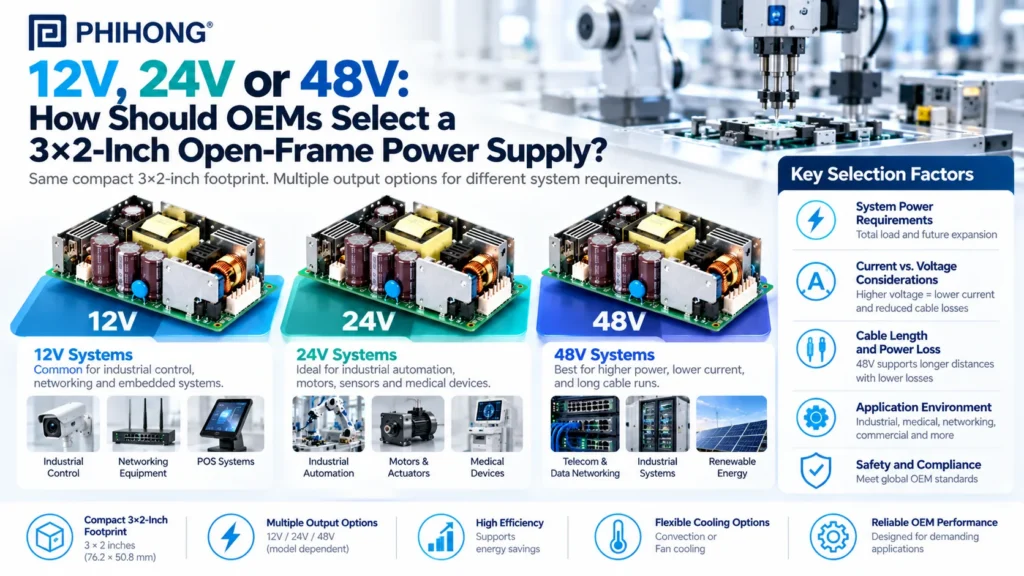
Select 12V, 24V or 48V by the equipment’s accepted DC input and distribution architecture, then choose a PBL130S or PBL200S variant whose qualified output meets the load. The highest voltage is not automatically the best fit. A suitable wattage cannot compensate for a rail that directly connected equipment cannot accept.
Phihong’s two 3×2-inch families identify separate fixed-voltage variants: suffix -120 for nominal 12V, -240 for 24V and -480 for 48V. Treat that mapping as a model choice, not a promise that one unit switches between all three voltages. The process below focuses on voltage selection, current distribution and downstream conversion.
Which DC rail do the actual loads require?
List the accepted input range of each directly connected load. Use its released specification, including any relevant operating and startup requirements. Group loads that can share a rail and identify those requiring another voltage. A peripheral’s connector shape or application category does not establish its electrical input.
The PBL family documents identify nominal output variants, but do not provide a complete user-selectable adjustment range. Do not assume an adjustment that is absent from the reviewed information. Likewise, distinguish a nominal rail from a full guaranteed voltage envelope. Regulation, ripple and dynamic behavior have their own conditions and need to be assessed against the load’s accepted input.
| Required nominal rail | PBL130S model | PBL200S model |
|---|---|---|
| 12V | PBL130S-120 | PBL200S-120 |
| 24V | PBL130S-240 | PBL200S-240 |
| 48V | PBL130S-480 | PBL200S-480 |
Keep the rail decision tied to the equipment revision. A later load or controller change can alter which variant is appropriate, even when the enclosure and total wattage remain unchanged.
Why This Matters
- Directly connected loads must accept the selected voltage, not merely fit its power class.
- Nominal voltage and a complete guaranteed operating envelope are different specifications.
What OEMs Should Do Now
- Build a load-input map using released component and equipment specifications.
- Confirm the exact variant’s output limits and any permitted adjustment from the supplier.
Useful Links
PBL130S voltage mapping and PBL200S voltage mapping
FEATURED PRODUCTS
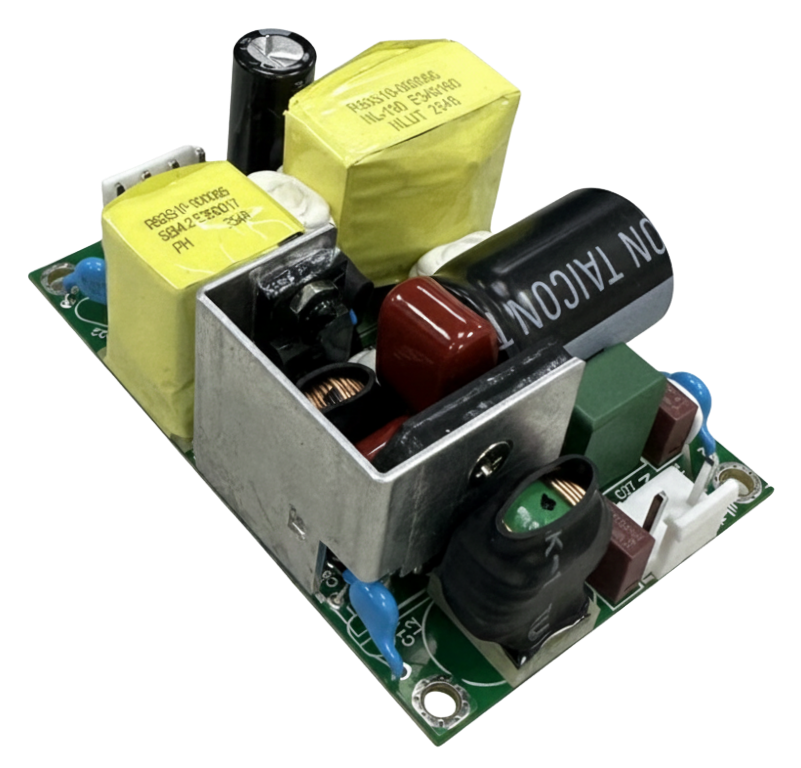
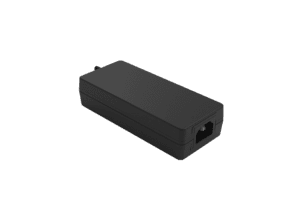
PBL130S-120
- Output Power - 130W(with Fan)
- Output Volt - 12Vdc
- Features - Class B EMI , High Efficiency Performance , OVP, OCP, SCP, OTP Protections , Operating Altitude: 5,000M
PBL130S-240
- Output Power - 130W(with Fan)
- Output Volt - 24Vdc
- Features - Class B EMI , High Efficiency Performance , OVP, OCP, SCP, OTP Protections , Operating Altitude: 5,000M
PBL130S-480
- Output Power - 130W(with Fan)
- Output Volt - 48Vdc
- Features - Class B EMI , High Efficiency Performance , OVP, OCP, SCP, OTP Protections , Operating Altitude: 5,000M
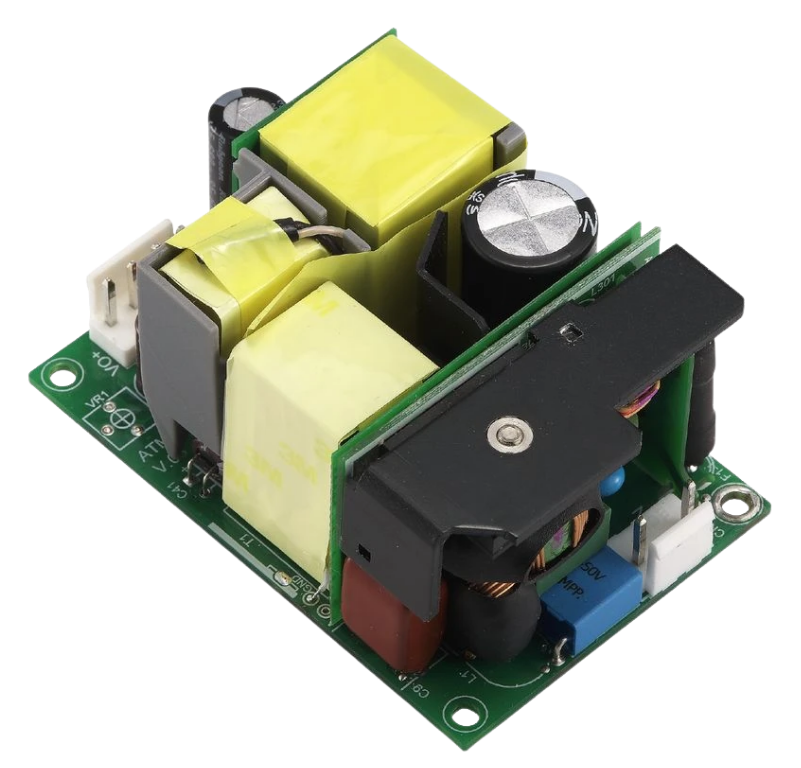
PBL200S-120
- Output Power - 200W(with Fan)
- Output Volt - 12Vdc
- Features - Class B EMI , High Efficiency Performance , OVP, OCP, SCP, OTP Protections , Operating Altitude: 5,000M
PBL200S-240
- Output Power - 200W(with Fan)
- Output Volt - 24Vdc
- Features - Class B EMI , High Efficiency Performance , OVP, OCP, SCP, OTP Protections , Operating Altitude: 5,000M
PBL200S-480
- Output Power - 200W(with Fan)
- Output Volt - 48Vdc
- Features - Class B EMI , High Efficiency Performance , OVP, OCP, SCP, OTP Protections , Operating Altitude: 5,000M
To carry output-voltage selection through to model and cooling decisions, review 130W versus 200W power budgeting, airflow planning for a 200W open-frame power supply and 130W and 200W open-frame power supply selection.
How does voltage change current and distribution planning?
At the same delivered power and nominal voltage, current is power divided by voltage. The table illustrates that relationship for a hypothetical 100W load before considering conversion differences. The values are calculations, not measurements or the maximum rated current of any PBL model.
Lower current can affect conductor and connector planning. For a fixed resistance, resistive loss follows current squared multiplied by resistance. Those relationships help compare architectures, but real wiring choices also depend on length, acceptable voltage drop, temperature and applicable equipment requirements. Do not turn the arithmetic into a blanket claim of lower installed loss without evaluating the actual path.
| Nominal rail | Calculation | Approximate current |
|---|---|---|
| 12V | 100W ÷ 12V | 8.33A |
| 24V | 100W ÷ 24V | 4.17A |
| 48V | 100W ÷ 48V | 2.08A |
Identify whether the comparison concerns the supply output, a distribution bus or a local converted rail. A higher-voltage bus feeding a converter is not the same architecture as connecting that voltage directly to the end load. Keep the different measurement and conversion boundaries visible.
Why This Matters
- Current requirements change with the chosen rail even when nominal load power is unchanged.
- Distribution calculations can become misleading when conversion and measurement boundaries are mixed.
What OEMs Should Do Now
- Calculate current and permitted voltage drop for each actual distribution path.
- Verify connectors and conductors for the released model and installation rather than example values.
Useful Links
IEC 62368-1 scope for the applicable equipment safeguards review
When does a higher-voltage bus need downstream conversion?
A system may distribute one voltage and convert it locally for loads requiring another. Decide whether that architecture helps the actual equipment before selecting the PSU variant. Include the converter’s accepted input range, output capability, efficiency under the intended load and dynamic interaction with the load. Those characteristics belong to the selected converter, not to the PBL datasheet.
For a mixed-voltage product, account for each conversion path in the upstream budget. Avoid adding a load’s delivered output power to another path’s input power without reconciling the boundary. Also review startup sequencing and the behavior of local rails during input interruption. A stable upstream bus does not by itself establish correct downstream operation.
| Arrangement | Key verification |
|---|---|
| PSU rail directly feeds the load | Load acceptance of the actual supply voltage behavior |
| One bus feeds local converters | Converter input, losses, sequencing and dynamic response |
| Mixed direct and converted loads | Concurrent upstream demand and each load’s accepted range |
| Networking power architecture | Required interface stages and applicable equipment specifications |
The supplier’s PoE and IoT application references do not establish IEEE PoE interface compliance. A 48V supply can be part of a design discussion, but the complete networking power architecture still needs its own requirements and qualification.
Why This Matters
- A convenient bus voltage may introduce conversion requirements that change the power budget.
- An application label does not establish compliance of an interface or finished equipment.
What OEMs Should Do Now
- Specify the complete conversion and distribution architecture alongside the PSU rail.
- Test downstream startup and dynamic behavior with the chosen upstream source.
Related Links
Phihong’s broader internal-PSU integration guide
How do cooling and exact model limits constrain voltage selection?
After choosing the rail, check that the selected family and cooling configuration support its required load. PBL130S lists 100W convection and 130W forced cooling; PBL200S lists 150W convection and 200W fan cooling. The shared board class does not mean every voltage variant has interchangeable electrical or thermal conditions.
Use released model information to settle current limits. The PBL130S summary includes a foreign label in an exact output-power entry, so its ambiguous number is not a sound basis for specifying PBL130S-480 current. The PBL200S summary gives slightly different exact fan-cooled power figures by variant. These details are why a rounded family rating should not replace the full model specification.
| Check | Question to close |
|---|---|
| Continuous output | What exact current and power limits cover this variant? |
| Cooling conditions | Which rating applies to the qualified installation? |
| Voltage behavior | Does the load accept static and dynamic output conditions? |
| Mechanical configuration | Do released drawings and connectors fit the equipment? |
No complete airflow prescription or thermal derating curve is supplied in the concise sources. Ask for those conditions before approving output close to the relevant limit. The listed operating-temperature range is not a substitute for that missing information.
Why This Matters
- Correct nominal voltage is necessary but does not settle available continuous output.
- Rounded classes and ambiguous summary text can create unsupported current specifications.
What OEMs Should Do Now
- Request the exact variant limits and resolve the inconsistent model-label entry.
- Qualify the chosen rail at the intended load and installed cooling conditions.
Useful Links
PBL200S model output and cooling information
How should Phihong review an OEM voltage-architecture decision?
Send Phihong the load-input map, selected distribution rail, converter paths and complete upstream power requirement. Name the PBL variant candidates and identify any voltage behavior, startup or current limit that requires clarification. This is more useful than asking which voltage is generally best for an entire application category.
Include the enclosure and cooling concept so the rail decision is evaluated with the actual power class. Request the released drawing, exact output limits and applicable model documentation. Current product pages identify the six model records, but the Coming Soon listing does not prove production availability or completed approvals for an intended order.
Retain the accepted architecture in the qualification and purchasing records. If a load, converter or voltage variant changes, review whether existing evidence covers the new configuration. A model with the same footprint and wattage name can still require a different electrical assessment.
Why This Matters
- The supplier can evaluate a defined architecture rather than an abstract voltage preference.
- Configuration control preserves the actual rail and load combination approved by engineering.
What OEMs Should Do Now
- Submit the voltage architecture and model-specific questions as one requirement package.
- Close electrical, thermal, mechanical and documentation questions before releasing the chosen variant.
Useful Links
Discuss PBL voltage selection with Phihong
Choose the rail required by the load architecture, then verify current distribution, conversion and cooling-qualified output for the exact variant. Contact Phihong with that architecture and the unresolved model limits to complete the selection review.
Frequently Asked Questions
Is 48V always better because the current is lower?
No. Lower nominal current at the same power is one distribution consideration. The loads must accept the voltage or use suitable conversion, and the complete architecture needs appropriate electrical and equipment assessment. Evaluate actual losses, converter behavior and wiring rather than selecting a rail solely from a current calculation.
Can PBL200S-480 directly power a 12V load?
The named variant is listed for nominal 48V output. Do not connect that rail directly to equipment that only accepts 12V. Choose an appropriate 12V variant or evaluate a separately specified conversion stage. The matching wattage class does not establish voltage compatibility.
Does the -480 model suffix establish PoE approval?
No. It identifies the documented nominal output variant in these families, not compliance of a PoE interface. Review the required networking architecture, interface electronics and applicable equipment requirements separately. A supplier application reference is not proof that an entire PoE system has been evaluated or approved.
Can rated current be obtained by dividing the family name by voltage?
That gives a rough nominal power-budget calculation, not a released model rating. Cooling mode and exact variant limits matter, and the PBL130S source contains an ambiguous output-summary label. Use current model documentation or supplier confirmation for the actual current specification.
What should be rechecked when the selected voltage changes?
Recheck load acceptance, converter inputs, current distribution, connectors, startup and dynamic behavior. Review the exact supply variant’s cooling and mechanical conditions as well. Engineering should decide whether previous qualification applies to the changed architecture rather than assuming that equal wattage and footprint make the variants interchangeable.