









BLOG
What Durability Tests Should a 45W USB-C Wall Charger Pass?
QUICK LINKS
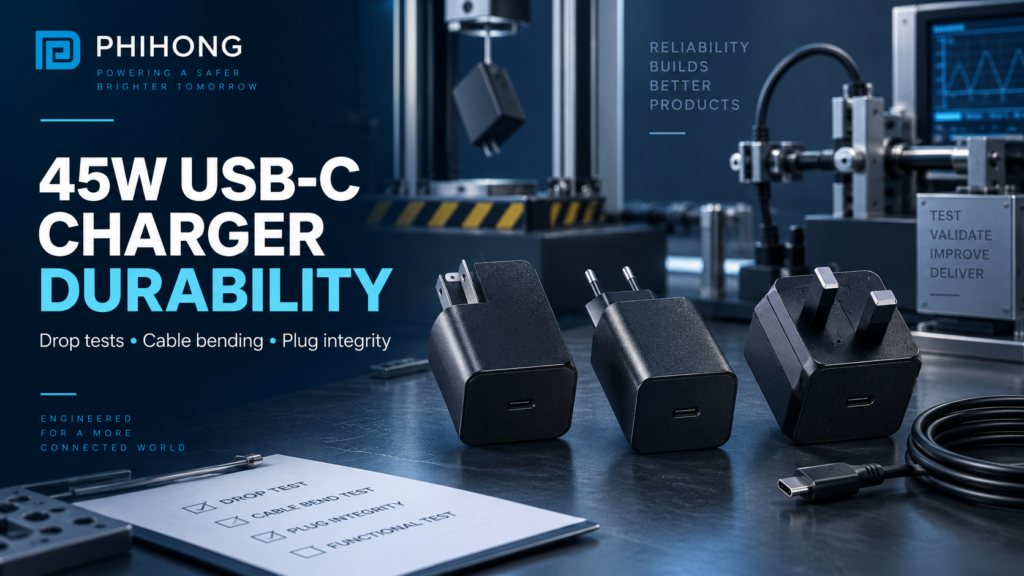
A 45W USB-C wall charger may look like a simple accessory, but for an OEM product bundle its reliability depends on considerably more than the output power printed on the label. Users pack chargers into bags, pull cables at awkward angles, plug and unplug devices and move equipment between outlets. A connector or enclosure failure can interrupt an otherwise well-designed device, create warranty costs and weaken customer confidence.
For device manufacturers, charger durability is therefore a qualification question: what mechanical and electrical tests should the complete adapter, USB-C cord and regional AC plug survive? Phihong’s AA45A-59FKE-R (US), AA45E-59FKE-R (EU) and AA45K-59FKE-R (UK) provide a product-specific reference. Their supplied technical datasheet defines distinct drop, cable bending, winding, tensile and regional tumbling procedures. The requirements vary by test; passing one does not establish universal durability or immunity from damage.
What Durability Risks Should OEMs Check in a 45W USB-C Wall Charger?
The first step is understanding which parts of a wall charger experience the greatest mechanical stress. The body may be dropped onto a hard floor. The AC blades must withstand insertion and removal. The USB-C plug may experience lateral force when a device is moved while charging. Repeated cable bending can concentrate stress near the strain relief or connector termination. These exposures are different, so a single generic “durability tested” claim is not sufficient for engineering approval.
Phihong’s 45W wall-adapter family supports USB Power Delivery 3.0 with fixed 5V, 9V, 15V and 20V output modes, up to 20V at 2.25A, plus PPS support described in the datasheet. Those electrical capabilities define the charging role, while the mechanical qualification methods address how the physical assembly tolerates handling. OEM teams should qualify both aspects together using the final charger and the intended device configuration.
| Risk area | Potential field issue | Qualification focus |
|---|---|---|
| Adapter enclosure | Impact damage after a drop | Six-face drop testing and inspection |
| USB-C output cord | Fatigue at cable exits | Repeated bending and winding tests |
| USB-C plug | Contact or housing stress | Plug strength and transverse-force requirements |
| Fixed AC prongs | Deformation during handling | Regional plug gauge and mechanical inspection |
| Complete system | Unexpected charging interruption | Output checks under defined test conditions |
Why This Matters
- Mechanical durability and USB-C electrical compatibility are separate requirements that must both be demonstrated.
- Different failure mechanisms require different tests, acceptance criteria and production controls.
What OEMs Should Do Now
- Create a durability matrix covering the enclosure, cord, connector and country-specific AC plug.
- Request the current revision of the exact model’s test plan and confirm which criteria apply before approving a product bundle.
Useful Links
- Phihong 45W USB-C wall-adapter family technical datasheet
- Phihong power adapter product line
- USB-IF specification document library
Related Links
How Do 1.1-Meter and 1.3-Meter Drop Tests Differ?
Drop tests are useful because the mechanical and electrical consequences of impact are not always identical. A housing can look undamaged while internal connections are compromised. Conversely, a more severe drop can be used to evaluate enclosure integrity without making the same electrical-performance demand as a lower-height test. Engineers should read each acceptance criterion instead of assuming that “drop tested to 1.3 meters” promises normal charging afterward.
Phihong’s supplied 45W family specification calls for six drops, one on each face, from a designated height onto concrete. At 1.1 meters, the stated electrical criterion is that the unit meet its defined 5V/3A, 9V/3A, 15V/3A and 20V/2.25A output specifications after testing. The mechanical criterion calls for no visual damage and no abnormal sound when shaken. At 1.3 meters, the same document explicitly allows that the unit may no longer meet the output specification. It still states mechanical inspection criteria. These are different requirements, not a contradiction to be smoothed over.
| Test condition | Documented electrical expectation | Documented mechanical expectation |
|---|---|---|
| 1.1 m, six-face drop onto concrete | Specified output modes must still be met after testing | No visual damage and no sound after shaking |
| 1.3 m, six-face drop onto concrete | Failure to meet output specification is acceptable under this test | No visual damage and no sound after shaking |
| OEM system evaluation | Device-specific recovery and charging behavior must be reviewed | Inspect the case, AC pins, cord and USB-C plug |
For procurement and product-management teams, that distinction affects how durability claims should appear in launch materials. It would be misleading to advertise the charger as guaranteed to charge normally after every 1.3-meter drop. The published specification supports a narrower, condition-specific description. It also does not remove the need for sampling, supplier qualification or evaluation of damage that could develop with repeated use.
Why This Matters
- Drop height alone does not tell OEMs whether the post-test electrical output is required to remain within specification.
- Exact acceptance criteria prevent exaggerated reliability claims and strengthen supplier-review documentation.
What OEMs Should Do Now
- Ask the supplier for a drop-test report that records sample size, orientation, output measurements and post-test inspections.
- Write marketing and technical claims to match the documented 1.1-meter and 1.3-meter criteria separately.
Useful Links
- 45W family mechanical and drop-test requirements
- Discuss OEM reliability and qualification requirements with Phihong
Related Links
What Do Cable Bending, Winding and Tensile Tests Reveal?
In everyday use, repeated movement of a USB-C cable may be more common than dropping the adapter body. Cable failures can occur where a flexible conductor meets a relatively rigid connector or strain-relief assembly. The risks include conductor fatigue, insulation damage, increased resistance and intermittent charging. For a wall adapter with a permanently attached output cord, this is especially important because cable replacement may not be as simple as swapping a detachable accessory.
Phihong’s 45W technical datasheet provides several distinct procedures. Its bending test uses a 200-gram weight, a 90-degree bend to each side for a total 180-degree excursion, 3,000 cycles and a rate of 40 cycles per minute. It also specifies limits on disconnection metrics at the cable interfaces and requires that the insulation not be damaged. The winding test uses a 200-gram weight, 1,080-degree movement about the X and Y axes and 500 cycles in each direction at four cycles per minute. A separate tensile test applies 10 kgf at the plug end and bushing for one minute under specified angles.
| Test | Selected documented conditions | Engineering question answered |
|---|---|---|
| Bending | 200 g, ±90°, 3,000 cycles, 40 cycles/min | How does repeated flexing affect the cable and strain relief? |
| Winding | 200 g, 1,080° movement, 500 cycles each direction | How does twisting and winding stress the assembly? |
| Tensile | 10 kgf at plug end and bushing for one minute | Can the termination resist the specified pull? |
| USB-C plug force | Separate torque and transverse-load criteria | How does the mating connector tolerate mechanical stress? |
These procedures are not a guarantee of unlimited cable life. They are controlled tests with defined loads, motions and acceptance criteria. Real deployment adds variables such as repeated packing, tight cable wrapping, user handling, accidental pulls, temperature and device movement. OEMs should review whether additional application-specific testing is justified and keep electrical continuity checks and post-test inspections in the approval plan.
Why This Matters
- A strong charger body does not compensate for weak cable terminations or a poorly protected USB-C plug.
- Testing must reflect the intended handling pattern, not just a broad claim that the cable is durable.
What OEMs Should Do Now
- Inspect cable exits, connector mating quality, pull resistance and insulation after mechanical cycling.
- Confirm test reports use production-intent cord materials, length and connector construction.
Useful Links
Related Links
Why Do EU and UK Fixed Plugs Need Regional Mechanical Checks?
A 45W USB-C charger may use the same power-delivery profiles across markets while its mains interface changes substantially. The US, European and UK fixed-blade arrangements have different physical geometries and packaging envelopes. An OEM should not assume that a successful test on one regional plug configuration automatically qualifies the other versions. The mechanical interface between charger body and wall outlet deserves attention alongside international electrical input compatibility.
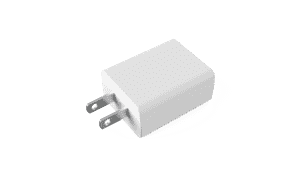
For Phihong’s 45W family, the model assignment is explicit: AA45A-59FKE-R for the US, AA45E-59FKE-R for Europe and AA45K-59FKE-R for the UK. The supplied documentation lists a tumbling test specifically for the EU and UK versions: 50-centimeter barrel height, 50 rotations per minute and 250 cycles. Post-test mechanical criteria include no visible damage or sound after shaking and plug-pin dimensions that meet the applicable gauge requirements. Importantly, the datasheet permits that electrical output specifications may no longer be met after this particular tumbling test.
| Model | Regional AC format | Mechanical review focus |
|---|---|---|
| AA45A-59FKE-R | US fixed plug | Blade integrity, outlet fit, case and cable durability |
| AA45E-59FKE-R | EU fixed plug | Pin geometry and the specified EU/UK tumbling criteria |
| AA45K-59FKE-R | UK fixed plug | Pin geometry and the specified EU/UK tumbling criteria |
This is also where sourcing and labeling intersect. Regional models should be matched to the sales territory and current safety documentation. The datasheet identifies standards and certification expectations, but any approval listed as pending must not be presented as already granted. The OEM needs to confirm the approved model revision and the finished product’s market-specific obligations.
Why This Matters
- A shared 45W USB-C electrical platform does not make the physical AC plug identical across markets.
- EU/UK tumbling requirements have specific mechanical criteria and should not be paraphrased as a guaranteed post-tumbling electrical pass.
What OEMs Should Do Now
- Track US, EU and UK model numbers separately in the product qualification and packaging records.
- Review plug gauges, labeling, regional certification evidence and test reports for each shipment market.
Useful Links
Related Links
How Does Phihong Support 45W USB-C Charger Qualification for OEM Devices?
Phihong’s AA45A-59FKE-R, AA45E-59FKE-R and AA45K-59FKE-R give device manufacturers three regional fixed-plug examples within a 45W USB Power Delivery 3.0 family. The technical datasheet documents a 90–264Vac input range, fixed output modes of 5V/3A, 9V/3A, 15V/3A and 20V/2.25A, PPS support and protection requirements covering overvoltage, overcurrent, short circuit and overtemperature. These electrical features should be matched with the mechanical test program rather than evaluated as unrelated purchasing criteria.
For a commercial OEM launch, the most useful qualification package combines the current product datasheet, model identification, representative mechanical test reports and an application-specific electrical validation plan. Engineers should confirm charging negotiation with the final device, cable and firmware and measure output stability under expected operating conditions. Product managers should keep acceptance criteria traceable so statements about drop resistance, cable durability and regional plug strength can be supported accurately.
| Phihong family element | Documented reference | OEM action |
|---|---|---|
| 45W USB PD 3.0 platform | Up to 20V at 2.25A | Validate sink profiles and the intended charging load |
| Mechanical qualification | Drop, bending, winding, tensile and connector tests | Review applicable acceptance criteria and test records |
| Regional variants | US, EU and UK fixed-plug model options | Match product, documentation and packaging to market |
| Featured Phihong products | Product records for AA45A, AA45E and AA45K | Select the appropriate models for the article and device program |
The result is a more useful purchasing decision than selecting the smallest or least expensive charger that advertises 45W. A qualified charger should fit the device’s electrical needs, withstand the documented handling tests and carry the required market-specific documentation. If your team is comparing 45W USB-C wall chargers for a laptop, tablet, communications product or commercial accessory, contact Phihong to discuss your application and the latest technical records.
Why This Matters
- Engineering, procurement and quality teams can work from the same model-specific evidence instead of relying on generic durability claims.
- A product-led comparison helps buyers connect mechanical reliability with charging compatibility and regional requirements.
What OEMs Should Do Now
- Request confirmation of the latest datasheet revision, test evidence and certification status for the proposed regional model.
- Validate representative production units and document the decision before finalizing the OEM device bundle.
Useful Links
- Official Phihong 45W AA45A/AA45E/AA45K technical datasheet
- Contact Phihong for OEM power requirements
Related Links
Frequently Asked Questions
What drop height should a 45W USB-C charger withstand?
There is no universal drop height that proves every charger is safe for every deployment. Phihong’s 45W family document describes six-face concrete drops at 1.1 meters and 1.3 meters with different electrical acceptance criteria. At 1.1 meters the specified output modes must still be met; after the 1.3-meter test, failure to meet output specification is explicitly acceptable under the listed criteria. Review the full test method and the model-specific reports.
Does a 1.3-meter drop test guarantee that charging still works?
No. The supplied Phihong specification does not require continued electrical conformity after the 1.3-meter drop. Its mechanical criteria still apply. Any marketing claim that implies guaranteed electrical functionality after that event would go beyond the stated source. OEMs should review both electrical and mechanical test outcomes independently.
How many bending cycles are specified for the 45W USB-C cord?
The supplied test requirements specify 3,000 bending cycles using a 200-gram weight, an excursion of 90 degrees to each side and a rate of 40 cycles per minute. The test includes interface-related limits and requires insulation integrity. These are controlled qualification conditions, not a promise that a cord will last indefinitely under every user behavior.
Why are EU and UK charger plugs tested differently?
Regional fixed-plug formats differ mechanically. Phihong’s current family document specifies a separate tumbling test for the European and UK variants, including 250 cycles at 50 revolutions per minute in a 50-centimeter barrel. The stated mechanical criteria concern visual damage, rattling and dimensional gauge requirements. OEM teams should still confirm local approvals and finished-product requirements.
Can one 45W charger model replace every other regional version?
Not automatically. The US AA45A-59FKE-R, European AA45E-59FKE-R and UK AA45K-59FKE-R share a documented 45W USB PD architecture but use different fixed AC plug configurations. Selection requires the correct outlet interface, appropriate regional approvals and matching device-side power negotiation. The intended market and current specification revision should drive the final model choice.