












BLOG
What Is Interleaved PFC and Why Is It Used in High-Power 460W Adapters?
QUICK LINKS
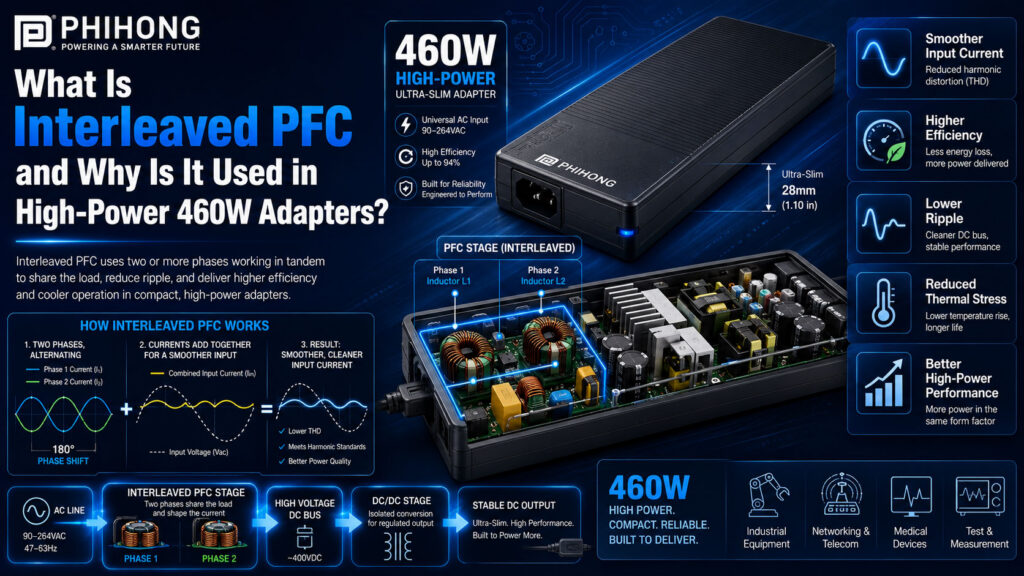
What is PFC in a high-power AC/DC adapter?
Power factor correction, or PFC, is part of the front-end power architecture used in many AC/DC power supplies to manage how the adapter draws current from the AC input. In a high-power adapter, this becomes more important because the adapter is not only converting AC power into DC output. It also needs to manage input current behavior, efficiency, heat, component stress, EMI considerations and regulatory expectations.
For OEM engineers, PFC should be treated as part of the complete power architecture rather than a hidden circuit block. A 460W external adapter draws significantly more input power than a low-wattage charger, so the way the front-end stage handles AC input matters. Phihong’s supplied engineering materials identify the AA460U-205A-R as using a front-end Active Bridge Rectifier design and interleaved PFC topology. That makes PFC especially relevant to the adapter’s high-wattage, ultra-slim design story.
| PFC Review Area | Why It Matters in a 460W Adapter | What OEM Teams Should Review |
|---|---|---|
| Input current behavior | High-power adapters must manage how current is drawn from the AC line. | AC input range, load level, power factor and line conditions. |
| Conversion efficiency | Front-end architecture affects how much energy becomes usable output versus heat. | Efficiency at expected line voltage, full-load operation and thermal behavior. |
| Component stress | High power can place more stress on rectification, switching and magnetic components. | Semiconductor ratings, magnetics, capacitors and thermal margin. |
| EMI and compliance | Input-stage behavior can influence conducted emissions and validation planning. | EMI filtering, layout, cable setup and final system testing. |
Why This Matters
• PFC helps high-power AC/DC adapters manage input current behavior and front-end conversion requirements.
• In a compact 460W adapter, the PFC stage affects efficiency, thermal design, component stress and validation planning.
What OEMs Should Do Now
• Review PFC as part of the complete adapter architecture instead of evaluating only output wattage.
• Validate input behavior, efficiency, thermal performance and EMI conditions with the intended AC line and device load.
Useful Links
Power Adapter Product Line: www.phihong.com/products/adapters/
Power Adapter Compliance Basics: www.phihong.com/what-compliance-engineers-look-for-in-internal-psus-emi-ems-and-safety-basics/
Contact Phihong: www.phihong.com/contact
Related Links
How 330W GaN Power Adapters Support Gaming Laptops and Mobile Workstations: www.phihong.com/how-330w-gan-power-adapters-support-gaming-laptops-and-mobile-workstations/
How Does an Ultra-Slim 460W Power Adapter Stay Cool at Nearly 18W/in³ Power Density?: www.phihong.com/how-does-an-ultra-slim-460w-power-adapter-stay-cool-at-nearly-18w-in%C2%B3-power-density/
FEATURED PRODUCTS
AM250U-540AP-R
AA240U-200A-R
AA240U-200B-R
AA280U-200B-R
AA240U-59FKEA-R
AA36U-240B-R

What does interleaved PFC mean in a 460W adapter design?
Interleaved PFC generally refers to a PFC architecture where power processing is divided across multiple phases or paths rather than relying on one single high-stress path. In a high-power adapter, this can help distribute electrical and thermal demands across the front-end stage. For OEM teams, the practical value is not that the topology sounds advanced. The value is that it can support a more manageable high-power architecture when output power, enclosure size and thermal limits are all constrained.
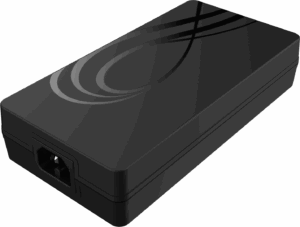
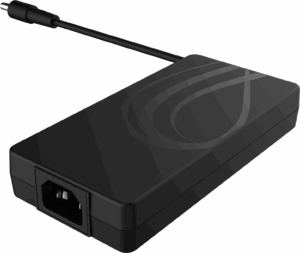
Phihong’s supplied materials identify interleaved PFC topology as part of the AA460U-205A-R design. This matters because the adapter is positioned as an ultra-slim 460W external power adapter with stated 17.85W/in³ power density and approximate 422cc case volume. When a high-power adapter is designed into a slim enclosure, the front-end architecture must help manage current, efficiency, ripple, component stress and thermal distribution. Interleaving can be one way to support that broader design goal.
| Interleaved PFC Area | Why It Matters | What OEM Teams Should Review |
| Load distribution | Multiple phases can help spread power-stage demand. | Phase balance, component ratings, control behavior and thermal profile. |
| Ripple considerations | Interleaving can affect input and output ripple behavior in the PFC stage. | Ripple current, filtering, capacitor stress and EMI implications. |
| Component stress | Dividing power across stages can help reduce stress on individual components. | Semiconductors, inductors, capacitors, heat sinks and derating. |
| Thermal distribution | Spreading power-stage activity can help avoid concentrated hot spots. | PCB placement, case temperature, airflow exposure and full-load conditions. |
Why This Matters
• Interleaved PFC can help support high-power adapter design by distributing electrical and thermal stress across the front-end stage.
• In a slim 460W adapter, PFC topology should be reviewed together with efficiency, PCB layout and surface-temperature behavior.
What OEMs Should Do Now
• Ask how the adapter’s interleaved PFC stage affects thermal distribution, ripple, EMI and component stress.
• Validate the adapter under expected line voltage, continuous load, transient load and ambient temperature conditions.
Useful Links
Power Adapter Product Line: www.phihong.com/products/adapters/
Thermal Performance Validation: www.phihong.com/how-to-validate-thermal-performance-of-open-frame-power-supplies-in-real-enclosures/
Contact Phihong: www.phihong.com/contact
Related Links
How Does an Ultra-Slim 460W Power Adapter Stay Cool at Nearly 18W/in³ Power Density?: www.phihong.com/how-does-an-ultra-slim-460w-power-adapter-stay-cool-at-nearly-18w-in%C2%B3-power-density/
What Does Class B EMI Mean for High-Power Open-Frame PSU Design?: www.phihong.com/what-does-class-b-emi-mean-for-high-power-open-frame-psu-design/
Why does interleaved PFC matter more as adapter wattage increases?
Interleaved PFC matters more as adapter wattage increases because high-power conversion places more demand on the front-end components. A small adapter may have more design tolerance because the total power is lower. A 460W adapter must manage higher current, higher heat, larger energy transfer and more demanding transient behavior while still maintaining efficiency and compliance expectations. If the front-end design is not well managed, heat and component stress can become limiting factors.
In the AA460U-205A-R, the interleaved PFC topology is part of a larger high-power design approach that also includes front-end Active Bridge Rectifier design, organized PCB placement for thermal distribution and stated efficiency up to 95% at 90Vac. These details should be interpreted as Phihong-supplied engineering data under the supplied conditions, not as universal results in every installation. The main engineering lesson is that high-power adapter design depends on the interaction between front-end architecture, thermal layout, EMI strategy and actual device load behavior.
| High-Wattage Design Factor | Why It Becomes More Important | What OEM Teams Should Review |
| Input current demand | Higher output power requires more input energy. | AC line conditions, power factor, current draw and input-stage stress. |
| Switching and conduction losses | Losses increase thermal load in compact designs. | Semiconductor losses, rectifier behavior, PFC operation and efficiency. |
| Magnetics and capacitors | High-power stages can stress inductors, transformers and capacitors. | Ripple current, temperature rise, component placement and lifetime assumptions. |
| Thermal recovery | High-power operation creates less room for thermal mistakes. | Case temperature, hot spots, ambient conditions and repeated load events. |
Why This Matters
• As adapter wattage rises, the front-end power architecture becomes more important to thermal and electrical performance.
• Interleaved PFC should be evaluated as part of the overall 460W adapter design, not as an isolated feature.
What OEMs Should Do Now
• Review interleaved PFC alongside efficiency, active rectification, magnetics, capacitors and PCB placement.
• Test adapter behavior under the final product’s expected operating profile, including full load and sudden load changes.
Useful Links
Power Adapter Product Line: www.phihong.com/products/adapters/
GaN Power Adapter Guide: www.phihong.com/best-guide-to-gan-power-adapters-what-modern-devices-need-from-compact-high-density-power/
Contact Phihong: www.phihong.com/contact
Related Links
How 330W GaN Power Adapters Support Gaming Laptops and Mobile Workstations: www.phihong.com/how-330w-gan-power-adapters-support-gaming-laptops-and-mobile-workstations/
How Does 200% Peak Load Capability Help a 460W Adapter Handle Sudden Power Demands?: www.phihong.com/how-does-200-peak-load-capability-help-a-460w-adapter-handle-sudden-power-demands/
CLIENT'S QUOTE
Phihong’s custom OEM power solutions have transformed our product development, boosting performance and reducing overhead. Their expert engineering support has simplified both the design and manufacturing phases.
How do interleaved PFC, efficiency and thermal layout work together?
Interleaved PFC, efficiency and thermal layout work together because a high-power adapter has to manage both electrical performance and heat. The PFC stage affects input current behavior and front-end power processing. Efficiency affects how much energy becomes useful output instead of heat. PCB placement affects where that heat appears inside the enclosure. In an ultra-slim 460W adapter, these factors cannot be treated as separate design topics.
Phihong’s supplied engineering materials identify the AA460U-205A-R as using interleaved PFC topology, front-end Active Bridge Rectifier design and organized PCB placement for thermal distribution. The same materials state efficiency up to 95% at 90Vac. That efficiency point should be described under the supplied condition, not generalized to every line, load or temperature condition. For OEM teams, the practical lesson is that high-power adapter performance depends on how the power stage, thermal paths, layout and operating environment work together.
| Design Area | How It Supports High-Power Adapter Design | What OEM Teams Should Review |
|---|---|---|
| Interleaved PFC | Helps distribute front-end power processing across phases or paths. | Phase behavior, ripple, component stress and thermal distribution. |
| Active Bridge Rectifier | Supports the front-end architecture of the high-power design. | Efficiency contribution, heat generation and input-stage behavior. |
| Efficiency | Reduces the amount of input energy lost as heat. | Efficiency at line voltage, load percentage, ambient temperature and duty cycle. |
| PCB placement | Helps organize heat-producing components inside a slim enclosure. | Hot spots, component spacing, temperature-sensitive parts and case temperature. |
Why This Matters
• In a high-density 460W adapter, PFC architecture, efficiency and PCB layout directly affect thermal behavior.
• Strong electrical architecture still needs validation under real load, ambient temperature and placement conditions.
What OEMs Should Do Now
• Review interleaved PFC and active rectification together with efficiency, thermal layout and component placement.
• Validate adapter behavior under the final device load profile, AC input condition, cable routing and ambient environment.
Useful Links
Power Adapter Product Line: www.phihong.com/products/adapters/
Thermal Performance Validation: www.phihong.com/how-to-validate-thermal-performance-of-open-frame-power-supplies-in-real-enclosures/
Contact Phihong: www.phihong.com/contact
Related Links
How Does an Ultra-Slim 460W Power Adapter Stay Cool at Nearly 18W/in³ Power Density?: www.phihong.com/how-does-an-ultra-slim-460w-power-adapter-stay-cool-at-nearly-18w-in%C2%B3-power-density/
How Does 200% Peak Load Capability Help a 460W Adapter Handle Sudden Power Demands?: www.phihong.com/how-does-200-peak-load-capability-help-a-460w-adapter-handle-sudden-power-demands/
How Phihong uses interleaved PFC in the AA460U-205A-R 460W adapter
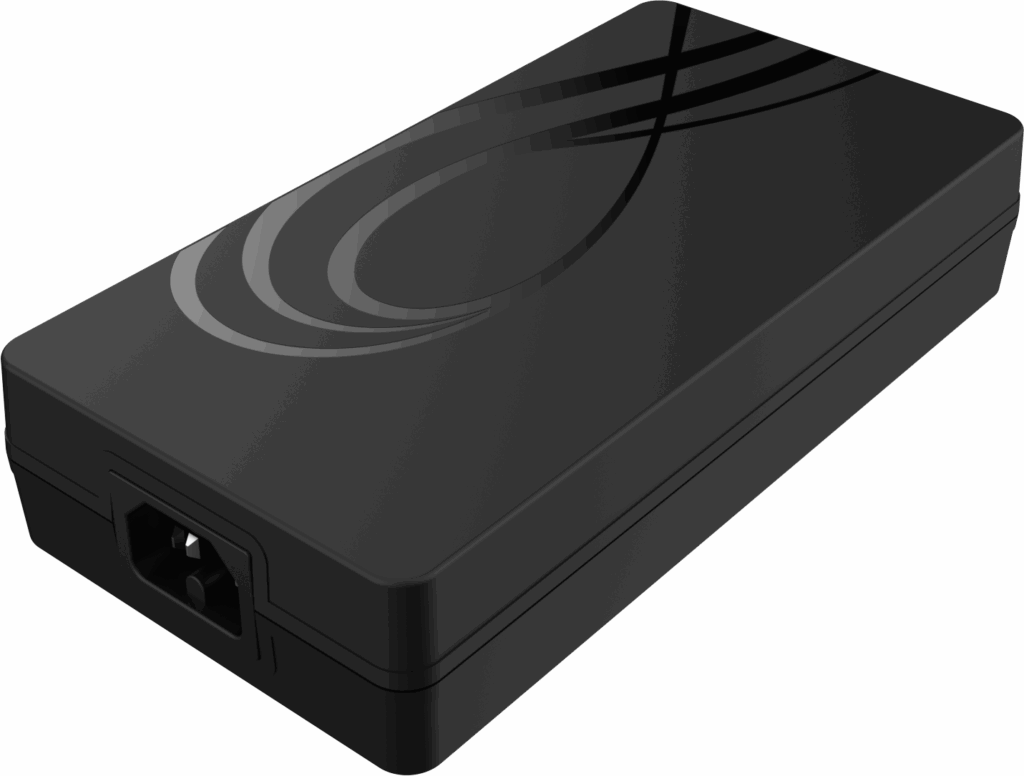
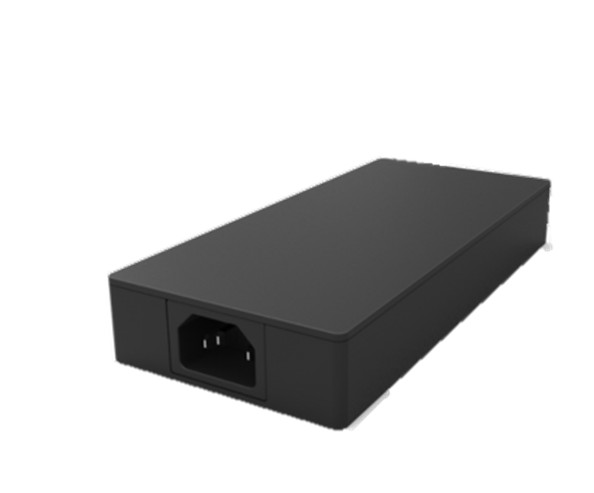
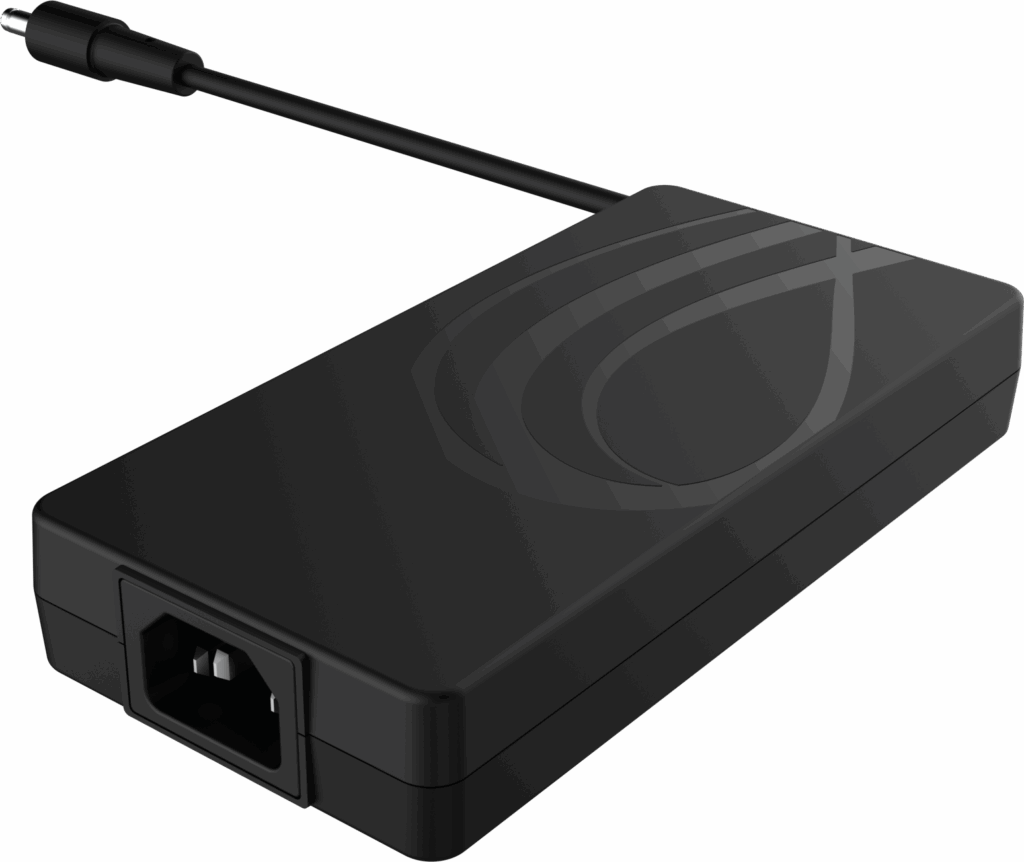
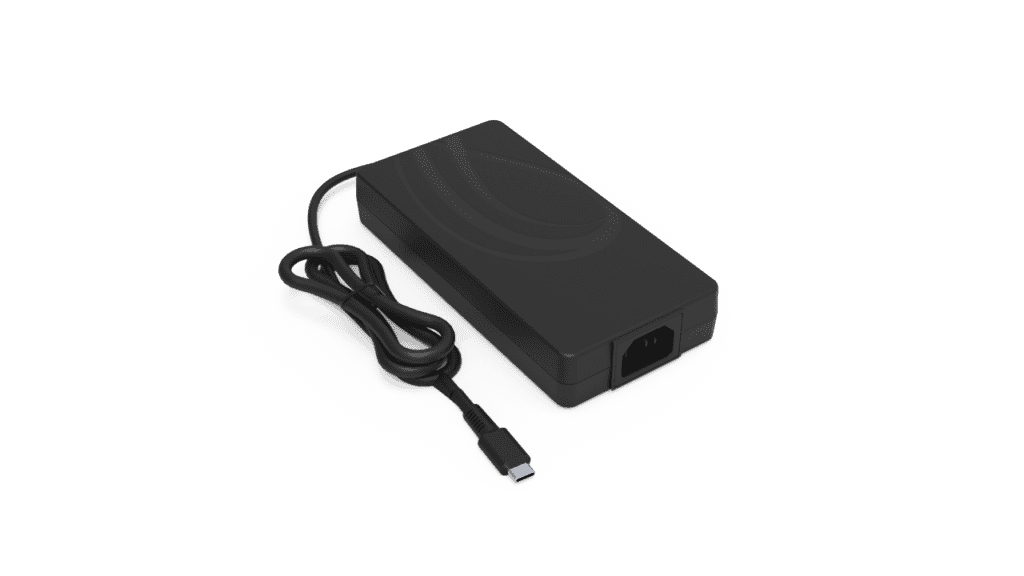
Phihong’s AA460U-205A-R gives OEM teams a product-specific example of interleaved PFC in a compact high-wattage external adapter. According to Phihong’s supplied engineering materials, the adapter is an ultra-slim 460W external power adapter with front-end Active Bridge Rectifier design, interleaved PFC topology, stated 17.85W/in³ power density, approximate 422cc case volume, product weight below 750g and organized PCB placement for thermal distribution.
The key point is not that interleaved PFC alone defines the adapter. It is one part of a broader high-power design approach that also includes efficiency, thermal layout, mechanical packaging, EMC / EMI engineering, surge-immunity design, peak-current capability and coreless DC cord construction. OEM teams should evaluate these features together because a 460W adapter must support electrical performance, temperature control, cable behavior and compliance expectations in one integrated product.
| Phihong Design Area | Why It Matters | What OEM Teams Should Review |
|---|---|---|
| Interleaved PFC topology | Supports high-power front-end architecture. | Input behavior, ripple, thermal distribution and component stress. |
| Active Bridge Rectifier design | Part of the adapter’s front-end conversion approach. | Efficiency, heat generation and operating conditions. |
| Organized PCB placement | Helps distribute thermal load inside a compact enclosure. | Hot spots, case temperature, component spacing and thermal validation. |
| 460W ultra-slim format | Raises the importance of power density and thermal control. | 17.85W/in³ data, case volume, weight, placement and final system use. |
Why This Matters
• The AA460U-205A-R illustrates how interleaved PFC can be part of a broader compact high-power adapter architecture.
• OEM teams should evaluate PFC topology with efficiency, thermal design, EMI, peak-load behavior and real-world integration needs.
What OEMs Should Do Now
• Use Phihong’s supplied AA460U-205A-R materials as a starting point for evaluating high-power adapter architecture.
• Contact Phihong to discuss electrical, thermal, EMI and mechanical requirements for the intended high-wattage external adapter application.
Useful Links
Power Adapter Product Line: www.phihong.com/products/adapters/
Contact Phihong: www.phihong.com/contact
GaN Power Adapter Guide: www.phihong.com/best-guide-to-gan-power-adapters-what-modern-devices-need-from-compact-high-density-power/
Related Links
How 330W GaN Power Adapters Support Gaming Laptops and Mobile Workstations: www.phihong.com/how-330w-gan-power-adapters-support-gaming-laptops-and-mobile-workstations/
Best Guide to GaN Power Adapters: What Modern Devices Need From Compact, High-Density Power: www.phihong.com/best-guide-to-gan-power-adapters-what-modern-devices-need-from-compact-high-density-power/
Interleaved PFC matters in high-power adapters because the front-end power stage must manage input current, efficiency, ripple, component stress and heat. At 460W, those design decisions become more important because thermal margin, EMC behavior and compact packaging are all connected.
For OEM teams evaluating ultra-slim high-wattage external adapters, PFC topology should be reviewed as part of the full system. The adapter, cable, device load, ambient temperature, operating profile, EMI requirements and peak-load behavior all affect final suitability. If your team is evaluating high-power external adapter requirements, contact Phihong to discuss your application.

CONTACT US TODAY
From concept to production, Phihong delivers custom OEM power solutions tailored to your specifications.
FAQ
What is PFC in an AC/DC power adapter?
PFC stands for power factor correction. In an AC/DC adapter, PFC helps manage how the adapter draws current from the AC input. This is especially important in high-power adapters because input current behavior can affect efficiency, thermal performance, component stress and compliance planning. For OEM engineers, PFC should be reviewed as part of the full adapter architecture, not as a standalone feature.
What does interleaved PFC mean?
Interleaved PFC generally means the PFC stage divides power processing across multiple phases or paths. This can help distribute electrical and thermal stress across components instead of concentrating demand in one path. In a high-power adapter, interleaving may help with ripple behavior, component stress and thermal distribution. The exact benefit depends on the full circuit design and operating conditions.
Why is interleaved PFC used in high-power adapters?
Interleaved PFC can be useful in high-power adapters because higher wattage increases the demand on front-end components. By distributing power-stage activity, the design can help manage current, heat and stress across the front-end architecture. In compact adapters, this matters because there is limited internal space for thermal spreading and component placement.
Does interleaved PFC make an adapter more efficient?
Interleaved PFC can be part of an efficient high-power architecture, but efficiency depends on the complete design, including rectification, switching devices, magnetics, layout, control strategy and load conditions. Phihong’s supplied materials state efficiency up to 95% at 90Vac for the AA460U-205A-R. That should not be interpreted as 95% under every line, load or temperature condition.
How does interleaved PFC affect thermal design?
Interleaved PFC can help distribute power-stage demand, which may support better thermal distribution when paired with careful PCB placement and component selection. However, it does not remove the need for thermal validation. OEM teams should test the adapter under the expected load, line voltage, ambient temperature, placement and cable-routing conditions of the final product.
What should OEMs validate before using a 460W adapter with interleaved PFC?
OEMs should validate input behavior, output stability, efficiency, thermal performance, case temperature, peak-load response, EMI / EMC behavior, surge requirements, cable routing and protection behavior. Testing should use the final device or a representative load profile. Interleaved PFC is one important design element, but final suitability depends on the complete adapter-to-device system.
POE technology supports the centralization of power

AC Adapter Guide: Everything You Need to Know
Moreover, PoE technology supports the centralization of power management. By powering devices through a PoE-enabled network …
AC DC Power Chargers and How They Work: A Comprehensive Technical Breakdown
Moreover, PoE technology supports the centralization of power management. By powering devices through a PoE-enabled network …

USB-C Charger: Shaping the Future of the Tech World
Moreover, PoE technology supports the centralization of power management. By powering devices through a PoE-enabled network …

AC Adapter Guide: Everything You Need to Know
Moreover, PoE technology supports the centralization of power management. By powering devices through a PoE-enabled network …

AC DC Power Chargers and How They Work: A Comprehensive Technical Breakdown
Moreover, PoE technology supports the centralization of power management. By powering devices through a PoE-enabled network …

USB-C Charger: Shaping the Future of the Tech World
Moreover, PoE technology supports the centralization of power management. By powering devices through a PoE-enabled network …