









BLOG
Why 12V and 54.5V/55V Dual Outputs Matter in PoE and IoT Power Architectures
QUICK LINKS
Why do PoE and IoT systems need more than one power rail?
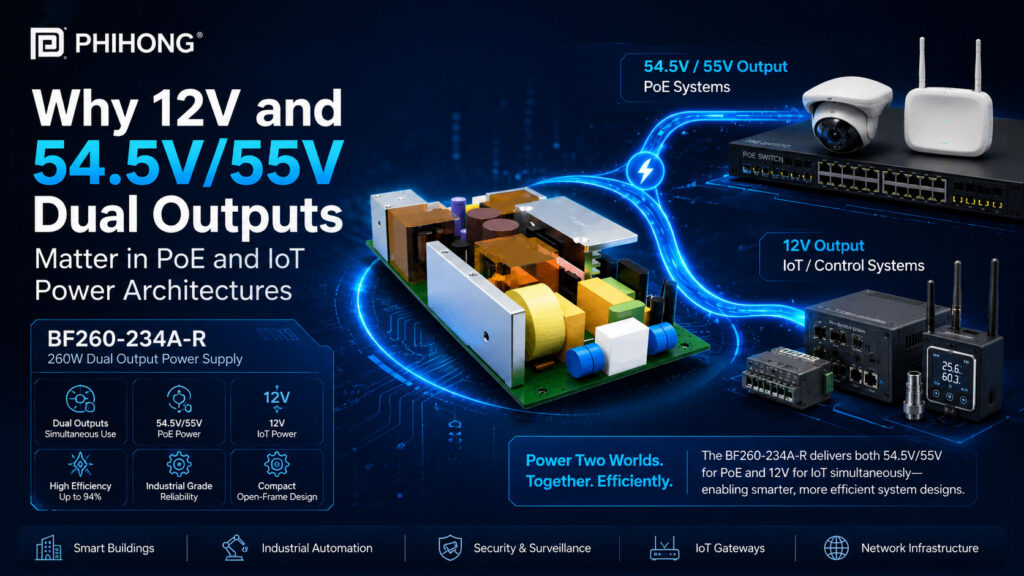
PoE and IoT systems often need more than one power rail because they combine local electronics with higher-voltage power distribution. A device may need 12V for control boards, fans, sensors, relays, indicators, gateways, or embedded logic while also needing a higher-voltage rail for PoE-related power, distributed loads, downstream conversion, or field-side equipment. This is why a dual-output power supply can be useful in system architectures where one rail is not enough.
Phihong’s BF260-234A-R and BF550-234A-R are strong examples from the product map because they are dual-output open-frame/internal PSUs with 12V plus 55V or 12V plus 54.5V output architectures. The map identifies the BF260-234A-R as a 260W fanless open-frame PSU for PoE and IoT systems, while the BF550-234A-R is a 550W dual-output option with 12V and 54.5V outputs. For OEMs, that product-family angle is more useful than writing another general open-frame PSU article.
| Power Architecture Need | Why It Matters in PoE and IoT Systems | What OEM Teams Should Review |
|---|---|---|
| 12V local power | Supports control electronics, fans, sensors, relays, gateways and logic circuits. | 12V current demand, startup load, standby behavior, transient load and auxiliary devices. |
| 54.5V / 55V power | Supports higher-voltage distribution, PoE-related architecture and downstream conversion. | Output current, port power budget, wiring, voltage drop, protection and load behavior. |
| Dual-output design | Allows one PSU platform to support both local electronics and higher-voltage loads. | Rail balance, cross-load behavior, thermal impact and sequencing. |
| Open-frame integration | Fits internal equipment designs where the PSU is built into the enclosure. | Mounting, airflow, spacing, safety, EMI and service access. |
Why This Matters
• PoE and IoT products often need both low-voltage control power and higher-voltage distribution power.
• A 12V plus 54.5V / 55V PSU can reduce the need for separate power supplies when both rails match real system loads.
What OEMs Should Do Now
• Separate the 12V control-side load from the higher-voltage PoE or field-side load before selecting a PSU.
• Validate both outputs under startup, full-load, peak-load, thermal and fault conditions.
Useful Links
BF260-234A-R Product Page: www.phihong.com/products/open-frame-internal-psu/bf260-234a-r/
BF550-234A-R Product Page: www.phihong.com/products/open-frame-internal-psu/bf550-234a-r/
Open-Frame / Internal PSU Product Line: www.phihong.com/products/open-frame-internal-psu/
Related Links
Introduction to PoE Injectors: What Are PoE Injectors?: www.phihong.com/introduction-to-poe-injectors-what-are-poe-injectors/
Best Guide to Open-Frame Internal Power Supplies: How to Choose the Right Internal PSU for Industrial Equipment: www.phihong.com/best-guide-to-open-frame-internal-power-supplies-how-to-choose-the-right-internal-psu-for-industrial-equipment/
FEATURED PRODUCTS
AM250U-540AP-R
AA240U-200A-R
AA240U-200B-R
AA280U-200B-R
AA240U-59FKEA-R
AA36U-240B-R

How does a 54.5V or 55V output support PoE power architecture?
A 54.5V or 55V output is important because PoE-related systems often need a higher-voltage rail to support power delivery beyond the local control board. A PoE switch, injector-related platform, industrial network device, smart building controller, gateway, or distributed IoT system may need higher-voltage power to support connected devices or downstream power conversion. In these designs, the higher-voltage rail is not optional decoration. It is tied to the core power-distribution strategy.
The advantage of a dual-output supply is that the OEM does not have to treat high-voltage power and control power as separate sourcing problems. The 54.5V or 55V rail can support PoE-adjacent distribution, while the 12V rail can support local electronics inside the same enclosure. This can simplify mechanical layout, sourcing, cable routing and service planning. However, OEM teams still need to verify port power budget, load balance, output protection, cable voltage drop and thermal behavior before choosing the final wattage class.
| PoE Power Design Area | Why 54.5V / 55V Matters | What OEM Teams Should Review |
| PoE-related distribution | Higher-voltage output can support power delivery to connected or remote devices. | Port count, per-port budget, total power demand and downstream load profile. |
| Voltage drop management | Higher-voltage rails can be useful when power travels through internal wiring or field-side paths. | Cable length, connector rating, wiring gauge and voltage margin. |
| Downstream conversion | Higher-voltage output may feed internal converters for other rails. | DC/DC converter design, efficiency, ripple, thermal load and sequencing. |
| Protection strategy | PoE and distributed systems need predictable fault behavior. | OVP, OCP, SCP, OTP, load faults and recovery behavior. |
Why This Matters
• 54.5V / 55V output can support PoE-related power distribution more effectively than a low-voltage-only PSU.
• The higher-voltage rail should be matched to the device’s real port budget, wiring strategy and downstream conversion needs.
What OEMs Should Do Now
• Calculate the total higher-voltage power requirement before choosing between BF260, BF460, BF550 or BF950 class options.
• Validate voltage drop, protection behavior and thermal performance with the actual PoE or distributed load configuration.
Useful Links
BF260-234A-R Product Page: www.phihong.com/products/open-frame-internal-psu/bf260-234a-r/
BF460-234A-R Product Page: www.phihong.com/products/open-frame-internal-psu/bf460-234a-r/
Power-Over-Ethernet Product Line: www.phihong.com/products/poe/
Related Links
Introduction to PoE Injectors: What Are PoE Injectors?: www.phihong.com/introduction-to-poe-injectors-what-are-poe-injectors/
The Power Supply Decisions OEMs Regret Most and Why They’re Hard to Fix Later: www.phihong.com/the-power-supply-decisions-oems-regret-most-and-why-theyre-hard-to-fix-later/
Why does the 12V output still matter in high-voltage PoE and IoT systems?
Even when a PoE or IoT system is built around a 54.5V or 55V distribution rail, the 12V output still matters because many internal subsystems do not operate directly from the higher-voltage rail. Local electronics may need lower-voltage support for fans, controllers, relays, sensors, communication boards, user interfaces, status LEDs, motor controls, or board-level conversion. In many designs, the 12V rail becomes the practical support layer that keeps the product’s internal logic and auxiliary functions operating.
This is why 12V plus 54.5V/55V dual-output architecture can be more useful than a single high-voltage supply. A single-output 55V supply may handle the PoE-related side of the product, but it does not directly solve the local control-power requirement. OEM teams may then need a separate 12V converter or another supply. A dual-output PSU can simplify this when the 12V rail is sized correctly and the loads on both outputs are validated together.
| 12V Load Area | Why It Matters | What OEM Teams Should Review |
| Control boards | Many embedded controllers and communication boards need local low-voltage support. | Board current, startup timing, ripple tolerance and sequencing. |
| Fans and thermal systems | Higher-power PoE and IoT systems may need active cooling. | Fan load, airflow, thermal sensors and failure behavior. |
| Relays and auxiliary circuits | Industrial and IoT equipment may include local electromechanical or support loads. | Coil current, surge load, switching behavior and protection. |
| Management electronics | Gateways and networked devices often need local monitoring or status functions. | Controller load, indicators, communication modules and service diagnostics. |
Why This Matters
• 12V output supports the local electronics that make a higher-voltage PoE or IoT system manageable.
• Dual-output design can reduce the need for separate auxiliary converters when the 12V rail is properly sized.
What OEMs Should Do Now
• Build a 12V load table that includes controllers, fans, relays, sensors, indicators and auxiliary circuits.
• Validate 12V performance at the same time as the 54.5V / 55V rail because both outputs affect the finished system.
Useful Links
BF550-234A-R Product Page: www.phihong.com/products/open-frame-internal-psu/bf550-234a-r/
BF950-234A-R Product Page: www.phihong.com/products/open-frame-internal-psu/bf950-234a-r-2/
Open-Frame / Internal PSU Product Line: www.phihong.com/products/open-frame-internal-psu/
Related Links
Best Guide to Open-Frame Internal Power Supplies: How to Choose the Right Internal PSU for Industrial Equipment: www.phihong.com/best-guide-to-open-frame-internal-power-supplies-how-to-choose-the-right-internal-psu-for-industrial-equipment/
How to Validate Thermal Performance of Open-Frame Power Supplies in Real Enclosures: www.phihong.com/how-to-validate-thermal-performance-of-open-frame-power-supplies-in-real-enclosures/
CLIENT'S QUOTE
Phihong’s custom OEM power solutions have transformed our product development, boosting performance and reducing overhead. Their expert engineering support has simplified both the design and manufacturing phases.
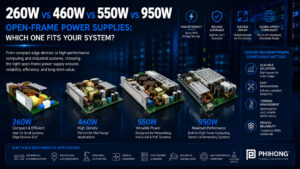
How should OEMs choose between BF260, BF460, BF550, and BF950 class dual-output PSUs?
OEMs should choose between BF260, BF460, BF550, and BF950 class dual-output PSUs by starting with the load profile, not the highest wattage option. A compact PoE or IoT gateway may need a lower-wattage 12V plus 55V architecture, while a larger industrial network device, multi-port PoE system, automation controller, or distributed power platform may need more headroom. The right model depends on total output power, rail balance, thermal design, airflow, duty cycle, enclosure size, and how much margin the product needs for future expansion.
This is why the BF product family is a stronger story than a generic dual-output PSU article. The BF260, BF460, BF550, and BF950 options give OEM teams a way to think about product tiers around a similar 12V plus higher-voltage architecture. That can help engineering and sourcing teams support multiple product sizes while keeping the power architecture more consistent. For PoE and IoT systems, this is useful when one product line includes smaller endpoints, midrange controllers, and larger multi-load systems.
| PSU Class | Best-Fit System Scenario | What OEM Teams Should Review |
|---|---|---|
| BF260 class | Lower-power PoE, IoT, networking, or control systems needing 12V plus 55V outputs. | Basic rail loads, fanless or airflow strategy, enclosure fit, and thermal margin. |
| BF460 class | Midrange systems with more power demand across both rails. | Output balance, peak load, wiring, cooling, and product-family scaling. |
| BF550 class | Higher-load systems needing more headroom for 12V plus 54.5V architecture. | Full-load behavior, thermal design, EMI, and operating duty cycle. |
| BF950 class | High-power systems with larger PoE-related or industrial load requirements. | Maximum system load, heat removal, installation environment, and service access. |
Why This Matters
• Choosing the right wattage class helps OEMs avoid underpowering, overdesign, and unnecessary thermal or sourcing complexity.
• A product-family approach can support scalable PoE and IoT system designs across multiple equipment sizes.
What OEMs Should Do Now
• Calculate 12V and 54.5V / 55V rail demand separately before selecting the BF product class.
• Compare wattage, output balance, thermal behavior, mechanical fit, EMI, safety, and lifecycle needs together.
Useful Links
BF260-234A-R Product Page: www.phihong.com/products/open-frame-internal-psu/bf260-234a-r/
BF460-234A-R Product Page: www.phihong.com/products/open-frame-internal-psu/bf460-234a-r/
BF550-234A-R Product Page: www.phihong.com/products/open-frame-internal-psu/bf550-234a-r/
BF950-234A-R Product Page: www.phihong.com/products/open-frame-internal-psu/bf950-234a-r-2/
Related Links
Best Guide to Dual-Output Power Supplies for Networking, Industrial Automation, and PoE Systems: www.phihong.com/best-guide-to-dual-output-power-supplies-for-networking-industrial-automation-and-poe-systems/
The Power Supply Decisions OEMs Regret Most and Why They’re Hard to Fix Later: www.phihong.com/the-power-supply-decisions-oems-regret-most-and-why-theyre-hard-to-fix-later/
How Phihong supports 12V and 54.5V/55V dual-output PSU design for PoE and IoT systems
For OEM teams designing PoE, IoT, networking, and industrial equipment, Phihong’s BF260 / BF460 / BF550 / BF950 family provides a product-led path for 12V plus higher-voltage power architecture. These models are relevant when a device needs one rail for local electronics and another rail for PoE-related distribution, field-side power, downstream conversion, or higher-voltage system loads.
The best fit is a product that truly needs both outputs. A dual-output PSU should not be selected only because it looks flexible on paper. OEM teams should compare each BF model against the actual 12V load, higher-voltage load, total wattage, enclosure design, airflow path, EMI requirements, safety requirements, protection behavior, and service strategy. When the rail requirements align, a 12V plus 54.5V / 55V PSU can simplify system design while supporting scalable product development across multiple equipment classes.
| Phihong Product Area | Why It Helps OEM Teams | What Teams Should Review |
|---|---|---|
| BF260-234A-R | Provides a lower-power 12V plus 55V dual-output PSU reference. | PoE and IoT load needs, enclosure design, airflow, and rail balance. |
| BF460-234A-R | Supports midrange dual-output equipment requirements. | Output power, peak demand, wiring, cooling, and integration needs. |
| BF550-234A-R | Supports higher-load 12V plus 54.5V architectures. | Full-load behavior, thermal performance, EMI, and duty cycle. |
| BF950-234A-R | Supports high-power dual-output platforms with larger system loads. | Maximum power, cooling, safety, service access, and installation environment. |
Why This Matters
• Product-specific BF family selection helps OEMs connect 12V and 54.5V / 55V rails to real PoE and IoT architecture needs.
• Dual-output power is most useful when both rails are sized, validated, and integrated around the final equipment design.
What OEMs Should Do Now
• Start with the BF260 / BF460 / BF550 / BF950 family and choose the wattage class based on actual rail-by-rail load requirements.
• Validate the selected PSU inside the final enclosure with the intended wiring, airflow, load behavior, EMI plan, and service model.
Useful Links
BF260-234A-R Product Page: www.phihong.com/products/open-frame-internal-psu/bf260-234a-r/
BF460-234A-R Product Page: www.phihong.com/products/open-frame-internal-psu/bf460-234a-r/
BF550-234A-R Product Page: www.phihong.com/products/open-frame-internal-psu/bf550-234a-r/
BF950-234A-R Product Page: www.phihong.com/products/open-frame-internal-psu/bf950-234a-r-2/
Related Links
Best Guide to Dual-Output Power Supplies for Networking, Industrial Automation, and PoE Systems: www.phihong.com/best-guide-to-dual-output-power-supplies-for-networking-industrial-automation-and-poe-systems/
Introduction to PoE Injectors: What Are PoE Injectors?: www.phihong.com/introduction-to-poe-injectors-what-are-poe-injectors/
Best Guide to Open-Frame Internal Power Supplies: How to Choose the Right Internal PSU for Industrial Equipment: www.phihong.com/best-guide-to-open-frame-internal-power-supplies-how-to-choose-the-right-internal-psu-for-industrial-equipment/
A 12V plus 54.5V / 55V dual-output power architecture can help PoE and IoT systems support both local electronics and higher-voltage distribution from one internal PSU platform. The 12V rail can support controllers, fans, sensors, relays, indicators, and auxiliary circuits, while the higher-voltage rail can support PoE-related power, distributed loads, and downstream conversion.
For OEMs, the strongest decision starts with the load map. Teams should define what each rail powers, how much margin each rail needs, how the system behaves at startup, and how the PSU performs inside the final enclosure. When the output rails, thermal design, EMI plan, safety requirements, and service model all align, a dual-output PSU can reduce complexity and support a more scalable product platform.

CONTACT US TODAY
From concept to production, Phihong delivers custom OEM power solutions tailored to your specifications.
FAQ
Why do PoE and IoT systems need 12V and 54.5V or 55V outputs?
PoE and IoT systems often combine local control electronics with higher-voltage power distribution. The 12V rail can support internal boards, fans, sensors, relays, indicators, or auxiliary circuits. The 54.5V or 55V rail can support PoE-related power, distributed loads, or downstream conversion. A dual-output PSU can simplify the design when both power layers are needed inside the same product.
What is a 12V and 55V dual-output PSU used for?
A 12V and 55V dual-output PSU is used when equipment needs both a lower-voltage rail and a higher-voltage rail from one supply platform. This can apply to PoE systems, IoT gateways, networking equipment, industrial automation controllers, smart building hardware, and distributed power devices. OEM teams should confirm that both outputs match the real load requirements before choosing a model.
Why does the 54.5V or 55V rail matter for PoE-related systems?
PoE-related systems often need a higher-voltage rail for power distribution or powered-device support. A 54.5V or 55V output can support that side of the architecture more directly than a low-voltage-only PSU. OEMs still need to calculate port power budget, wiring losses, connector ratings, protection behavior, load transients, and thermal performance in the final system.
Why does the 12V rail still matter in high-voltage PoE and IoT equipment?
The 12V rail matters because many internal subsystems do not run directly from the higher-voltage rail. Fans, controllers, sensors, relays, communication boards, status circuits, and auxiliary electronics may need 12V support. A dual-output PSU can reduce the need for a separate auxiliary supply when the 12V rail is properly sized and validated with the rest of the system.
How should OEMs choose between BF260, BF460, BF550, and BF950?
OEMs should choose based on rail-by-rail power demand, total wattage, peak load, continuous load, thermal margin, mechanical fit, EMI, safety, and lifecycle requirements. BF260 may fit lower-power systems, while BF460, BF550, and BF950 classes may support progressively larger PoE, IoT, networking, or industrial platforms. The best choice depends on the final equipment load profile.
POE technology supports the centralization of power

AC Adapter Guide: Everything You Need to Know
Moreover, PoE technology supports the centralization of power management. By powering devices through a PoE-enabled network …
AC DC Power Chargers and How They Work: A Comprehensive Technical Breakdown
Moreover, PoE technology supports the centralization of power management. By powering devices through a PoE-enabled network …

USB-C Charger: Shaping the Future of the Tech World
Moreover, PoE technology supports the centralization of power management. By powering devices through a PoE-enabled network …

AC Adapter Guide: Everything You Need to Know
Moreover, PoE technology supports the centralization of power management. By powering devices through a PoE-enabled network …

AC DC Power Chargers and How They Work: A Comprehensive Technical Breakdown
Moreover, PoE technology supports the centralization of power management. By powering devices through a PoE-enabled network …

USB-C Charger: Shaping the Future of the Tech World
Moreover, PoE technology supports the centralization of power management. By powering devices through a PoE-enabled network …