










BLOG
USB-C PD 3.1 EPR vs PD 3.0: What Does 240W Mean for High-Power Device Design?
QUICK LINKS
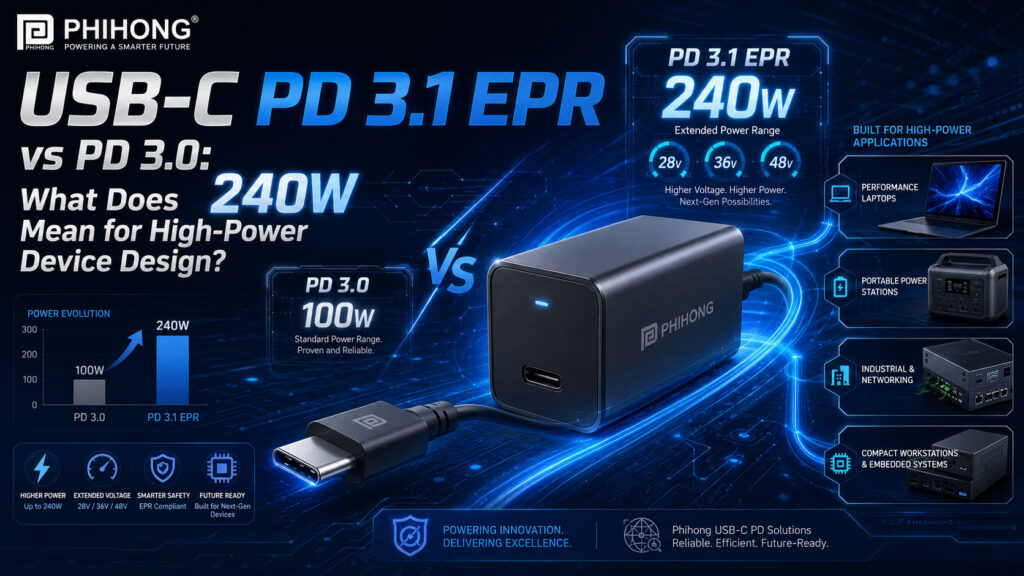
What is the difference between USB-C PD 3.1 EPR and USB-C PD 3.0?
USB-C PD 3.0 helped make USB-C a practical charging and power standard for many laptops, tablets, monitors, docking stations and commercial devices. For many years, product teams often planned around USB-C power levels up to 100W, which worked well for mainstream notebooks and lower-power equipment. But as laptops, portable systems, AI-ready devices, docking platforms and commercial electronics became more power hungry, 100W started to limit what OEMs could realistically design around USB-C.
USB-C PD 3.1 EPR, or Extended Power Range, expands that power ceiling by adding higher voltage levels. Instead of stopping at 20V, PD 3.1 EPR introduces 28V, 36V and 48V fixed voltage options that allow USB-C power delivery to scale toward 140W, 180W and 240W when the adapter, cable and device all support the required profile. For OEM teams, the difference is not just more watts. It is a different power architecture decision that affects adapter selection, cable policy, device-side power design, firmware, thermals and customer instructions.
| Comparison Area | USB-C PD 3.0 | USB-C PD 3.1 EPR |
|---|---|---|
| Typical upper power range | Commonly planned around up to 100W. | Enables higher power levels up to 240W. |
| Fixed voltage levels | Uses lower USB-C PD voltage levels such as 5V, 9V, 15V and 20V. | Adds 28V, 36V and 48V fixed voltage levels. |
| Best fit | Mainstream laptops, tablets, monitors and lower-power USB-C systems. | High-performance laptops, portable workstations, docking systems and higher-power equipment. |
| Design complexity | Often simpler for mature USB-C charging designs. | Requires EPR cable, device readiness, controller support and stronger thermal planning. |
Why This Matters
• USB-C PD 3.1 EPR expands USB-C from mainstream charging into higher-power device design.
• OEMs need to evaluate EPR as a full system decision, not just a higher-wattage adapter upgrade.
What OEMs Should Do Now
• Compare the device’s real power budget against PD 3.0 and PD 3.1 EPR before choosing the adapter class.
• Review adapter, cable, USB-C connector, PD controller, firmware and thermal requirements together before committing to EPR.
Useful Links
AA240U-59FKEA-R Product Page: www.phihong.com/products/aa240u-59fkea-r-2/
AA240U-59FKEA-R 240W USB-C PD 3.1 Datasheet: www.phihong.com/wp-content/uploads/AA240U-59FKEA-R.pdf
USB Power Delivery Specification: www.usb.org/usb-charger-pd
Related Links
Best Guide to USB-C PD 3.1 EPR: What 240W Power Changes for High-Performance Laptops, Portable Equipment, and USB-C Systems: www.phihong.com/best-guide-to-usb-c-pd-3-1-epr-what-240w-power-changes-for-high-performance-laptops-portable-equipment-and-usb-c-systems/
What Can a 240W USB-C PD 3.1 Adapter Power That 100W and 140W Chargers Cannot?: www.phihong.com/what-can-a-240w-usb-c-pd-3-1-adapter-power-that-100w-and-140w-chargers-cannot/
Why 28V, 36V, and 48V USB-C PD Outputs Matter for High-Power Devices: www.phihong.com/why-28v-36v-and-48v-usb-c-pd-outputs-matter-for-high-power-devices/
FEATURED PRODUCTS
AM250U-540AP-R
AA240U-200A-R
AA240U-200B-R
AA280U-200B-R
AA240U-59FKEA-R
AA36U-240B-R

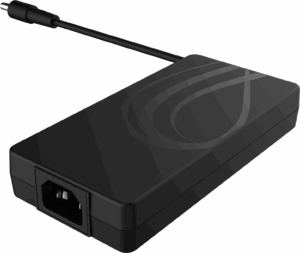
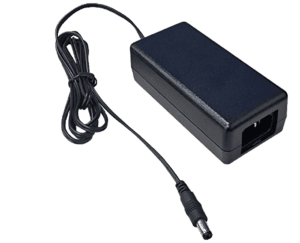
What does 240W change for high-power USB-C device design?
240W changes USB-C device design because it gives OEMs more room to support devices that exceed the power assumptions of older USB-C charging systems. A product that needs only 65W, 100W, or 140W may not need the full PD 3.1 EPR range. But high-performance laptops, portable workstations, docking systems, field equipment, larger battery-powered platforms and commercial USB-C systems may benefit from the additional headroom.
The design challenge is that 240W is not just a charger label. A device must be able to negotiate the correct EPR profile, accept higher voltage input, manage current safely, convert power internally, control heat and communicate compatibility clearly to users. If the device is not designed for 240W, it may simply negotiate a lower profile. That makes 240W most valuable when it is planned from the beginning as part of the device’s power architecture.
| Design Area | What 240W Changes | What OEM Teams Should Review |
| Power budget | More headroom for high-performance systems and larger batteries. | Sustained load, charging under use, peak demand and power margin. |
| Input architecture | Higher EPR voltages may feed internal conversion stages differently. | 28V, 36V, 48V support, DC/DC design and protection circuits. |
| Cable and connector plan | Full-power operation depends on approved EPR cables and hardware. | Cable rating, connector temperature, durability and labeling. |
| Customer experience | Users may expect any USB-C charger to perform the same way. | Approved accessories, fallback behavior, system messages and support notes. |
Why This Matters
• 240W USB-C power can support higher-performance device categories that PD 3.0 may not cover well.
• The benefit depends on full system readiness across adapter, cable, device hardware, firmware and thermal design.
What OEMs Should Do Now
• Decide whether 240W is truly needed for the product’s workload, battery size, and usage model.
• Validate charge-under-load behavior using the approved adapter and cable, not only basic idle charging tests.
Useful Links
AA240U-59FKEA-R Product Page: www.phihong.com/products/aa240u-59fkea-r-2/
AA240U-59FKEA-R 240W USB-C PD 3.1 Datasheet: www.phihong.com/wp-content/uploads/AA240U-59FKEA-R.pdf
USB Power Delivery Specification: www.usb.org/usb-charger-pd
Related Links
What Can a 240W USB-C PD 3.1 Adapter Power That 100W and 140W Chargers Cannot?: www.phihong.com/what-can-a-240w-usb-c-pd-3-1-adapter-power-that-100w-and-140w-chargers-cannot/
Why 28V, 36V, and 48V USB-C PD Outputs Matter for High-Power Devices: www.phihong.com/why-28v-36v-and-48v-usb-c-pd-outputs-matter-for-high-power-devices/
How 330W GaN Power Adapters Support Gaming Laptops and Mobile Workstations: www.phihong.com/how-330w-gan-power-adapters-support-gaming-laptops-and-mobile-workstations/
When should OEMs choose PD 3.1 EPR instead of PD 3.0?
OEMs should choose PD 3.1 EPR when the product’s power requirements exceed what PD 3.0 can reasonably support. This does not mean every new USB-C device should move to 240W. Many commercial products still fit well within lower power classes. A mainstream laptop, compact monitor, tablet, or small peripheral may not need EPR. But a high-performance portable system may need more than 100W to operate, charge and support connected workloads at the same time.
The decision should start with power demand, not marketing. If the device needs 140W, 180W, or 240W under realistic conditions, PD 3.1 EPR may be a better fit. If the device can operate comfortably within 100W, PD 3.0 may still be more practical. OEM teams should also account for compatibility, approved cable requirements, thermal behavior, power negotiation, safety documentation and user expectations. EPR adds power headroom, but it also adds design responsibility.
| Selection Question | PD 3.0 May Fit When | PD 3.1 EPR May Fit When |
| How much power does the device need? | The product stays within a 100W-class power budget. | The product needs 140W, 180W, or 240W capability. |
| What type of device is being built? | Mainstream notebooks, displays, tablets and smaller USB-C products. | Performance laptops, workstations, docking systems and portable equipment. |
| Is the system ready for higher voltage? | The design is built around standard USB-C PD voltage levels. | The design supports 28V, 36V, or 48V EPR operation. |
| Can users manage compatibility? | Standard USB-C charging behavior is enough. | The product needs approved EPR cables, clear instructions and fallback planning. |
Why This Matters
• PD 3.1 EPR should be selected when the product’s real power demand justifies higher USB-C power levels.
• Choosing EPR without device, cable and support readiness can create cost, complexity and customer confusion.
What OEMs Should Do Now
• Use measured system power demand to decide whether PD 3.0 or PD 3.1 EPR is the better fit.
• Define the approved adapter and cable ecosystem before the product reaches certification or customer launch.
Useful Links
AA240U-59FKEA-R Product Page: www.phihong.com/products/aa240u-59fkea-r-2/
AA240U-59FKEA-R 240W USB-C PD 3.1 Datasheet: www.phihong.com/wp-content/uploads/AA240U-59FKEA-R.pdf
Power Adapter Product Line: www.phihong.com/products/adapters/
Related Links
Best Guide to USB-C PD 3.1 EPR: What 240W Power Changes for High-Performance Laptops, Portable Equipment, and USB-C Systems: www.phihong.com/best-guide-to-usb-c-pd-3-1-epr-what-240w-power-changes-for-high-performance-laptops-portable-equipment-and-usb-c-systems/
What Can a 240W USB-C PD 3.1 Adapter Power That 100W and 140W Chargers Cannot?: www.phihong.com/what-can-a-240w-usb-c-pd-3-1-adapter-power-that-100w-and-140w-chargers-cannot/
Why 65W GaN Power Adapters Are Becoming the New Standard for Commercial Laptops: www.phihong.com/why-65w-gan-power-adapters-are-becoming-the-new-standard-for-commercial-laptops/
CLIENT'S QUOTE
Phihong’s custom OEM power solutions have transformed our product development, boosting performance and reducing overhead. Their expert engineering support has simplified both the design and manufacturing phases.
What design risks increase when moving from PD 3.0 to PD 3.1 EPR?
Moving from PD 3.0 to PD 3.1 EPR can increase design risk because the product is no longer dealing only with mainstream USB-C charging assumptions. Higher voltage levels, higher wattage, EPR cable requirements, more demanding thermal behavior and more complex compatibility planning all become part of the design. A 240W USB-C adapter can support more demanding products, but only if the rest of the system is designed to handle that power safely and consistently.
The most common risk is assuming that a higher-wattage adapter automatically improves the product. In reality, the device must be able to request, receive, convert and manage the selected EPR voltage profile. The battery system, connector, protection circuitry, board layout, thermal design and firmware all need to work together. If the product is not ready, the system may fall back to lower power, run hotter than expected, or create customer confusion around cable and charger compatibility.
| Risk Area | Why It Increases With EPR | What OEM Teams Should Review |
|---|---|---|
| Voltage readiness | EPR introduces 28V, 36V and 48V operating profiles. | Component ratings, protection circuits, PD controller support and DC/DC conversion. |
| Cable compatibility | 240W operation requires the correct EPR-rated cable. | Approved cable list, cable labeling, user instructions and support policy. |
| Thermal behavior | Higher power can increase heat across the adapter, cable, connector and device. | Full-load charging, enclosure temperature, battery temperature and airflow. |
| Customer confusion | Users may expect every USB-C charger or cable to deliver full power. | Fallback messaging, support notes, packaging and compatibility language. |
Why This Matters
• PD 3.1 EPR adds power headroom, but it also increases the importance of system-level validation.
• The main design risk is treating 240W as an adapter upgrade instead of a complete power architecture decision.
What OEMs Should Do Now
• Review every part of the USB-C power path before committing to a 240W EPR product strategy.
• Test full-power charging and fallback behavior with approved and non-approved charging scenarios before launch.
Useful Links
AA240U-59FKEA-R Product Page: www.phihong.com/products/aa240u-59fkea-r-2/
AA240U-59FKEA-R 240W USB-C PD 3.1 Datasheet: www.phihong.com/wp-content/uploads/AA240U-59FKEA-R.pdf
USB Power Delivery Specification: www.usb.org/usb-charger-pd
Related Links
Why 28V, 36V, and 48V USB-C PD Outputs Matter for High-Power Devices: www.phihong.com/why-28v-36v-and-48v-usb-c-pd-outputs-matter-for-high-power-devices/
What Can a 240W USB-C PD 3.1 Adapter Power That 100W and 140W Chargers Cannot?: www.phihong.com/what-can-a-240w-usb-c-pd-3-1-adapter-power-that-100w-and-140w-chargers-cannot/
How 330W GaN Power Adapters Support Gaming Laptops and Mobile Workstations: www.phihong.com/how-330w-gan-power-adapters-support-gaming-laptops-and-mobile-workstations/
How Phihong supports USB-C PD 3.1 EPR adapter selection for OEM device design
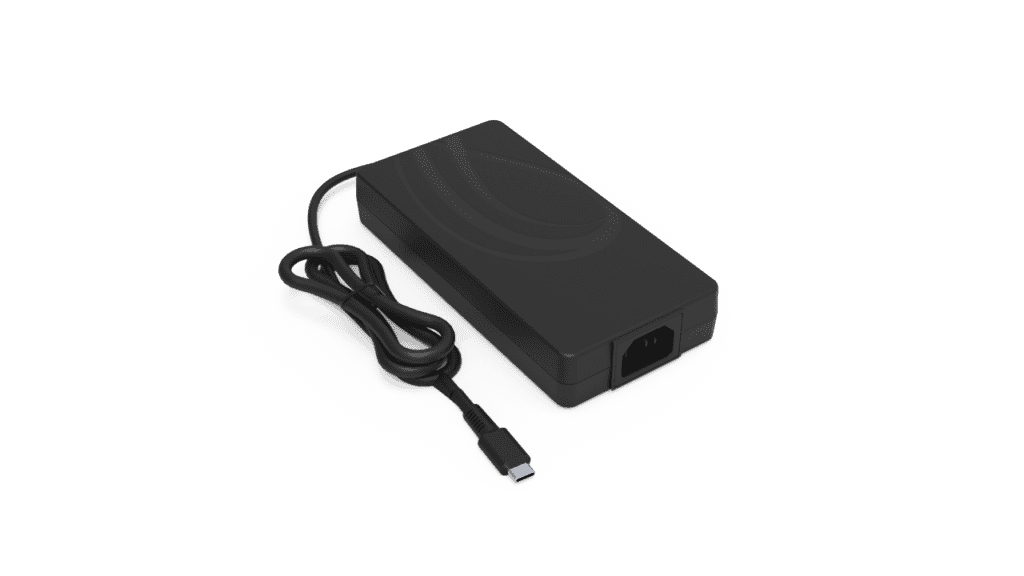
For OEM teams comparing USB-C PD 3.1 EPR with PD 3.0, Phihong’s AA240U-59FKEA-R gives engineers and sourcing teams a product-specific reference for 240W USB-C adapter selection. It is a USB-C Power Delivery 3.1 desktop adapter designed for higher-power output profiles, including EPR voltage levels used for 140W, 180W and 240W-class systems. That makes it relevant for high-performance laptops, portable equipment, docking systems, USB-C commercial devices and advanced power platforms that may need more than standard PD 3.0 power.
The product should be evaluated as part of the complete USB-C power system. OEM teams should review the adapter’s output modes, C14 input format, USB-C output plug, protection functions, Class B EMI, safety documentation, environmental limits and 5,000-meter operating altitude against the device’s actual needs. The best fit is a product that needs higher USB-C power and is designed with the correct EPR sink capability, controller support, approved cable plan, thermal behavior and user documentation.
| Phihong Product Area | Why It Helps OEM Teams | What Teams Should Review |
|---|---|---|
| AA240U-59FKEA-R | Provides a product-specific 240W USB-C PD 3.1 adapter reference. | Output modes, EPR support, current limits, protections and documentation. |
| EPR voltage support | Helps teams evaluate whether 28V, 36V, or 48V input fits the system. | PD controller, cable rating, firmware, fallback behavior and DC/DC conversion. |
| Desktop adapter format | Supports higher-power USB-C charging with external AC/DC conversion. | C14 input strategy, adapter placement, cord selection and service model. |
| Compliance planning | Gives teams a stronger starting point for commercial product review. | EMI, safety, environmental limits, altitude rating and validation process. |
Why This Matters
• Product-specific adapter evaluation helps OEMs compare PD 3.1 EPR and PD 3.0 based on real device requirements.
• A 240W USB-C adapter only delivers value when the complete system is designed for EPR operation.
What OEMs Should Do Now
• Start with the AA240U-59FKEA-R datasheet and compare its output modes against the product’s required power profile.
• Validate adapter, cable, connector, controller firmware, battery behavior, thermal conditions, EMI and safety together before production.
Useful Links
AA240U-59FKEA-R Product Page: www.phihong.com/products/aa240u-59fkea-r-2/
AA240U-59FKEA-R 240W USB-C PD 3.1 Datasheet: www.phihong.com/wp-content/uploads/AA240U-59FKEA-R.pdf
Power Adapter Product Line: www.phihong.com/products/adapters/
Related Links
Best Guide to USB-C PD 3.1 EPR: What 240W Power Changes for High-Performance Laptops, Portable Equipment, and USB-C Systems: www.phihong.com/best-guide-to-usb-c-pd-3-1-epr-what-240w-power-changes-for-high-performance-laptops-portable-equipment-and-usb-c-systems/
Why 28V, 36V, and 48V USB-C PD Outputs Matter for High-Power Devices: www.phihong.com/why-28v-36v-and-48v-usb-c-pd-outputs-matter-for-high-power-devices/
What Can a 240W USB-C PD 3.1 Adapter Power That 100W and 140W Chargers Cannot?: www.phihong.com/what-can-a-240w-usb-c-pd-3-1-adapter-power-that-100w-and-140w-chargers-cannot/
USB-C PD 3.1 EPR does not replace PD 3.0 for every product. Many devices still fit well within PD 3.0 power levels. The important shift is that OEMs now have a USB-C path for higher-power designs that previously may have required proprietary adapters or separate charging strategies.
For high-performance laptops, portable workstations, docking systems and advanced USB-C equipment, 240W power can change the architecture discussion. The strongest product teams will evaluate PD 3.1 EPR by power budget, voltage tier, cable ecosystem, device readiness, thermal behavior, safety, EMI and customer compatibility before making the move.

CONTACT US TODAY
From concept to production, Phihong delivers custom OEM power solutions tailored to your specifications.
FAQ
What is the main difference between USB-C PD 3.0 and USB-C PD 3.1 EPR?
The main difference is power range. USB-C PD 3.0 is commonly associated with USB-C power levels up to 100W, while USB-C PD 3.1 EPR expands the system with higher voltage levels that can support up to 240W. PD 3.1 EPR adds 28V, 36V and 48V output profiles, which makes USB-C more practical for high-performance laptops, portable equipment and higher-power USB-C systems.
Does USB-C PD 3.1 EPR replace PD 3.0?
No. PD 3.1 EPR does not mean every product should use 240W USB-C power. Many devices still fit well within PD 3.0-style power ranges. EPR is most useful when the product needs higher power levels, such as 140W, 180W, or 240W. OEMs should choose based on the device’s real power budget, not simply because the newer standard supports more watts.
What does 240W mean for high-power device design?
240W gives OEMs more power headroom for products that need more than traditional USB-C charging. This can include selected high-performance laptops, portable workstations, docking systems and field equipment. However, the device must support the correct EPR voltage, cable requirements, PD controller behavior, internal power conversion and thermal design. A 240W adapter alone does not make every USB-C device a 240W system.
Can a PD 3.0 device use a PD 3.1 EPR adapter?
In many cases, a lower-power USB-C device may still charge from a higher-capability adapter, but it will only negotiate the power level it supports. A PD 3.0 device should not be expected to receive 240W just because the adapter supports EPR. OEMs should define fallback behavior carefully so users understand how the device behaves with different chargers and cables.
What should OEMs check before moving from PD 3.0 to PD 3.1 EPR?
OEMs should check power budget, EPR voltage requirements, PD controller support, firmware behavior, EPR cable rating, USB-C connector design, protection circuits, internal DC/DC conversion, thermal behavior, EMI, safety documentation and user instructions. The adapter should be validated with the actual device and approved cable configuration under realistic operating conditions before production.
POE technology supports the centralization of power

AC Adapter Guide: Everything You Need to Know
Moreover, PoE technology supports the centralization of power management. By powering devices through a PoE-enabled network …
AC DC Power Chargers and How They Work: A Comprehensive Technical Breakdown
Moreover, PoE technology supports the centralization of power management. By powering devices through a PoE-enabled network …

USB-C Charger: Shaping the Future of the Tech World
Moreover, PoE technology supports the centralization of power management. By powering devices through a PoE-enabled network …

AC Adapter Guide: Everything You Need to Know
Moreover, PoE technology supports the centralization of power management. By powering devices through a PoE-enabled network …

AC DC Power Chargers and How They Work: A Comprehensive Technical Breakdown
Moreover, PoE technology supports the centralization of power management. By powering devices through a PoE-enabled network …

USB-C Charger: Shaping the Future of the Tech World
Moreover, PoE technology supports the centralization of power management. By powering devices through a PoE-enabled network …