









BLOG
Why Does USB-C PD 3.1 Use 28V, 36V, and 48V for High-Power Devices?
QUICK LINKS
Why do 28V, 36V, and 48V outputs matter in USB-C PD 3.1?
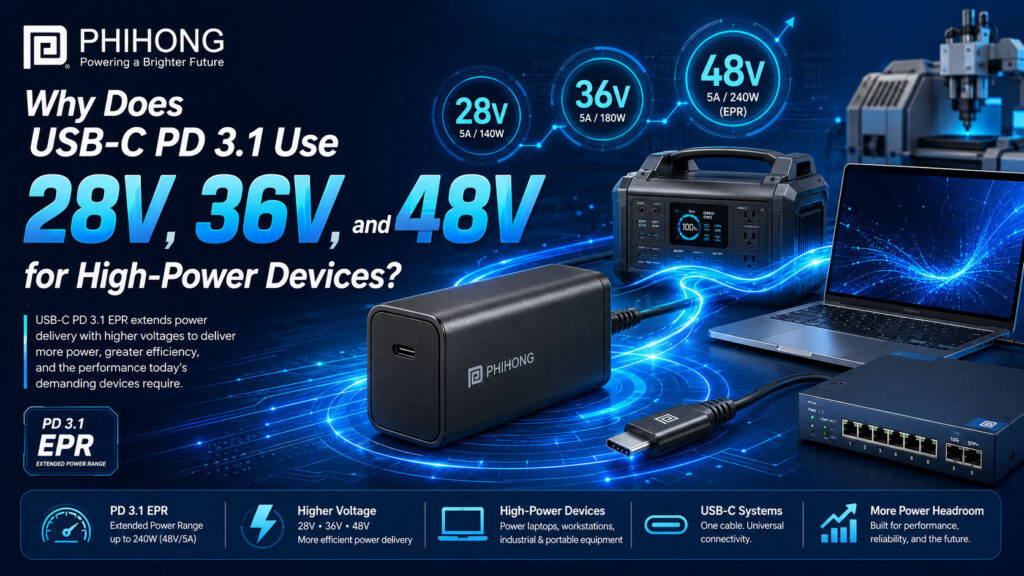
The 28V, 36V, and 48V output levels matter because they are what allow USB-C PD 3.1 EPR to move beyond the older 100W power ceiling. Instead of pushing more power only by increasing current, USB-C PD 3.1 uses higher voltage levels to support higher wattage while keeping current within the USB-C ecosystem’s defined limits. For OEMs, startups, engineers, and sourcing teams, this changes what USB-C can realistically power.
At a high level, 28V supports up to 140W, 36V supports up to 180W and 48V supports up to 240W when the adapter, cable and device are all designed for the correct EPR profile. This matters for high-performance laptops, portable equipment, docking systems, field devices and commercial USB-C systems that need more than mainstream charging. The voltage level is not just a spec line. It shapes the device input stage, cable requirements, PD controller behavior, internal DC/DC conversion and thermal design.
| EPR Voltage Level | Power Class It Enables | Why It Matters for OEMs |
|---|---|---|
| 28V | Up to 140W | Useful for devices that need more than 100W but do not require the full 240W range. |
| 36V | Up to 180W | Gives product teams a middle power tier for higher-performance portable systems. |
| 48V | Up to 240W | Supports the highest USB-C PD 3.1 EPR power class for demanding laptops, equipment and USB-C platforms. |
| Lower USB-C PD voltages | 5V, 9V, 15V, 20V | Still important for compatibility, fallback behavior and lower-power device support. |
Why This Matters
• The new EPR voltage levels are the reason USB-C can support higher-power products beyond traditional 100W charging.
• OEMs need to evaluate voltage negotiation, cable support and device-side power design before using 28V, 36V, or 48V USB-C input.
What OEMs Should Do Now
• Identify the voltage tier that matches the product’s real power budget instead of defaulting to the highest wattage.
• Review PD controller support, EPR cable requirements, connector design and internal conversion needs early in development.
Useful Links
AA240U-59FKEA-R Product Page: www.phihong.com/products/aa240u-59fkea-r-2/
AA240U-59FKEA-R 240W USB-C PD 3.1 Datasheet: www.phihong.com/wp-content/uploads/AA240U-59FKEA-R.pdf
USB Power Delivery Specification: www.usb.org/usb-charger-pd
Related Links
Best Guide to USB-C PD 3.1 EPR: What 240W Power Changes for High-Performance Laptops, Portable Equipment, and USB-C Systems: www.phihong.com/best-guide-to-usb-c-pd-3-1-epr-what-240w-power-changes-for-high-performance-laptops-portable-equipment-and-usb-c-systems/
What Can a 240W USB-C PD 3.1 Adapter Power That 100W and 140W Chargers Cannot?: www.phihong.com/what-can-a-240w-usb-c-pd-3-1-adapter-power-that-100w-and-140w-chargers-cannot/
Best Guide to GaN Power Adapters: What Modern Devices Need From Compact, High-Density Power: www.phihong.com/best-guide-to-gan-power-adapters-what-modern-devices-need-from-compact-high-density-power/
FEATURED PRODUCTS
AM250U-540AP-R
AA240U-200A-R
AA240U-200B-R
AA280U-200B-R
AA240U-59FKEA-R
AA36U-240B-R

How does higher voltage help USB-C deliver more power without only increasing current?
Higher voltage helps USB-C deliver more power because power is the product of voltage and current. In practical terms, a system can reach higher wattage by increasing voltage while keeping current within a defined range. That is why USB-C PD 3.1 EPR uses higher voltage levels such as 28V, 36V and 48V to support higher-power devices. This approach is especially important because high current can create cable, connector, heat and efficiency challenges.
For OEM teams, this means 48V USB-C is not just “more powerful.” It is a different design condition than 20V USB-C. A device that accepts 48V input may need a different internal DC/DC conversion strategy, protection design, connector review, battery charging architecture and firmware behavior than a lower-voltage product. The adapter can provide the EPR voltage, but the device must be ready to request, receive and manage it safely.
| Design Area | Why Higher Voltage Helps | What OEM Teams Should Review |
| Cable and connector loading | Higher voltage can support more power without increasing current beyond the defined EPR range. | EPR cable rating, connector temperature, cable length and approved accessory policy. |
| Internal conversion | Higher input voltage may feed downstream DC/DC stages more efficiently in some architectures. | DC/DC topology, conversion losses, board layout and point-of-load needs. |
| Thermal behavior | Current-related losses can be easier to manage when voltage is raised appropriately. | Adapter heat, cable heat, connector temperature and device enclosure temperature. |
| System negotiation | The device must request the correct voltage from the adapter. | PD controller, firmware, fallback behavior and error handling. |
Why This Matters
• Higher EPR voltage levels help make 140W, 180W and 240W USB-C power practical for more demanding devices.
• The device must be designed for the selected voltage tier, not simply connected to a higher-watt adapter.
What OEMs Should Do Now
• Treat 28V, 36V and 48V as architecture decisions that affect the power path, not just charger options.
• Validate voltage negotiation, thermal behavior and lower-power fallback before finalizing the USB-C system.
Useful Links
AA240U-59FKEA-R Product Page: www.phihong.com/products/aa240u-59fkea-r-2/
AA240U-59FKEA-R 240W USB-C PD 3.1 Datasheet: www.phihong.com/wp-content/uploads/AA240U-59FKEA-R.pdf
USB Power Delivery Specification: www.usb.org/usb-charger-pd
Related Links
What Can a 240W USB-C PD 3.1 Adapter Power That 100W and 140W Chargers Cannot?: www.phihong.com/what-can-a-240w-usb-c-pd-3-1-adapter-power-that-100w-and-140w-chargers-cannot/
How 330W GaN Power Adapters Support Gaming Laptops and Mobile Workstations: www.phihong.com/how-330w-gan-power-adapters-support-gaming-laptops-and-mobile-workstations/
Why 65W GaN Power Adapters Are Becoming the New Standard for Commercial Laptops: www.phihong.com/why-65w-gan-power-adapters-are-becoming-the-new-standard-for-commercial-laptops/
Which high-power devices benefit from 28V, 36V, and 48V USB-C outputs?
The devices that benefit most from 28V, 36V and 48V USB-C outputs are products that need more power than traditional USB-C charging can provide, but still benefit from a standardized USB-C connector strategy. This can include high-performance laptops, creator notebooks, mobile workstations, portable diagnostic systems, field equipment, docking stations, commercial electronics and USB-C powered platforms.
The best voltage tier depends on the device’s power budget and internal architecture. A system that needs more than 100W but stays below 140W may fit a 28V EPR approach. A product that needs more headroom may evaluate 36V. A device that needs the top end of USB-C PD 3.1 power may use 48V. OEM teams should not assume 48V is always the best answer. The correct voltage is the one that fits the load profile, internal conversion strategy, thermal design and user experience.
| Device Type | Why EPR Voltage Matters | Likely Review Focus |
| High-performance laptop | Heavier CPU, GPU, display and battery loads may exceed lower USB-C power levels. | Charge-under-load behavior, battery profile, thermal design and cable policy. |
| Portable workstation | Professional workloads may need higher sustained external power. | Sustained load, 36V or 48V readiness, adapter placement and user instructions. |
| Docking system | Power may need to support host charging and connected peripherals. | Power allocation, host compatibility, voltage negotiation and fallback modes. |
| Field or industrial equipment | USB-C may support portable systems with processors, sensors, displays and batteries. | Ruggedness, serviceability, cable management and environmental conditions. |
Why This Matters
• EPR voltage levels expand USB-C into device categories that may not fit well within 100W charging limits.
• Matching the correct voltage tier helps OEMs avoid overdesign, underpowering, or confusing compatibility behavior.
What OEMs Should Do Now
• Map the product’s realistic power scenarios before choosing a 28V, 36V, or 48V USB-C input strategy.
• Test with the approved adapter and EPR cable under real workloads, not only idle charging conditions.
Useful Links
AA240U-59FKEA-R Product Page: www.phihong.com/products/aa240u-59fkea-r-2/
AA240U-59FKEA-R 240W USB-C PD 3.1 Datasheet: www.phihong.com/wp-content/uploads/AA240U-59FKEA-R.pdf
Power Adapter Product Line: www.phihong.com/products/adapters/
Related Links
Best Guide to USB-C PD 3.1 EPR: What 240W Power Changes for High-Performance Laptops, Portable Equipment, and USB-C Systems: www.phihong.com/best-guide-to-usb-c-pd-3-1-epr-what-240w-power-changes-for-high-performance-laptops-portable-equipment-and-usb-c-systems/
What Can a 240W USB-C PD 3.1 Adapter Power That 100W and 140W Chargers Cannot?: www.phihong.com/what-can-a-240w-usb-c-pd-3-1-adapter-power-that-100w-and-140w-chargers-cannot/
Top 10 Reasons Edge AI Devices Need High-Density GaN Power Adapters: www.phihong.com/top-10-reasons-edge-ai-devices-need-high-density-gan-power-adapters/
CLIENT'S QUOTE
Phihong’s custom OEM power solutions have transformed our product development, boosting performance and reducing overhead. Their expert engineering support has simplified both the design and manufacturing phases.
What should OEMs verify before designing around 28V, 36V, or 48V USB-C input?
OEMs should verify the full USB-C power chain before designing around 28V, 36V, or 48V input. A product cannot use these higher EPR voltage levels just because the adapter supports them. The device must be designed with the right USB-C PD controller, firmware behavior, input protection, connector rating, cable requirement, thermal strategy, battery charging profile, and internal conversion architecture.
This is where 28V, 36V, and 48V become product design decisions instead of simple charger options. A 28V system may have different internal conversion needs than a 48V system. A 48V design may offer higher power headroom, but it may also require more careful attention to safety, protection, creepage, clearance, component ratings, and thermal behavior. For high-power USB-C devices, the right voltage tier should come from the product’s actual load profile, not from a desire to advertise the highest possible charging number.
| Verification Area | Why It Matters | What OEM Teams Should Review |
|---|---|---|
| EPR negotiation | The device must request and accept the correct voltage profile. | PD controller, firmware, sink capability, voltage selection and fallback behavior. |
| Component ratings | Higher input voltages may change protection and conversion requirements. | MOSFETs, capacitors, connectors, protection circuits and DC/DC converter limits. |
| Thermal design | Higher power can create heat across the adapter, cable, connector and device. | Full-load operation, battery charging, airflow, enclosure temperature and cable temperature. |
| User compatibility | Customers may use lower-power chargers or non-EPR cables. | Approved cable policy, support documentation, user instructions and safe fallback modes. |
Why This Matters
• EPR voltage support requires device-side readiness, not just a 240W adapter.
• Choosing 28V, 36V, or 48V affects internal power conversion, safety review, thermal behavior and customer experience.
What OEMs Should Do Now
• Build a USB-C EPR readiness checklist before selecting the final adapter and cable configuration.
• Validate higher-voltage operation and lower-power fallback under real workloads, not only basic charging tests.
Useful Links
AA240U-59FKEA-R Product Page: www.phihong.com/products/aa240u-59fkea-r-2/
AA240U-59FKEA-R 240W USB-C PD 3.1 Datasheet: www.phihong.com/wp-content/uploads/AA240U-59FKEA-R.pdf
USB Power Delivery Specification: www.usb.org/usb-charger-pd
Related Links
What Can a 240W USB-C PD 3.1 Adapter Power That 100W and 140W Chargers Cannot?: www.phihong.com/what-can-a-240w-usb-c-pd-3-1-adapter-power-that-100w-and-140w-chargers-cannot/
How 330W GaN Power Adapters Support Gaming Laptops and Mobile Workstations: www.phihong.com/how-330w-gan-power-adapters-support-gaming-laptops-and-mobile-workstations/
Best Guide to GaN Power Adapters: What Modern Devices Need From Compact, High-Density Power: www.phihong.com/best-guide-to-gan-power-adapters-what-modern-devices-need-from-compact-high-density-power/
How Phihong supports high-power USB-C PD 3.1 EPR adapter selection
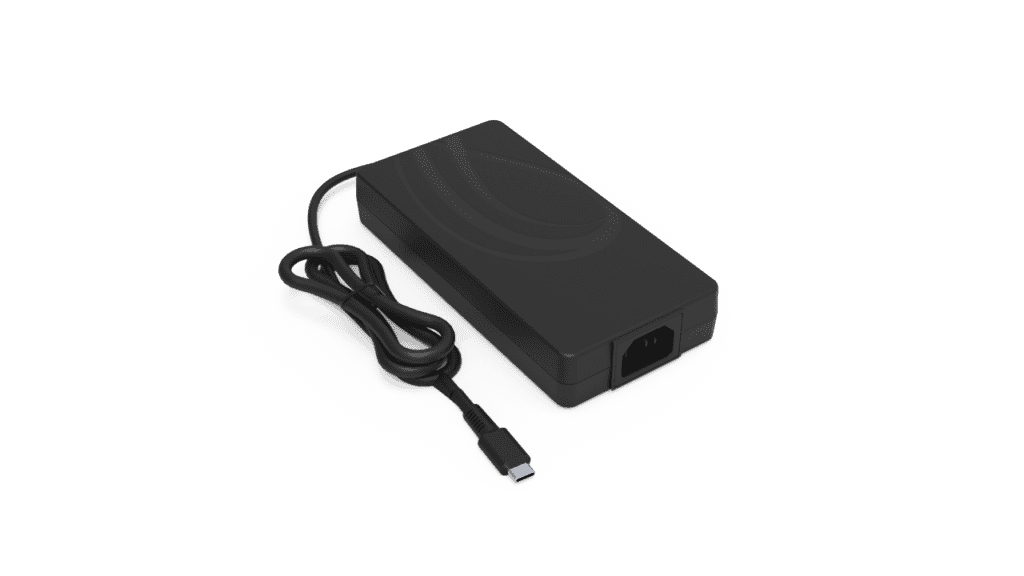
For OEM teams evaluating 28V, 36V, and 48V USB-C PD outputs, Phihong’s AA240U-59FKEA-R provides a product-specific reference for high-power USB-C adapter selection. It is positioned as a 240W USB-C Power Delivery 3.1 desktop adapter with EPR voltage support, C14 input, USB-C output, protection features, Class B EMI, high-efficiency performance and 5,000-meter operating altitude.
The adapter is relevant for teams designing high-performance laptops, portable equipment, docking systems, commercial USB-C electronics and other high-power devices that may need more than 100W or 140W charging. The best fit depends on the full product architecture. OEMs should compare the supported voltage modes, device-side EPR capability, cable requirements, power budget, thermal design, safety documentation, EMI plan and user experience before selecting a 240W USB-C PD 3.1 adapter for production.
| Phihong Product Area | Why It Helps OEM Teams | What Teams Should Review |
| AA240U-59FKEA-R | Provides a 240W USB-C PD 3.1 adapter reference for EPR systems. | Output modes, USB-C plug, C14 input, protections, EMI and environmental details. |
| EPR voltage support | Helps teams evaluate higher-power USB-C charging beyond 100W. | 28V, 36V, 48V readiness, PD controller support and cable requirements. |
| Desktop adapter format | Supports higher-power external charging with detachable AC cord planning. | AC cord strategy, adapter placement, user access and service model. |
| Product documentation | Gives engineers and sourcing teams a stronger review starting point. | Datasheet values, safety records, test conditions and validation requirements. |
Why This Matters
• Product-specific evaluation helps OEMs connect EPR voltage levels to real device requirements.
• A 240W USB-C PD 3.1 adapter should be selected by voltage support, power budget, cable requirements and system readiness.
What OEMs Should Do Now
• Start with the AA240U-59FKEA-R datasheet and compare the supported output modes against the device’s actual power architecture.
• Validate adapter, cable, USB-C connector, controller firmware, battery behavior, thermal performance and user instructions together.
Useful Links
AA240U-59FKEA-R Product Page: www.phihong.com/products/aa240u-59fkea-r-2/
AA240U-59FKEA-R 240W USB-C PD 3.1 Datasheet: www.phihong.com/wp-content/uploads/AA240U-59FKEA-R.pdf
Power Adapter Product Line: www.phihong.com/products/adapters/
Related Links
What Can a 240W USB-C PD 3.1 Adapter Power That 100W and 140W Chargers Cannot?: www.phihong.com/what-can-a-240w-usb-c-pd-3-1-adapter-power-that-100w-and-140w-chargers-cannot/
How 330W GaN Power Adapters Support Gaming Laptops and Mobile Workstations: www.phihong.com/how-330w-gan-power-adapters-support-gaming-laptops-and-mobile-workstations/
Why 65W GaN Power Adapters Are Becoming the New Standard for Commercial Laptops: www.phihong.com/why-65w-gan-power-adapters-are-becoming-the-new-standard-for-commercial-laptops/
The 28V, 36V, and 48V output levels are what make USB-C PD 3.1 EPR important for high-power devices. They give OEM teams a path to higher wattage while keeping USB-C as the power connector strategy, but they also require more careful system design.
For high-performance laptops, portable workstations, field equipment, docking systems and commercial USB-C platforms, the best voltage tier depends on the device’s real power budget. The strongest product teams will evaluate adapter capability, cable rating, device-side negotiation, internal conversion, thermal behavior and user compatibility before committing to an EPR power architecture.

CONTACT US TODAY
From concept to production, Phihong delivers custom OEM power solutions tailored to your specifications.
FAQ
Why did USB-C PD 3.1 add 28V, 36V, and 48V outputs?
USB-C PD 3.1 added higher EPR voltage levels so USB-C could support more power than older USB-C charging designs. Instead of relying only on higher current, the specification uses higher voltages to reach higher wattage classes. This matters for high-performance laptops, portable equipment, docking systems and commercial USB-C devices that need more than traditional USB-C charging power.
What power levels do 28V, 36V, and 48V support?
In USB-C PD 3.1 EPR, 28V can support up to 140W, 36V can support up to 180W and 48V can support up to 240W when the adapter, cable and device are all designed for the required profile. The device must support the selected voltage tier, and the cable must meet the required EPR rating for full-power operation.
Does a 48V USB-C adapter always deliver 240W?
No. A 48V-capable USB-C adapter can only deliver 240W when the connected device and cable support the correct EPR power profile. If the device is designed for a lower power level, or the cable is not approved for EPR operation, the system may negotiate a lower voltage or lower wattage. OEMs should plan fallback behavior clearly.
Why does higher voltage help high-power USB-C systems?
Higher voltage helps because it allows more power to be delivered without increasing current beyond the defined limits of the USB-C EPR system. This can help reduce current-related stress on cables, connectors and internal power paths. However, higher voltage also requires careful device-side design, including protection, conversion, firmware and thermal validation.
What should OEMs check before using 28V, 36V, or 48V USB-C input?
OEMs should review power budget, PD controller support, firmware behavior, cable rating, connector design, protection circuits, internal DC/DC conversion, thermal behavior, battery charging requirements, EMI, safety documentation and user instructions. The adapter should be tested with the actual device and approved cable under realistic operating conditions before production.
POE technology supports the centralization of power

AC Adapter Guide: Everything You Need to Know
Moreover, PoE technology supports the centralization of power management. By powering devices through a PoE-enabled network …
AC DC Power Chargers and How They Work: A Comprehensive Technical Breakdown
Moreover, PoE technology supports the centralization of power management. By powering devices through a PoE-enabled network …

USB-C Charger: Shaping the Future of the Tech World
Moreover, PoE technology supports the centralization of power management. By powering devices through a PoE-enabled network …

AC Adapter Guide: Everything You Need to Know
Moreover, PoE technology supports the centralization of power management. By powering devices through a PoE-enabled network …

AC DC Power Chargers and How They Work: A Comprehensive Technical Breakdown
Moreover, PoE technology supports the centralization of power management. By powering devices through a PoE-enabled network …

USB-C Charger: Shaping the Future of the Tech World
Moreover, PoE technology supports the centralization of power management. By powering devices through a PoE-enabled network …