









BLOG
Industrial PSU Cooling: Can 300W or 600W Models Operate Without a Fan?
QUICK LINKS
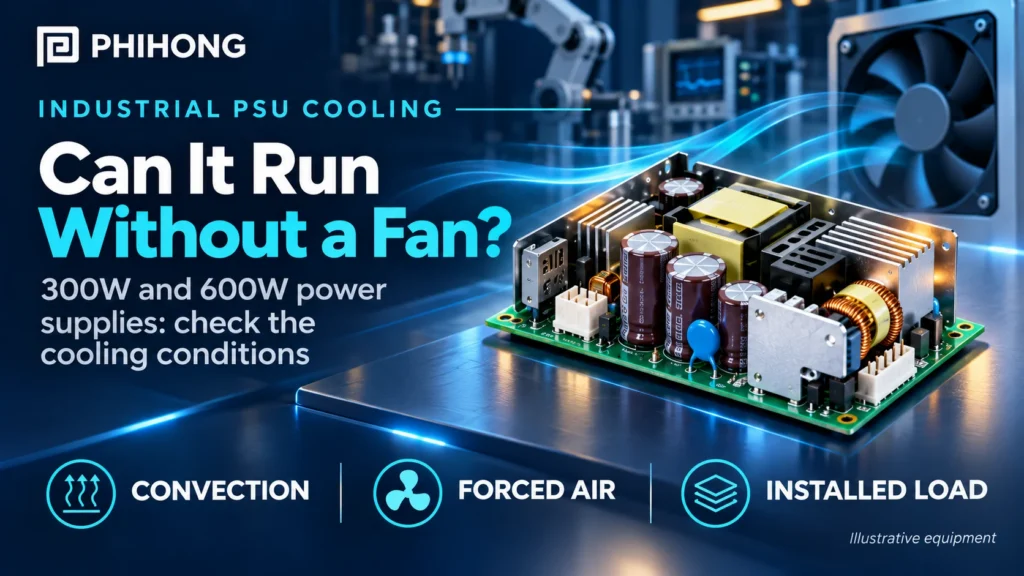
Quick Answer: Some open-frame power supplies support convection operation at a lower output than their fan-cooled rating. Phihong’s PBL300M documentation lists 300W with fan cooling and 200W with convection; the PBL600L documentation lists 600W with fan cooling and 400W with convection. These are model-document references, not a promise that an arbitrary sealed enclosure can deliver those outputs without a fan. Confirm all applicable conditions and validate the intended installation.
The question often appears late in product development: can the fan be removed to reduce noise, simplify maintenance or free enclosure space? The supply’s family name may suggest ample capacity, but that name can refer to a different cooling arrangement from the one the equipment will use. A correct decision starts by separating the model’s published operating cases.
This article focuses on the cooling decision for the PBL300M and PBL600L families. The 300W and 600W selection guide covers the wider load, voltage and integration questions. Here, the task is to determine which cooling basis applies and what evidence the equipment team needs.
Which rating applies when the equipment has no fan?
Read the cooling condition beside the output rating. The PBL300M datasheet distinguishes 300W fan-cooled operation from a 200W convection reference. The PBL600L datasheet distinguishes 600W fan-cooled operation from a 400W convection reference. Keep the exact output variant and document revision with the comparison.
Do not treat those references as interchangeable operating points. A team planning convection cooling should compare its actual equipment demand against the applicable documented convection conditions. It should not start from the larger family wattage and assume that unused nominal capacity compensates for an undefined thermal installation. Confirm ambient, mounting and any other relevant limitations before accepting a candidate.
Convection operation also does not automatically establish that the complete equipment is fanless. Another module may need forced cooling, or the enclosure may depend on a system fan to maintain the environment around the supply. Define the proposed equipment architecture clearly. The useful question is whether the selected supply can operate at the required output in that architecture, under conditions supported by documentation and representative evaluation.
| Family document | Fan-cooled output reference | Convection output reference |
|---|---|---|
| PBL300M | 300W | 200W |
| PBL600L | 600W | 400W |
| OEM decision | Confirm the required forced-cooling conditions | Confirm the applicable installation and derating conditions |
Why This Matters
- The family wattage can describe a different cooling case from the equipment being designed.
- A convection rating applies with its conditions, rather than to every enclosure.
What OEMs Should Do Now
- Identify the exact candidate, output variant and intended cooling case on the comparison sheet.
- Ask Phihong to confirm any missing conditions before accepting the equipment power budget.
FEATURED PRODUCTS

PBL300M-120
- Output Power - 300W(with Fan)
- Output Volt - 12Vdc
- Features - Class I Design , High Efficiency Performance , OVP, OCP, SCP, OTP Protections , Operating Altitude: 5,000M
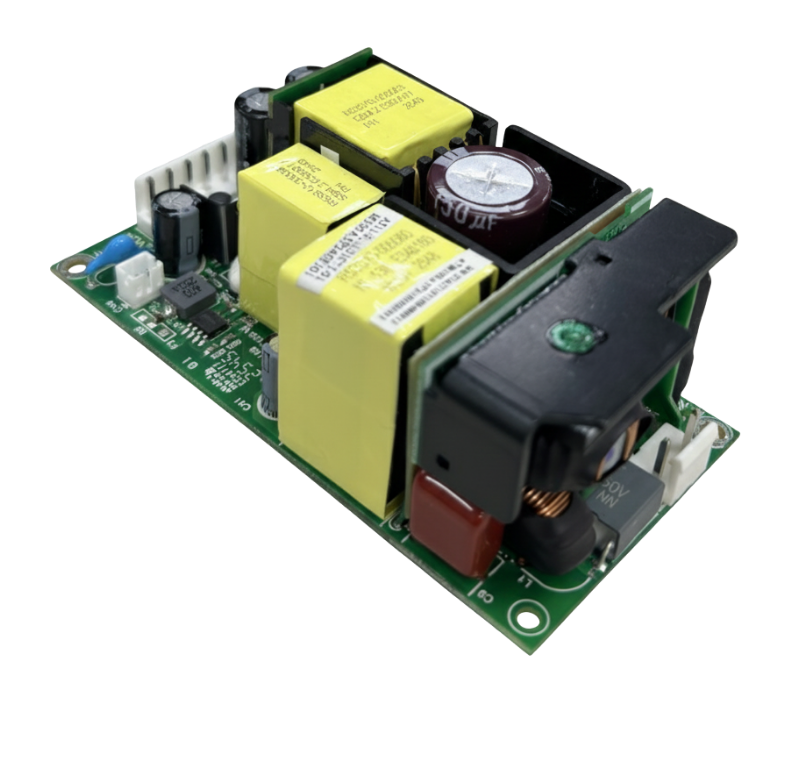
PBL300M-240
- Output Power - 300W(with Fan)
- Output Volt - 24Vdc
- Features - Class I Design , High Efficiency Performance , OVP, OCP, SCP, OTP Protections , Operating Altitude: 5,000M

PBL600L-240
- Output Power - 600W(with Fan)
- Output Volt - 24Vdc
- Features - Class I Design , High Efficiency Performance , OVP, OCP, SCP, OTP Protections , Operating Altitude: 5,000M
PBL600L-480
- Output Power - 600W(with Fan)
- Output Volt - 48Vdc
- Features - Class I Design , High Efficiency Performance , OVP, OCP, SCP, OTP Protections , Operating Altitude: 5,000M
Why does an open-bench result differ from an enclosure result?
The supply’s surroundings affect how heat leaves the assembly. A representative enclosure can introduce nearby warm components, restricted openings, covers and cable bundles that were absent on an open bench. A successful bench demonstration is useful evidence for that setup, but it does not establish the temperature distribution inside the finished equipment.
Review the actual assembly rather than estimating the result from vent area alone. Identify the mounting orientation, surrounding parts and planned enclosure configuration. Ask which supplier conditions need to be reproduced and which equipment measurements determine acceptance. Where the document leaves an installation detail unclear, obtain clarification instead of inventing an airflow or clearance number.
Phihong’s enclosure thermal validation guide discusses the broader evaluation process. For these families, retain the exact supply, hardware revision, load and environment used in the new review. A result from a smaller open-frame family can explain the method, but it cannot qualify the PBL300M or PBL600L installation.
Keep changes visible after the first test. A revised cover, new filter or relocated harness may change the installation that produced the evidence. Decide whether the earlier evaluation remains representative before carrying its conclusion into the released equipment.
Why This Matters
- The finished enclosure changes the thermal surroundings of the supply.
- An evaluation result belongs to a defined assembly and operating condition.
What OEMs Should Do Now
- Evaluate representative enclosure hardware with its intended covers and adjacent components.
- Retain the mounting, load, environment and configuration with the thermal evidence.
What must be confirmed when forced cooling is required?
A fan somewhere in the chassis is not enough to establish the cooling condition at the supply. The team needs the supplier’s applicable airflow and installation basis for the exact model. Do not assume that the published fan-cooled output includes a particular fan assembly or that a catalog fan’s unrestricted airflow represents the installed path.
Review the complete path through openings, filters, brackets, nearby hardware and the supply location. The equipment team should decide how to demonstrate that the required local conditions are achieved. If the supplier document does not provide enough information to select or position the cooling arrangement, keep that question open and ask Phihong for clarification.
Noise and service goals belong in the same discussion. A design may have more than one feasible cooling arrangement, but the choice must satisfy the actual load and installation requirements. Avoid comparing a fanless concept at one output with a fan-cooled concept at another output as though the hardware conditions were equivalent.
The existing 200W cooling comparison illustrates why cooling-dependent output should be read carefully. Its figures apply to that separate product family. Use it as background for the decision process, then return to the current PBL300M or PBL600L documentation for the new equipment.
Why This Matters
- Installed airflow can differ from a fan’s isolated catalog specification.
- Cooling hardware and available output need to be reviewed as one configuration.
What OEMs Should Do Now
- Confirm whether cooling hardware is supplied and which airflow basis applies to the candidate.
- Verify the intended installed cooling arrangement rather than assuming a chassis fan is sufficient.
How should OEMs account for load changes and cooling degradation?
Use the equipment’s real operating combinations when setting the thermal evaluation plan. Normal operation, accessory use and changing demand may create different conditions. Record the location and duration of measurements so a short observation is not mistaken for evidence covering every operating case. Keep measured values separate from estimates in the requirement record.
If the design relies on forced cooling, decide how the equipment responds when that cooling is reduced or unavailable. That is an equipment-level behavior requiring its own review. A protection function in the power supply does not automatically provide the preferred response for a monitor, controller, network appliance or industrial system.
Do not assume that a fan stopping creates an approved transition from the fan-cooled rating to the convection rating. The equipment may still be demanding the higher load, and the actual enclosure may not meet the convection conditions. Any intended load reduction or controlled shutdown must be designed and evaluated by the responsible equipment team.
Capture the observations needed to distinguish a supply protection event from a downstream reset or a device-side software response. The purpose is a clear equipment decision, not merely proof that one part survived an undefined event. Record unresolved behavior for follow-up before the configuration is released.
Why This Matters
- Changing loads and cooling conditions can create cases missed by a nominal steady-load check.
- A listed supply protection function does not define the complete equipment response.
What OEMs Should Do Now
- Define representative operating cases and acceptance criteria before evaluating samples.
- Review the equipment response to degraded cooling instead of assuming automatic qualified derating.
What should the cooling decision record contain?
Keep the decision record concise but traceable. Identify the exact model, required output, intended cooling method, enclosure revision and supplier documentation. List the conditions supported by the available evidence and assign an owner to remaining questions. This makes a provisional selection distinguishable from a completed equipment evaluation.
Include the supplied sample configuration. A review can become difficult to interpret if a different fan, harness, cover or mounting arrangement was used without being recorded. When the assembly changes, identify whether the evidence still represents the proposed release configuration. Retain the rationale rather than replacing the older result with an unexplained new approval label.
Bring the defined requirement to Phihong using the internal power supply range to identify candidates. Ask which current documentation and cooling conditions should govern the evaluation. Confirm sample and commercial availability directly, as a product listing does not establish stock or a delivery commitment.
The final selection should explain why the chosen cooling case supports the equipment requirement. If that evidence is incomplete, the useful next step is a targeted supplier question or an assigned equipment check. Increasing the nominal family wattage without closing the installation questions does not complete the cooling review.
Why This Matters
- A traceable decision helps later teams assess enclosure and cooling changes.
- Clear open questions produce a more useful supplier discussion than an undefined wattage request.
What OEMs Should Do Now
- Retain the selected cooling case, configuration and acceptance evidence with the equipment revision.
- Confirm unresolved conditions and sample configuration with Phihong before production release.
Frequently Asked Questions
Can the PBL300M deliver 300W without a fan?
The family documentation distinguishes 300W with fan cooling from a 200W convection reference. Do not carry the 300W figure into a no-fan equipment budget without model-specific support. Confirm the exact variant, installation conditions and relevant derating, then evaluate the intended enclosure at the required operating load.
Does a 400W convection reference make the PBL600L suitable for a sealed box?
Not automatically. The published reference applies with its documented conditions; it does not describe every sealed enclosure. Review the actual load, surrounding hardware, mounting and environment. Obtain any missing installation guidance and use representative equipment evidence before accepting the thermal configuration.
Is the fan included with an open-frame supply?
Do not infer the supplied cooling hardware from a nominal wattage or product photograph. Confirm the exact supplied assembly and required cooling arrangement with Phihong. The equipment designer must establish how the intended installation meets the applicable conditions, including any external cooling hardware needed for the selected operating case.
Can we use the same fan when upgrading from 300W to 600W?
That requires a new review. The required cooling conditions, supply position and enclosure path may differ. A shared fan part number does not establish the necessary local airflow. Compare the exact candidate’s requirements and evaluate the complete installation rather than transferring the earlier fan selection without evidence.
Does overtemperature protection replace thermal validation?
No. A protection function is not proof of acceptable equipment temperatures or the preferred equipment behavior during a cooling problem. Define the operating limits and equipment response, then validate the representative configuration. Keep protection behavior and normal operating suitability as separate questions in the evaluation record.